Richmond in Ottawa, Ontario — Central Canada (North America)
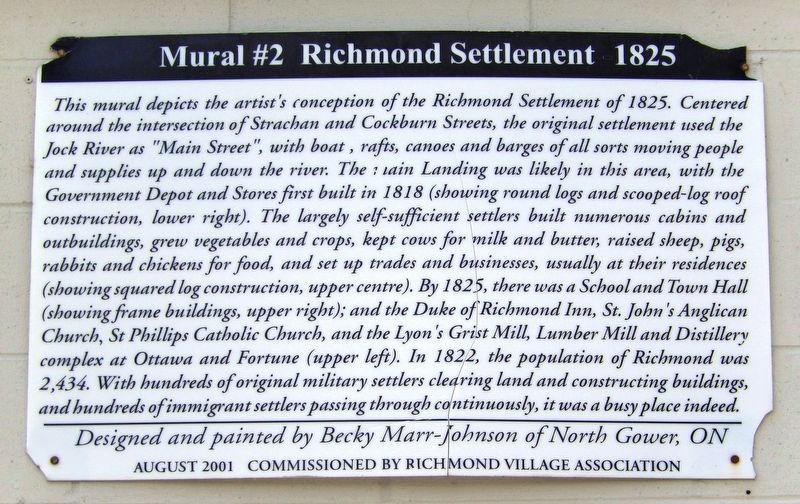
Richmond Settlement 1825
| — | Richmond Heritage Mural Gallery | — |
Photographed by Cosmos Mariner, May 29, 2024
1. Richmond Settlement 1825 Marker
this page online
Erected 2001 by Richmond Village Association. (Marker Number 2.)
Topics. This historical marker is listed in these topic lists: Industry & Commerce • Religion & Religious Structures • Settlements & Settlers • Waterways & Vessels. A significant historical year for this entry is 1825.
Location. 45° 11.747′ N, 75° 50.26′ W. Marker is in Ottawa, Ontario. It is in Richmond. It is on Huntley Road just north of Perth Street, on the left when traveling north. The marker and mural are mounted high on the east facade of the Richmond Memorial Community Centre. Touch for map. Marker is at or near this postal address: 6095 Perth Street, Ottawa ON K0A 2Z0, Canada. Touch for directions.

Regionally, this marker is in Eastern Ontario. It is also in Central Canada. Globally, it is in North America, the Western Hemisphere, the Western World, and the Anglosphere. Historically, it finds itself in what was once a British colony, the Viceroyalty of New France, the Haudenosaunee (Iroquois) Confederacy,
Photographed by Cosmos Mariner, May 29, 2024
2. Richmond Settlement 1825 Marker
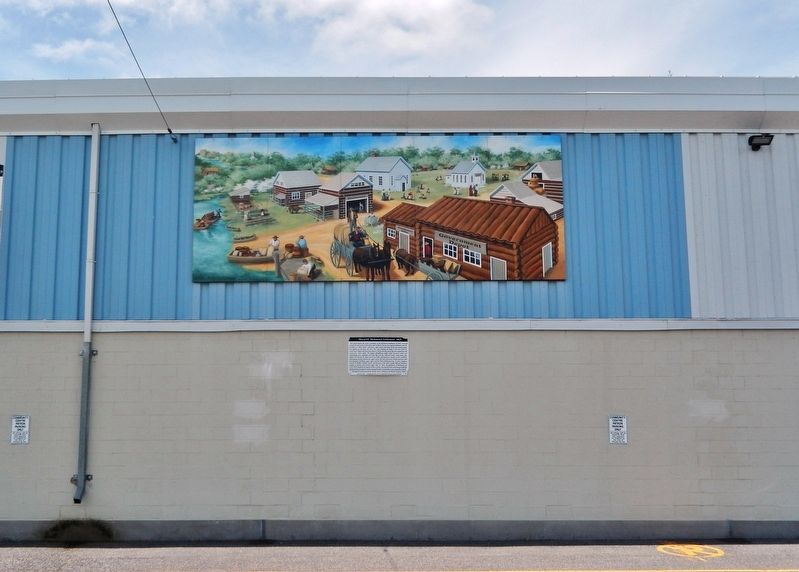
Looking west from Huntley Road; the marker and mural are mounted high on the east facade of the Richmond Memorial Community Centre.
Other nearby markers. At least 8 other markers are within 11 kilometers of this marker, measured as the crow flies: Breaking Through to the Jock River (a few steps from this marker); Richmond Military Settlement (about 90 meters away, measured in a direct line); County of Carleton/Richmond Agricultural Society (about 90 meters away); War Memorial Cenotaph (about 180 meters away); St. Andrew's Presbyterian Church (approx. 0.6 kilometers away); Loyal Orange Lodge #151 (approx. 0.7 kilometers away); Charles Lennox (approx. 4.8 kilometers away); War Memorial (approx. 11 kilometers away). Touch for a list and map of all markers in Ottawa.
Related markers. Click here for a list of markers that are related to this marker. Richmond Heritage Mural Gallery
Also see . . . Richmond History (Goulbourn Township Historical Society).
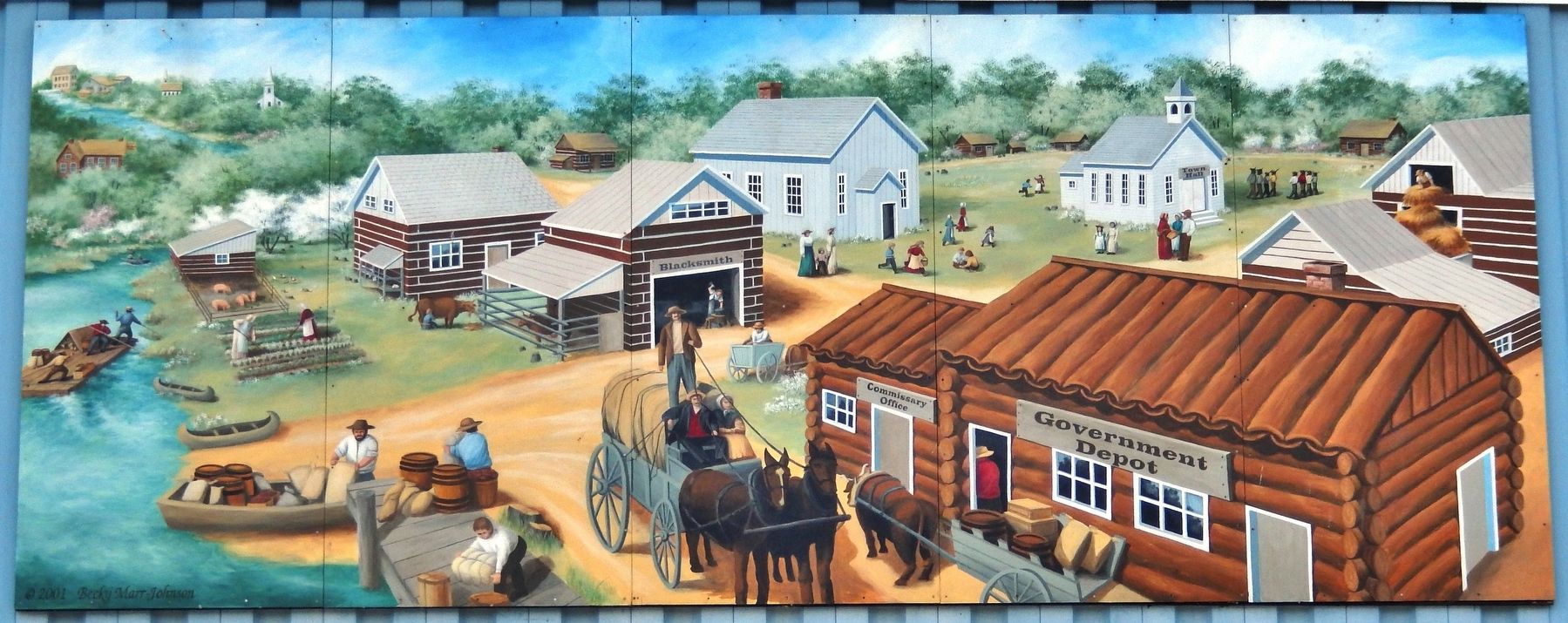
Excerpt: Richmond did not grow gradually; it was set up as a complete town with instant settlers – members of the Irish-raised 100th regiment which was renamed the 99th by the time its members got to Richmond. The settlement straddled the Jock River, which was then considered(Submitted on August 24, 2024, by Cosmos Mariner of Cape Canaveral, Florida.)a useful transport route. Early Richmond had a school, an Anglican and a Roman Catholic church, a government stores depot, a number of log homes, a grist mill and a saw mill, owned by George Lyon, a town hall and the Masonic Arms Hotel owned by Sergeant Andrew Hill and his wife Maria. Colonel George Thew Burke oversaw the settlement. Although the military withdrew its support in 1822, Richmond continued to do well and in 1850, it was the first municipal corporation in Carleton County to be formed as a village.Photographed by Cosmos Mariner, May 29, 20243. Richmond Settlement 1825 MuralDesigned and painted by Becky Marr-Johnson of North Gower, Ontario.
Credits. This page was last revised on August 24, 2024. It was originally submitted on August 24, 2024, by Cosmos Mariner of Cape Canaveral, Florida. This page has been viewed 371 times since then and 38 times this year. Photos: 1, 2, 3. submitted on August 24, 2024, by Cosmos Mariner of Cape Canaveral, Florida.
