Luzern, Switzerland — Central Europe (the Alps)
Ludwig Pfyffer
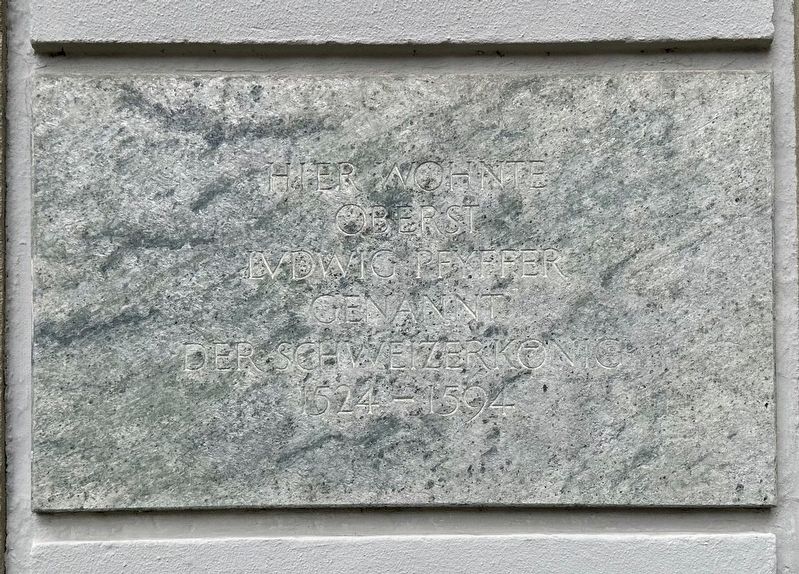
Photographed by Andrew Ruppenstein, August 19, 2024
1. Ludwig Pfyffer Marker

Hier wohnte
Oberst
Ludwig Pfyffer
genannt
der Schweizer König
1524-1594
Here lived Colonel Ludwig Pfyffer (1524-1594), called the “King of the Swiss”.
Topics. This historical marker is listed in this topic list: Government & Politics. A significant historical date for this entry is March 9, 1594.
Location. 47° 3.141′ N, 8° 18.458′ E. Marker is in Luzern. It is at the intersection of Kapellplatz and Furrengasse, on the right when traveling east on Kapellplatz. Touch for map. Marker is at or near this postal address: Kapellplatz 3, Luzern 6004, Switzerland. Touch for directions.

Regionally, it is in Europe, Central Europe, the Schengen Area, Western Europe, and the Western World. Historically, it finds itself in what was once the Roman Empire and specifically also the Holy Roman Empire.
Other nearby markers. At least 8 other markers are within walking distance of this marker: Joseph Willmann-Haus (within shouting distance of this marker); "At the White Cross" Inn (within shouting distance of this marker); "Star Square" (within shouting distance of this marker); The von Silenen Home
this page online
Also see . . . Ludwig Pfyffer (Wikipedia).
Excerpt: Ludwig Pfyffer von Altishofen (Lucerne, 1524 – Lucerne, 17 March 1594) was a Swiss military and political leader, spokesman for Roman Catholic interests in the cantons, chief magistrate of Lucerne, and probably the most important Swiss political figure in the latter half of the 16th century.(Submitted on August 25, 2024.)
…Pfyffer was elected chief magistrate (schultheiss) of Lucerne in 1571, serving eleven consecutive terms until his death. He made the city the centre of Catholic Counter-Reformation activity in Switzerland. As a leading figure of the Catholic cantons, Pfyffer influenced all of the Confederation's policy in matters of recruitment, alliances, and military capitulations (with Savoy in 1577 and Spain in 1587), which earned him the nickname “King of the Swiss”.
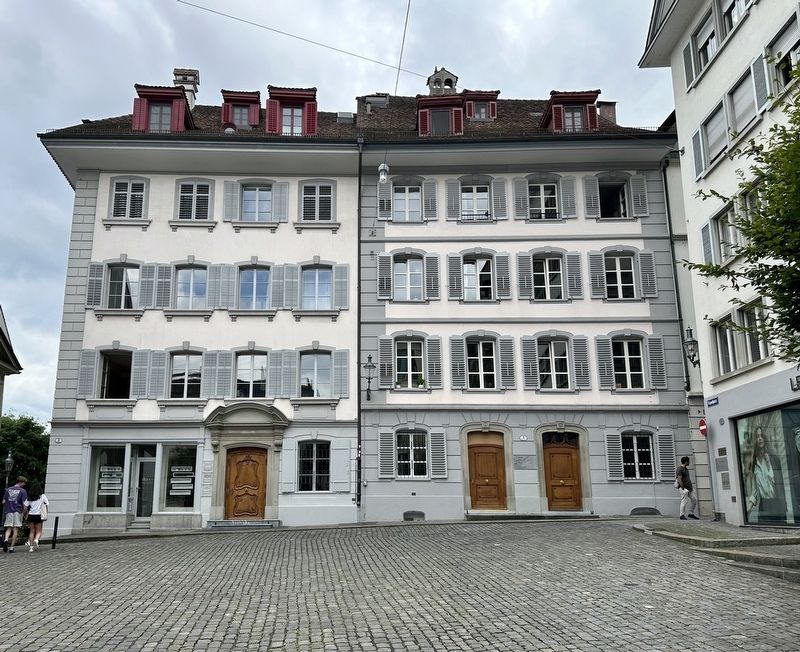
Photographed by Andrew Ruppenstein, August 19, 2024
2. Ludwig Pfyffer Marker - wide view
The marker is visible here between the two doors on the rightmost building.
Credits. This page was last revised on August 25, 2024. It was originally submitted on August 25, 2024, by Andrew Ruppenstein of Lamorinda, California. This page has been viewed 237 times since then and 42 times this year. Photos: 1, 2. submitted on August 25, 2024, by Andrew Ruppenstein of Lamorinda, California.
