Pasadena in Anne Arundel County, Maryland — The American Northeast (Mid-Atlantic)
Fort Carroll Lighthouse
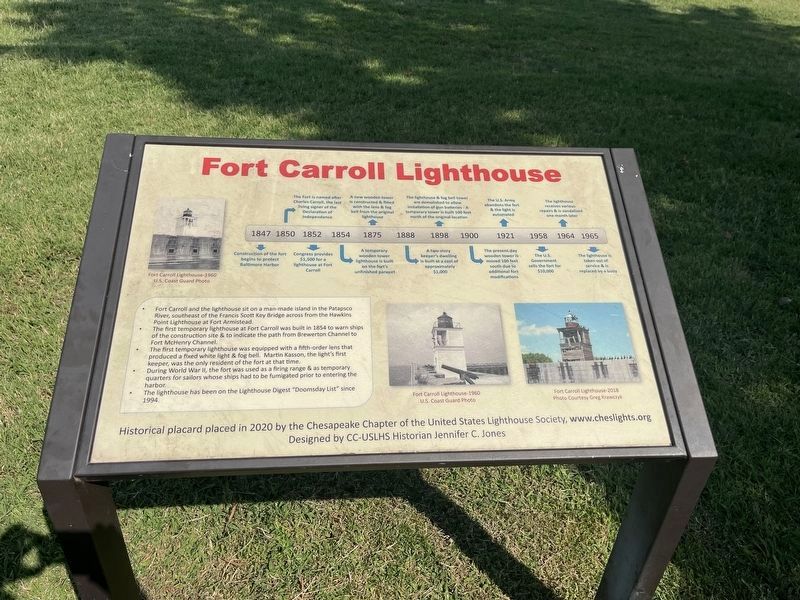
1847 Construction of the fort begins to protect Baltimore Harbor.
1850 The Fort is named after Charles Carroll, the last living signer of the Declaration of Independence.
1852 Congress provides $1,500 for a lighthouse at Fort Carroll.
1854 A temporary wooden tower lighthouse is built on the fort's unfinished parapet.
1875 A new wooden tower is constructed & fitted with the lens & fog bell from the original lighthouse.
1888 A two-story keeper's dwelling is built at a cost of approximately 1,000.
1898 The lighthouse & fog bell tower are demolished to allow installation of gun batteries — A temporary tower is built 100 feet north of the original location.
1900 The present-day wooden tower is moved 100 feet south due to additional fort modifications.
1921 The U.S. Army abandons the fort & the light is automated.
1958 The U.S. Government sells the fort for $10,000.
1964 The lighthouse receives various repairs & is vandalized one month later.
1965 The lighthouse is taken out of service & is replaced by a buoy.
• Fort Carroll and the lighthouse sit on a man-made island in the Patapsco River,
this page online
• The first temporary lighthouse at Fort Carroll was built in 1854 to warn ships of the construction site & to indicate the path from Brewerton Channel to Fort McHenry Channel.
• The first temporary lighthouse was equipped with a fifth-order lens that produced a fixed white light & bog bell. Martin Kasson, the light's first keeper was the only resident of the fort at that time.
• During World War II, the fort was used as a firing range & as temporary quarters for sailors whose ships had to be fumigated prior to entering the harbor.
• The lighthouse has been on the Lighthouse Digest "Doomsday List" since 1994.
Erected 2020 by The Chesapeake Chapter of the United States Lighthouse Society; designed by CC-USLHS Historian Jennifer C. Jones.
Topics and series. This historical marker is listed in these topic lists: Communications • Forts and Castles • Waterways & Vessels. In addition, it is included in the Lighthouses series list. A significant historical year for this entry is 1847.
Location. 39° 10.004′ N, 76° 28.728′ W.


Regionally, this marker is in the Baltimore Metro Region. It is also in the American Mid-Atlantic and on the Eastern Seaboard. Globally, it is in the North Atlantic Region, North America, the Western Hemisphere, the Western World, and the Anglosphere. Historically, it finds itself in what was once one of the original Thirteen Colonies and also the Antebellum South.
Other nearby markers. At least 8 other markers are within 2 miles of this marker, measured as the crow flies: Prime View (a few steps from this marker); Seven Foot Knoll Lighthouse (about 500 feet away, measured in a direct line); Fort Smallwood Park Memorial Grove (approx. 0.3 miles away); Fort Smallwood Park Flagpole (approx. 0.3 miles away); Bill Burton Fishing Pier (approx. half a mile away); Veterans of Foreign Wars (approx. 1.6 miles away); Still on Patrol (approx. 1.7 miles away); Riviera Beach Veterans Memorial (approx. 2.1 miles away). Touch for a list and map of all markers in Pasadena.
Other markers no longer nearby. The History of Ft Smallwood Park (was approx. 0.4 miles away but has been permanently removed); a different marker also named The History of Ft Smallwood Park (was approx. 0.4 miles away but has been permanently removed); Preservation in Progress (was approx. 0.4 miles away but has been permanently removed).
Credits. This page was last revised on August 25, 2024. It was originally submitted on August 25, 2024, by Devry Becker Jones of Washington, District of Columbia. This page has been viewed 156 times since then and 22 times this year. Photos: 1, 2. submitted on August 25, 2024, by Devry Becker Jones of Washington, District of Columbia.
