Bellevue in Nashville in Davidson County, Tennessee — The American South (East South Central)
Welcome to the Warner Parks
Photographed by Darren Jefferson Clay, July 28, 2024
1. Welcome to the Warner Parks Marker
Inscription.
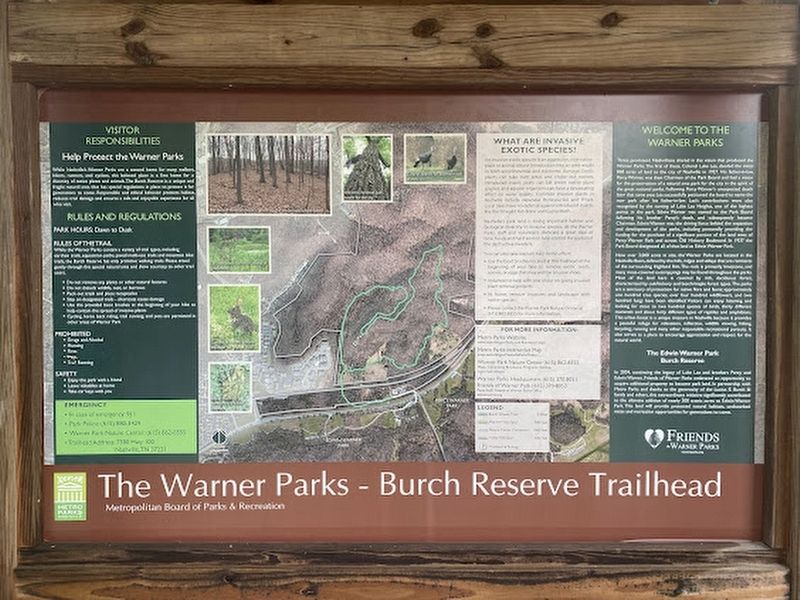
Welcome to the Warner Parks. . Three prominent Nashvillians shared in the vision that produced the Warner Parks. The first of these, Colonel Luke Lea, deeded the initial 868 acres of land to the city of Nashville in 1927. His father-in-law, Percy Warner, was then Chairman of the Park Board and had a vision for the preservation of a natural area park for the city in the spirit of the great national parks. Following Percy Warner's unexpected death later that same year, Lea successfully petitioned the board to name the new park after his father-in-law. Lea's contributions were also recognized by the naming of Luke Lea Heights, one of the highest points in the park. Edwin Warner was named to the Park Board following his brother Percy's death, and subsequently became Chairman. Edwin Warner was the driving force behind the expansion and development of the parks, including personally providing the funding for the purchase of a significant portion of the land west of Percy Warner Park and across Old Hickory Boulevard. In 1937 the Park Board designated all of that land as Edwin Warner Park. , Now over 3,000 acres in size, the Warner Parks are located in the Nashville Basin, defined by the hills, ridges and valleys that are remnants of the surrounding Highland Rim. The rock is primarily limestone, and many moss-covered outcroppings may be found throughout the parks. Most of the land here is covered by rich, deciduous forest, characterized by oak/hickory and beech/maple forest types. The parks are a sanctuary of protection for native flora and fauna; approximately one hundred tree species, over four hundred wildflowers, and two hundred fungi have been identified. Visitors can enjoy listening and looking for close to two hundred species of birds, thirty different mammals and about forty different types of reptiles and amphibians. This urban forest is a unique treasure in Nashville because it provides a peaceful refuge for relaxation, reflection, wildlife viewing, hiking, bicycling, running and many other responsible recreational pursuits. It also serves as a place to encourage appreciation and respect for the natural world. , The Edwin Warner Park Burch Reserve , In 2004, continuing the legacy of Luke Lea and brothers Percy and Edwin Warner, Friends of Warner Parks embraced an opportunity to acquire additional property to become park land. In partnership with Metro Parks and thanks to the generosity of the Lucius E. Burch III family and others, this extraordinary initiative significantly contributed to the ultimate addition of nearly 500 scenic acres to Edwin Warner Park. This land will provide protected natural habitats, undisturbed vistas and recreation opportunities for generations to come. , WHAT ARE INVASIVE EXOTIC SPECIES? , An invasive exotic species is an aggressive, non-native plant or animal whose introduction into an area results in both environmental and economic damage. Exotic plants can take over areas and choke out natives, introduced insect pests can kill entire native plant species, and aquatic organisms can have a devastating effect on water quality. Common invasive plants in Nashville include Japanese Honeysuckle and Privet. Local trees have no defense against introduced insects like the Emerald Ash Borer and Gypsy Moth. , Nashville's park land is losing important habitat and biological diversity to invasive species. At the Warner Parks, staff and volunteers dedicate a great deal of time, funds and hard work to help control the spread of the destructive invaders., You can also take steps to help in this effort: , . Use the boot brushes located at this trailhead at the beginning of your hike to remove exotic seeds, spores, or eggs that may well be on your shoes. , . Volunteer to help with one of our on-going invasive plant removal projects. , . At home, remove invasives and landscape with native species. , . Please contact the Warner Park Nature Center at (615) 862-8555 for more information., FOR MORE INFORMATION: Metro Parks Website , www.nashville.gov/Parks-and-Recreation.aspx, Metro Parks Interactive Map , maps.nashville.gov/Nashville ParksFinder/, Warner Park Nature Center (615) 862-8555 , Maps. Interpretive Brochures, Programs. Exhibits wprnc.nashville.gov, Warner Parks Headquarters (615) 370-8051 , Friends of Warner Park (615) 370-8053 , Parks Staff, Friends of Warner Parks Office warnerparks.org., VISITOR RESPONSIBILITIES , Help Protect the Warner Parks , While Nashville's Warner Parks are a second home for many walkers, hikers, runners, and cyclists, this beloved place is a first home for a diversity of native plants and animals. The Burch Reserve is a unique and fragile natural area that has special regulations in place to protect it for generations to come. Responsible and ethical behavior protects habitat, reduces trail damage and ensures a safe and enjoyable experience for all who visit., RULES AND REGULATIONS, PARK HOURS: Dawn to Dusk , RULES OF THE TRAIL , While the Warner Parks contain a variety of trail types, including earthen trails, equestrian paths, paved multi-use trails and mountain bike trails, the Burch Reserve has only primitive walking trails. Please travel gently through this special natural area and show courtesy to other trail users., . Do not remove any plants or other natural features , . Do not disturb wildlife, nest, or burrows , . Pack out trash and place receptacles , Stay on designated trails - shortcuts cause damage , . Use the provided boot brushes at the beginning of your hike to help contain the spread of invasive plants , . Cycling, horse back riding, trail running, and pets are permitted in other areas of Warner Park, PROHIBITED , . Drugs and Alcohol , . Hunting , . Fires , . Trail Running, SAFETY , . Enjoy the park with a friend , . Leave valuables at home . Take car keys with you, EMERGENCY , . In case of emergency: 911 , . Park Police: (615) 880-3429 , . Warner Park Nature Center: (615) 862-8555 , . Trailhead Address: 7300 Hwy 100 Nashville, TN 37221
Three prominent Nashvillians shared in the vision that produced the Warner Parks. The first of these, Colonel Luke Lea, deeded the initial 868 acres of land to the city of Nashville in 1927. His father-in-law, Percy Warner, was then Chairman of the Park Board and had a vision for the preservation of a natural area park for the city in the spirit of the great national parks. Following Percy Warner's unexpected death later that same year, Lea successfully petitioned the board to name the new park after his father-in-law. Lea's contributions were also recognized by the naming of Luke Lea Heights, one of the highest points in the park. Edwin Warner was named to the Park Board following his brother Percy's death, and subsequently became Chairman. Edwin Warner was the driving force behind the expansion and development of the parks, including personally providing the funding for the purchase of a significant portion of the land west of Percy Warner Park and across Old Hickory Boulevard. In 1937 the Park Board designated all of that land as Edwin Warner Park.
Now over 3,000 acres in size, the Warner Parks are located in the Nashville Basin, defined by the hills, ridges and valleys that are remnants of the surrounding Highland Rim. The rock is primarily limestone, and many moss-covered outcroppings may be found throughout the parks. Most
Click or scan to see this page online
of the land here is covered by rich, deciduous forest, characterized by oak/hickory and beech/maple forest types. The parks are a sanctuary of protection for native flora and fauna; approximately one hundred tree species, over four hundred wildflowers, and two hundred fungi have been identified. Visitors can enjoy listening and looking for close to two hundred species of birds, thirty different mammals and about forty different types of reptiles and amphibians. This urban forest is a unique treasure in Nashville because it provides a peaceful refuge for relaxation, reflection, wildlife viewing, hiking, bicycling, running and many other responsible recreational pursuits. It also serves as a place to encourage appreciation and respect for the natural world.
The Edwin Warner Park Burch Reserve
In 2004, continuing the legacy of Luke Lea and brothers Percy and Edwin Warner, Friends of Warner Parks embraced an opportunity to acquire additional property to become park land. In partnership with Metro Parks and thanks to the generosity of the Lucius E. Burch III family and others, this extraordinary initiative significantly contributed to the ultimate addition of nearly 500 scenic acres to Edwin Warner Park. This land will provide protected natural habitats, undisturbed vistas and recreation opportunities for generations to come.
WHAT ARE INVASIVE
Photographed by Darren Jefferson Clay, July 28, 2024
2. Welcome to the Warner Parks Marker
EXOTIC SPECIES?
An invasive exotic species is an aggressive, non-native plant or animal whose introduction into an area results in both environmental and economic damage. Exotic plants can take over areas and choke out natives, introduced insect pests can kill entire native plant species, and aquatic organisms can have a devastating effect on water quality. Common invasive plants in Nashville include Japanese Honeysuckle and Privet. Local trees have no defense against introduced insects like the Emerald Ash Borer and Gypsy Moth.
Nashville's park land is losing important habitat and biological diversity to invasive species. At the Warner Parks, staff and volunteers dedicate a great deal of time, funds and hard work to help control the spread of the destructive invaders.
You can also take steps to help in this effort:
Use the boot brushes located at this trailhead at the beginning of your hike to remove exotic seeds, spores, or eggs that may well be on your shoes.
Volunteer to help with one of our on-going invasive plant removal projects.
At home, remove invasives and landscape with native species.
Please contact the Warner Park Nature Center at (615) 862-8555 for more information.
FOR MORE INFORMATION:
Metro Parks Website
www.nashville.gov/Parks-and-Recreation.aspx
Metro Parks Interactive Map
maps.nashville.gov/Nashville
ParksFinder/
Warner Park Nature Center (615) 862-8555
Maps. Interpretive Brochures, Programs. Exhibits
wprnc.nashville.gov
Warner Parks Headquarters (615) 370-8051
Friends of Warner Park (615) 370-8053
Parks Staff, Friends of Warner Parks Office
warnerparks.org.
VISITOR RESPONSIBILITIES
Help Protect the Warner Parks
While Nashville's Warner Parks are a second home for many walkers, hikers, runners, and cyclists, this beloved place is a first home for a diversity of native plants and animals. The Burch Reserve is a unique and fragile natural area that has special regulations in place to protect it for generations to come. Responsible and ethical behavior protects habitat, reduces trail damage and ensures a safe and enjoyable experience for all who visit.
RULES AND REGULATIONS
PARK HOURS: Dawn to Dusk RULES OF THE TRAIL
While the Warner Parks contain a variety of trail types, including earthen trails, equestrian paths, paved multi-use trails and mountain bike trails, the Burch Reserve has only primitive walking trails. Please travel gently through this special natural area and show courtesy to other trail users.
Do not remove any plants or other natural features
Do not disturb wildlife, nest, or burrows
Pack out trash and place receptacles
Stay on designated trails - shortcuts cause damage
Use the provided boot brushes at the beginning of your hike to help contain the spread of invasive plants
Cycling, horse back riding, trail running, and pets are permitted in other areas of Warner Park
SAFETY
Enjoy the park with a friend
Leave valuables at home
Take car keys with you
EMERGENCY
In case of emergency: 911
Park Police: (615) 880-3429
Warner Park Nature Center: (615) 862-8555
Trailhead Address: 7300 Hwy 100
Nashville, TN 37221
Erected by Metropolitan Board of Parks and Recreation.
Location. 36° 3.735′ N, 86° 54.39′ W. Marker is in Nashville, Tennessee, in Davidson County. It is in Bellevue. It can be reached from State Highway 100. Touch for map. Marker is at or near this postal address: 7300 TN-100, Nashville TN 37221, United States of America. Touch for directions.

Regionally, this marker is in Middle Tennessee. It is also in the American South and specifically in the Upper South. Globally, it is in North America, the Western Hemisphere, the Western World, and the Anglosphere. Historically, it finds itself in what was once the territory of the Mississippian Culture, one of the Confederate States of America, and the Antebellum South.
Credits. This page was last revised on August 31, 2024. It was originally submitted on August 26, 2024, by Darren Jefferson Clay of Duluth, Georgia. This page has been viewed 480 times since then and 72 times this year. Photos:1, 2. submitted on August 26, 2024, by Darren Jefferson Clay of Duluth, Georgia. • James Hulse was the editor who published this page.
