Chamberlin Observatory
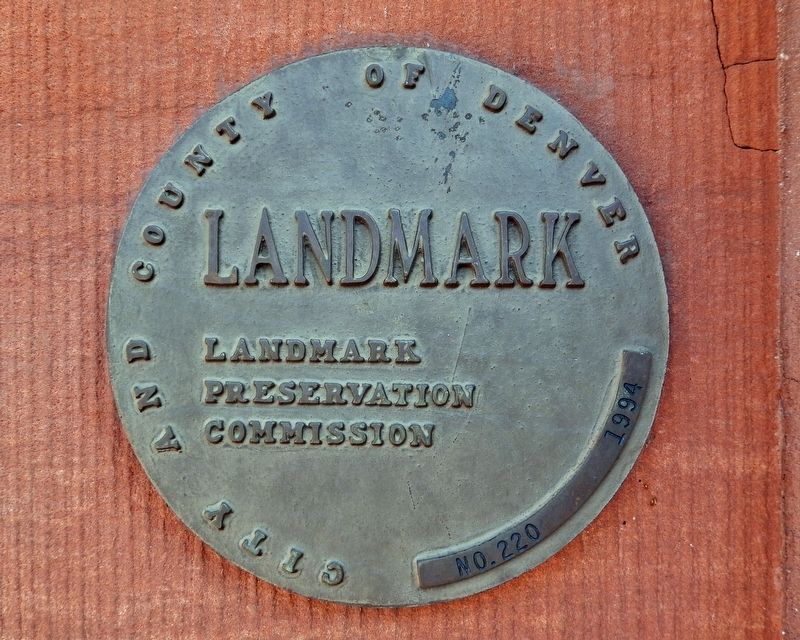
Landmark Preservation Commission
Erected 1994 by City and County of Denver. (Marker Number 220.)
Topics and series. This historical marker is listed in these topic lists: Architecture • Charity & Public Work • Education • Science & Medicine. In addition, it is included in the National Register of Historic Places (NRHP) series list. A significant historical year for this entry is 1890.
Location. 39° 40.559′ N, 104° 57.177′ W. Marker is in Denver, Colorado, in Denver County. It is in University Park. It can be reached from East Warren Avenue just east of South Fillmore Street, on the right when traveling east. The marker is mounted at eye-level, directly on the subject building, on the right side of the south/front entrance. Touch for map. Marker is at or near this postal address: 2930 East Warren Avenue, Denver CO 80210, United States of America. Touch for directions.

Regionally, this marker is in the Front Range. It is also in the American Mountain West. Globally, it is in North America, the Rocky Mountains, the Western Hemisphere, the Western World,
this page online
Other nearby markers. At least 8 other markers are within 5 miles of this marker, measured as the crow flies: S. R. DeBoer (approx. 0.6 miles away); Overland Park (approx. 2.4 miles away); 1956 Hungarian Uprising (approx. 3.2 miles away); Colorado Volunteers (approx. 3.7 miles away); Zang Mansion (approx. 3.8 miles away); Grant-Humphreys Mansion (approx. 3.9 miles away); Governor's Residence (approx. 4 miles away); Crawford Hill Mansion (approx. 4.2 miles away). Touch for a list and map of all markers in Denver.
Regarding Chamberlin Observatory. National Register of Historic Places #80000887, Colorado Register of Historic Places #5DV.187, and Denver County Historical Landmark #220 (1994).
From the National Register Nomination prepared by Dr. Edgar Everhart, Denver University - Department of Physics, 7/10/1979:
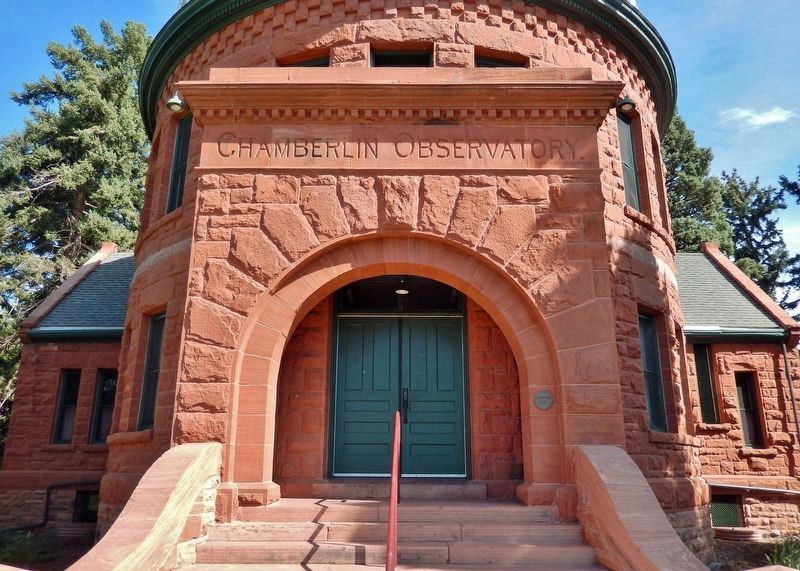
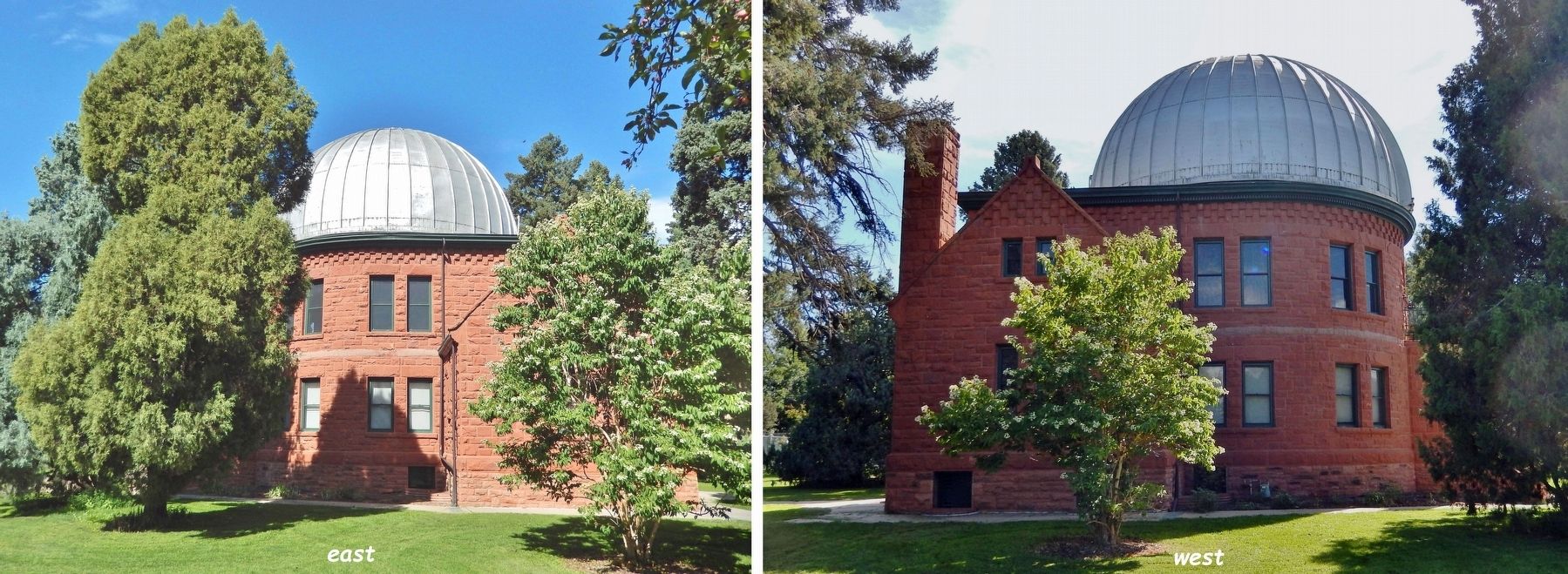
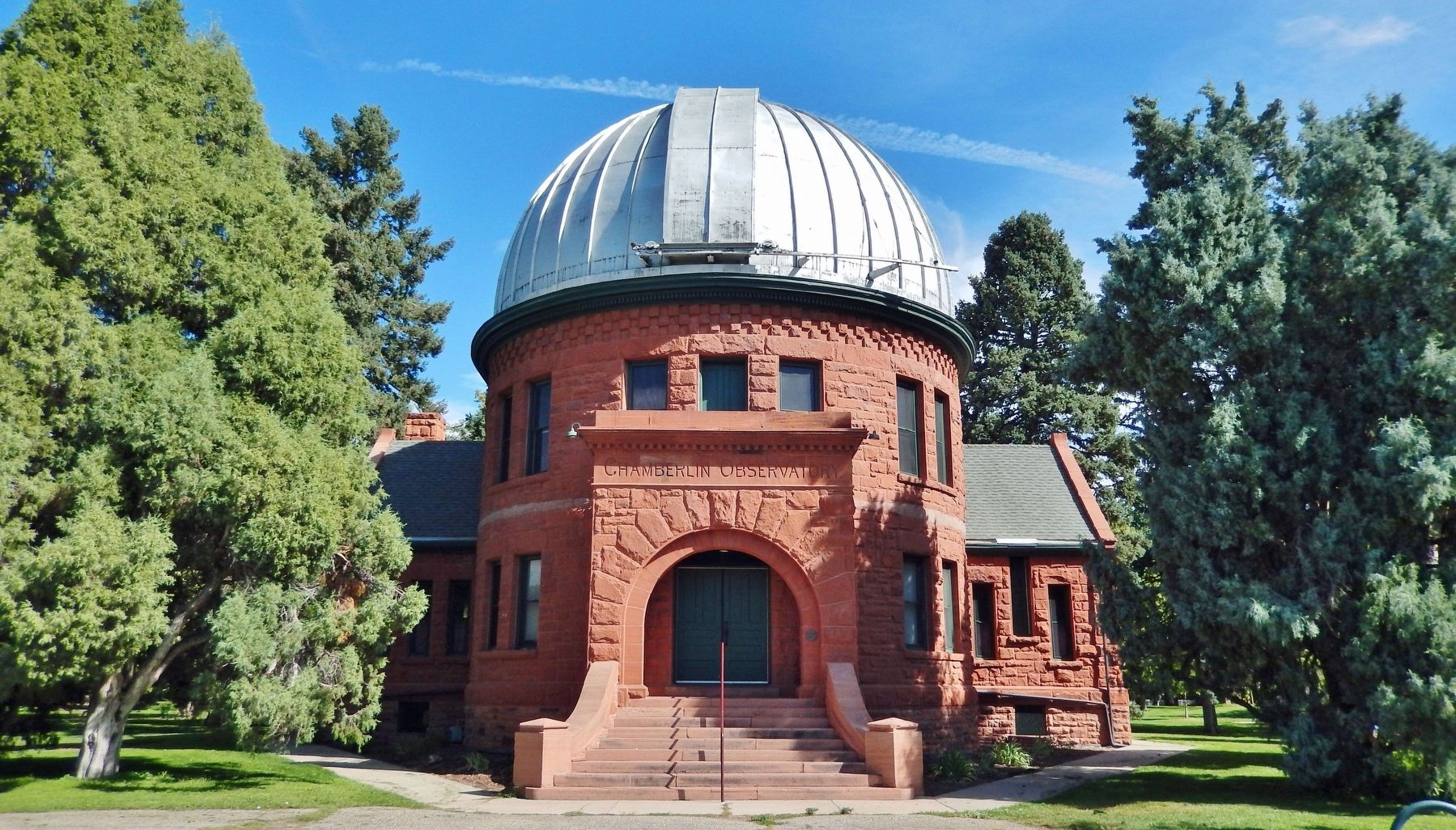
The Chamberlin Observatory is significant for its role in education and in the advance of science, and for its fine architectural features which display the adaptation of the Richardsonian Romanesque style to an observatory.The
cornerstone was set in place in 1890, and the building became fully operational when the telescope was installed in 1894. Of particular note, both then and now, was the telescope itself. The lenses were prepared by one of the master craftsmen of nineteenth-century lensmaking, Alvan G. Clark, the son of Alvan Clark. The firm of Alvan Clark & Sons was one of the prominent enterprises that built optics for scientific instruments in the last half of the century.Photographed by Cosmos Mariner, August 23, 20242. Chamberlin Observatory MarkerThe marker is on the right side of the south/front entrance.The first director of the observatory was Dr. Howe of the University of Denver. As one of the designers of the structure, he required that the outer walls serve as supports for the revolving dome, but that the building itself had to be constructed separately from the deep piers that support the telescope so that building vibrations would not be transmitted to the instrumentation. He also desired thick walls to maintain a more constant average temperature so that varying conditions would not affect observation. He even demanded that all of the stones in the foundation of the telescope be of the same color to assure even heating and cooling.
The architect of the observatory was Robert
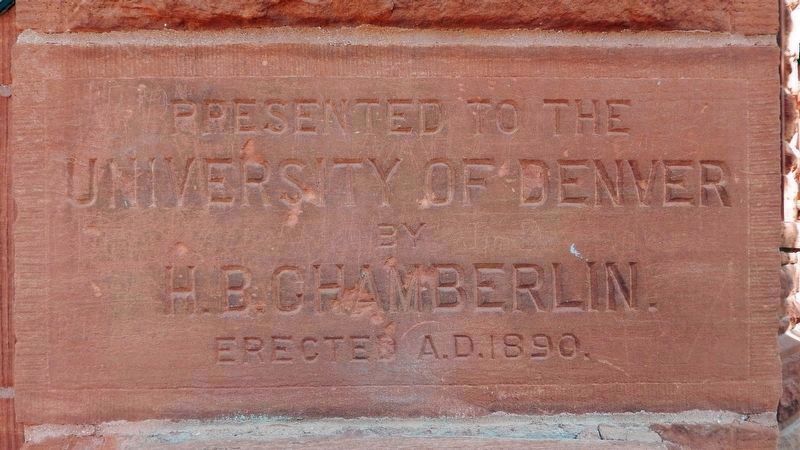
S. Roeschlaub, one of Denver's foremost nineteenth century designers. Born in Munich, Germany in 1843, he later emigrated to Illinois and served in the Union Army during the Civil War. He began to practice architecture in Denver in 1875 and eventually became the city's primary institutional architect. He was the first licensed architect in Colorado and in 1891 served as the president of the Colorado Chapter of the American Institute of Architects.Photographed by Cosmos Mariner, August 23, 20243. Chamberlin Observatory CornerstonePresented to the University of Denver by H.B. Chamberlin. Erected A.D. 1890.
Also see . . .
1. Chamberlin Observatory (Wikipedia).
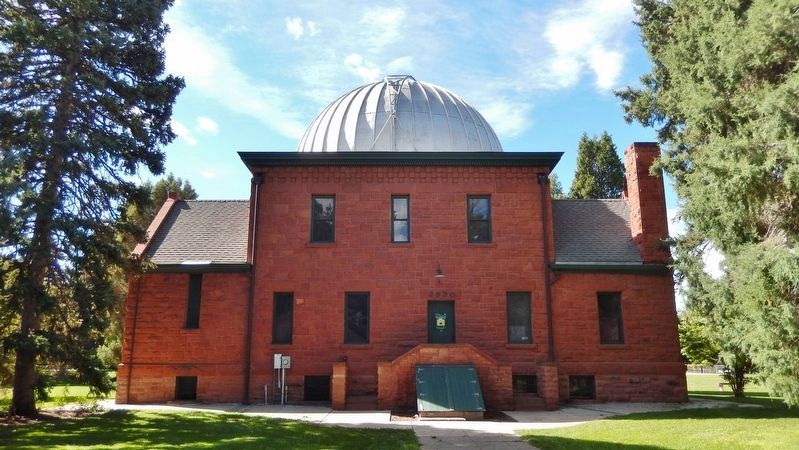
Excerpt: Chamberlin Observatory is an astronomical observatory owned and operated by the University of Denver. It is located in Denver, Colorado in Observatory Park. It is named for Humphrey B. Chamberlin, a Denver real estate magnate who pledged $50,000 in 1888 to build and equip the facility. It was modeled after the Goodsell Observatory at Carleton College in Northfield, Minnesota.(Submitted on August 26, 2024, by Cosmos Mariner of Cape Canaveral, Florida.)The 20-inch objective lens for the observatory's main refracting telescope was made by Alvan Clark & Sons, and the mount was built by George Nicholas Saegmuller. The mount rests on a cast iron pillar which is in turn supported by a massive stone
pier. Assembly of the telescope was supervised by Professor Herbert Alonzo Howe. The telescope saw first light in 1894.Photographed by Cosmos Mariner, August 23, 20244. Chamberlin ObservatoryAs of 2018, the Denver Astronomical Society hosts several public outreach events at the observatory every month. As it is located in a large metropolitan area, the observatory is heavily affected by light pollution, which limits its use in scientific research.
2. Chamberlin Observatory website. (Submitted on September 1, 2024, by Cosmos Mariner of Cape Canaveral, Florida.)
Credits. This page was last revised on September 2, 2024. It was originally submitted on August 26, 2024, by Cosmos Mariner of Cape Canaveral, Florida. This page has been viewed 269 times since then and 38 times this year. Photos: 1, 2, 3, 4, 5, 6. submitted on August 26, 2024, by Cosmos Mariner of Cape Canaveral, Florida.
