Saratoga in Hardin County, Texas — The American South (West South Central)
Oilfield Cemetery
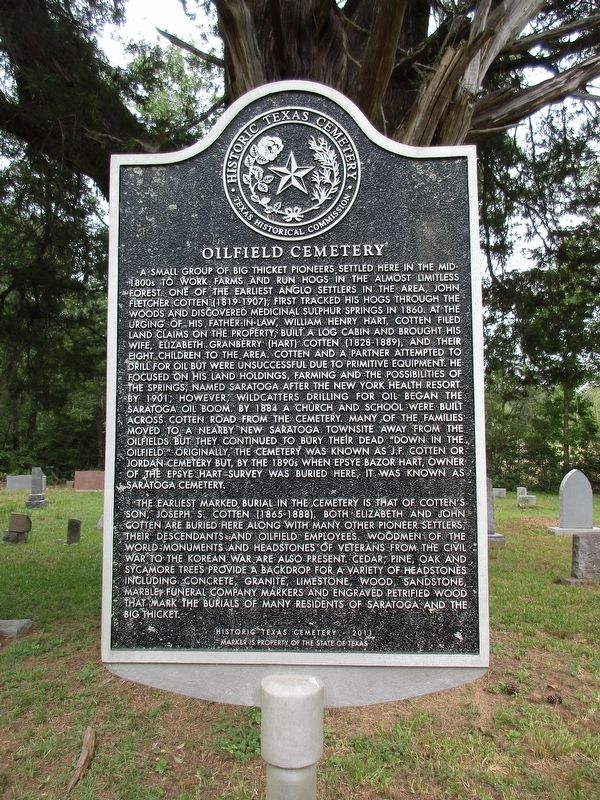
Photographed by Jeff Leichsenring, August 26, 2024
1. Oilfield Cemetery Marker
Inscription.
Oilfield Cemetery. . A small group of Big Thicket pioneers settled here in the mid- 1800 to work farms and run hogs in the almost limitless forest. One of the earliest anglo settlers in the area, John Fletcher Cotten (1819-1907), first tracked his hogs through the woods and discovered medicinal sulphur springs in 1860. At the urging of his father-in-law, William Henry Hart, Cotten filed land claims on the property, built a log cabin and brought his wife, Elizabeth Granberry (Hart) Cotten (1828-1889), and their eight children to the area. Cotten and a partner attempted to drill for oil but were unsuccessful due to primitive equipment. He focused on his land holdings, farming and the possibilities of the springs, named Saratoga after the New York health resort. By 1901, however, wildcatters drilling for oil began the Saratoga oil boom. By 1884 a church and school were built across Cotten road from the cemetery. Many of the families moved to a nearby new Saratoga townsite away from the oilfields but they continued to bury their dead "down in the oilfield." Originally, the cemetery was known as J.F. Cotten or Jordan Cemetery but, by the 1890s when Epsye Bazor Hart, owner of the Epsye Hart Survey was buried here, it was known as Saratoga Cemetery., The earliest marked burial in the cemetery is that of Cotten's son Joseph S. Cotten (1865-1888), both Elizabeth and John Cotten are buried here along with many other pioneer settlers, their descendants and oilfield employees. Woodmen of the World monuments and headstones of veterans from the Civil War to the Korean War are also present. Cedar, pine, oak and sycamore trees provide a backdrop for a variety of headstones including concrete, granite, limestone, wood, sandstone, marble funeral company markers and engraved petrified wood that mark the burials of many residents of Saratoga and the Big Thicket.
Historic Texas Cemetery 2011.
A small group of Big Thicket pioneers settled here in the mid-
1800 to work farms and run hogs in the almost limitless
forest. One of the earliest anglo settlers in the area, John
Fletcher Cotten (1819-1907), first tracked his hogs through the
woods and discovered medicinal sulphur springs in 1860. At the
urging of his father-in-law, William Henry Hart, Cotten filed
land claims on the property, built a log cabin and brought his
wife, Elizabeth Granberry (Hart) Cotten (1828-1889), and their
eight children to the area. Cotten and a partner attempted to
drill for oil but were unsuccessful due to primitive equipment. He
focused on his land holdings, farming and the possibilities of
the springs, named Saratoga after the New York health resort.
By 1901, however, wildcatters drilling for oil began the
Saratoga oil boom. By 1884 a church and school were built
across Cotten road from the cemetery. Many of the families
moved to a nearby new Saratoga townsite away from the
oilfields but they continued to bury their dead "down in the
oilfield." Originally, the cemetery was known as J.F. Cotten or
Jordan Cemetery but, by the 1890s when Epsye Bazor Hart, owner
of the Epsye Hart Survey was buried here, it was known as
Saratoga Cemetery.
The earliest marked burial in the cemetery is that of Cotten's
son Joseph S. Cotten
Click or scan to see this page online
(1865-1888), both Elizabeth and John
Cotten are buried here along with many other pioneer settlers,
their descendants and oilfield employees. Woodmen of the
World monuments and headstones of veterans from the Civil
War to the Korean War are also present. Cedar, pine, oak and
sycamore trees provide a backdrop for a variety of headstones
including concrete, granite, limestone, wood, sandstone,
marble funeral company markers and engraved petrified wood
that mark the burials of many residents of Saratoga and the
Big Thicket.
Historic Texas Cemetery 2011
Erected 2012 by Texas Historical Commission. (Marker Number 17169.)
Topics. This historical marker is listed in this topic list: Cemeteries & Burial Sites. A significant historical year for this entry is 1800.
Location. 30° 16.962′ N, 94° 30.759′ W. Marker is in Saratoga, Texas, in Hardin County. It is on Rosier Park Road 0.2 miles south of Road 770. In the old oilfield, about one-quarter mile; South of SH 770 on the east side of Cotten Road, also called Rosier Park Road, a dirt road which leads to the historic Teel Cemetery and to the Lance Rosier unit in the Big Thicket Preserve. Touch for map. Marker is at or near this postal address: 6570 Rosier Park Rd, Saratoga TX 77585, United States of America. Touch for directions.
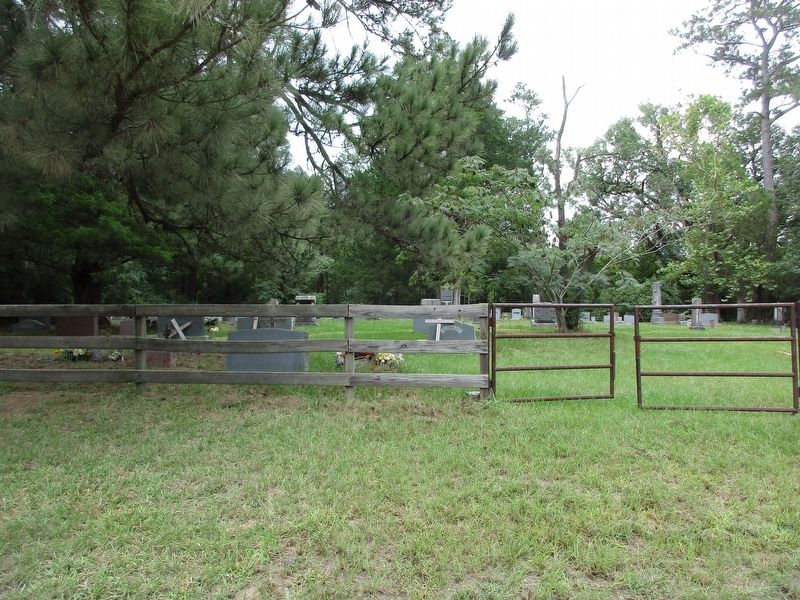
Regionally, this marker is in Texas’ Golden Triangle. It is also in the American South and in the Piney Woods. Globally, it is in North America, a Gulf of Mexico state, the Western Hemisphere, the Western World, and the Anglosphere. Historically, it finds itself in what was once New Spain, the Republic of Texas, one of the Confederate States of America, and the Antebellum South.
Other nearby markers. At least 8 other markers are within 14 miles of
Photographed by Jeff Leichsenring, August 26, 2024
Credits. This page was last revised on November 30, 2024. It was originally submitted on August 27, 2024, by Jeff Leichsenring of Garland, Texas. This page has been viewed 328 times since then and 39 times this year. Photos:1, 2. submitted on August 27, 2024, by Jeff Leichsenring of Garland, Texas. • James Hulse was the editor who published this page.

