The Associated Country Women of the World
⎯⎯⎯
L'union mondiale des femmes rurales
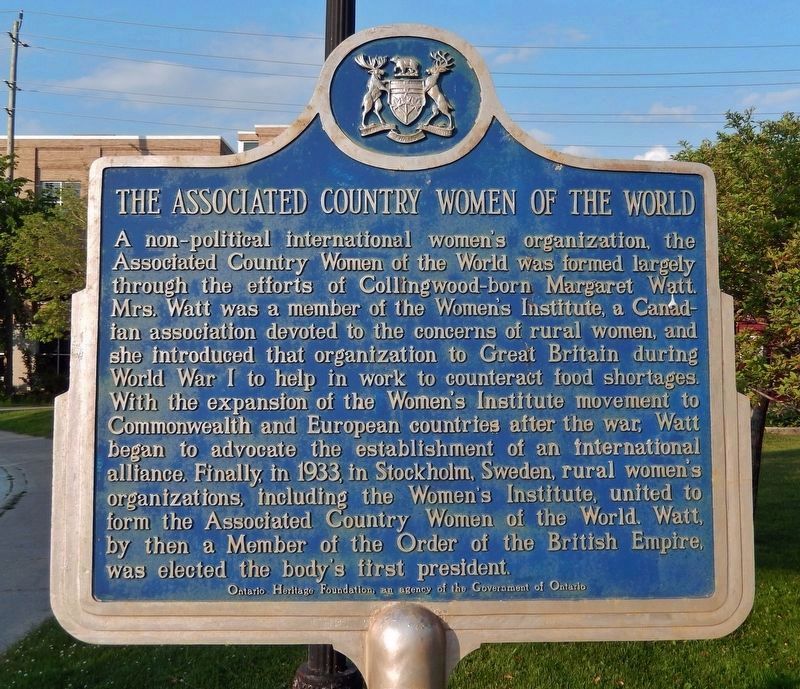
(marker west side)

this page online
Erected 1990 by Ontario Heritage Foundation / Fondation du patrimoine ontarien.
Topics and series. This historical marker is listed in these topic lists: Charity & Public Work • Fraternal or Sororal Organizations • War, World I • Women. In addition, it is included in the Canada, Ontario Heritage Trust series list. A significant historical year for this entry is 1933.
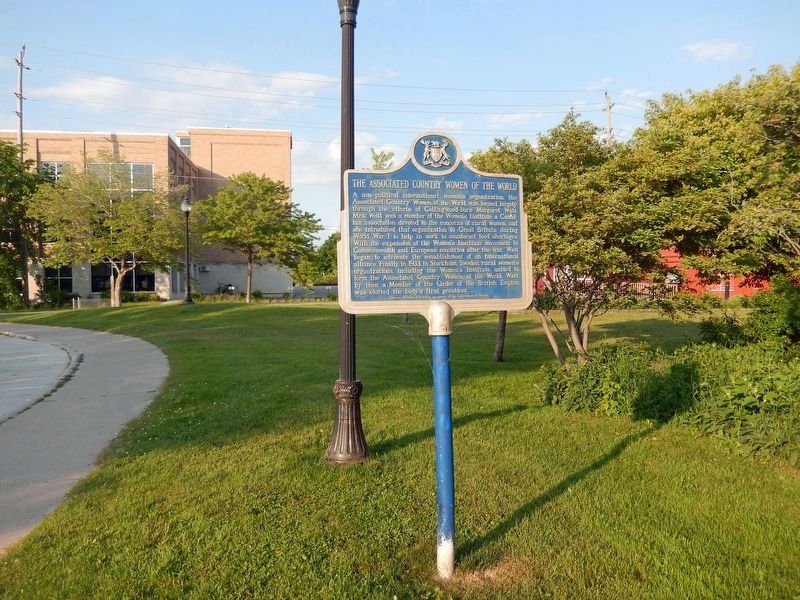
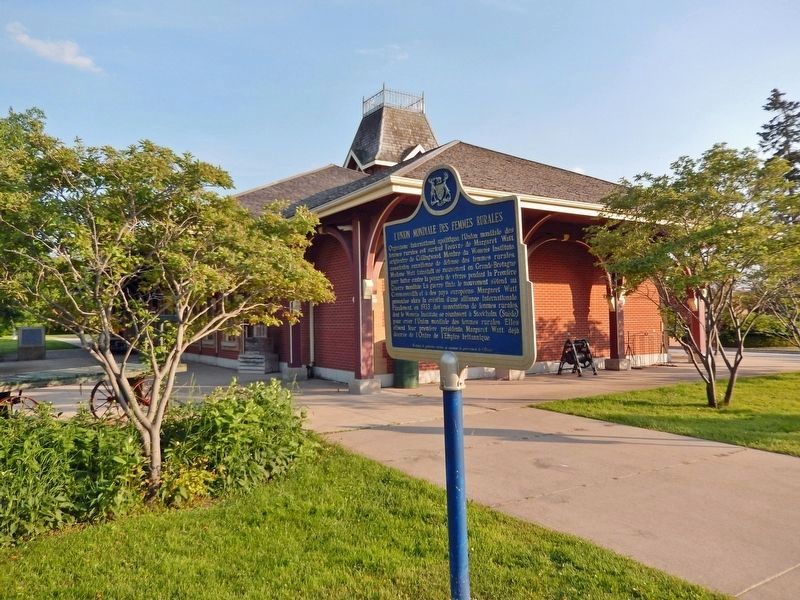
Location. 44° 30.182′ N, 80° 12.857′ W. Marker is in Collingwood, Ontario, in Simcoe County. It can be reached from Saint Paul Street just south of Huron Street (Provincial Highway 26), on the left when traveling south. The marker is located near the parking lot
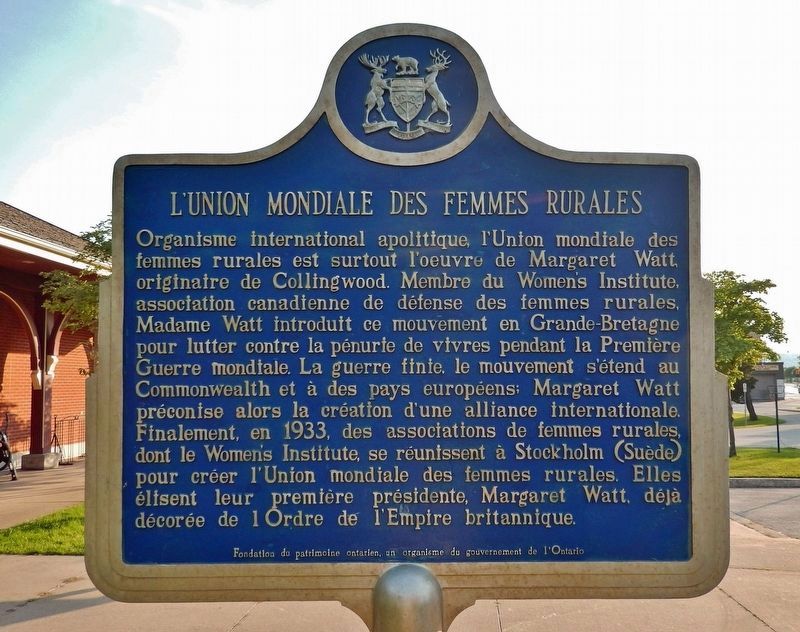
(marker east side)

Regionally, this marker is in Central Ontario Cottage Country and specifically in Georgian Bay Country. It is also in Central Canada. Globally, it is in North America, on the Great Lakes, in the Western Hemisphere, in the Western World, and in the Anglosphere. Historically, it finds itself in what was once a British colony, the Viceroyalty of New France, the Haudenosaunee (Iroquois) Confederacy, and Rupert’s Land.
Other nearby markers. At least 8 other markers are within walking distance of this marker: The Northern Railway Company of Canada (here, next to this marker); Collingwood - An Overview / Collingwood Elevators (within shouting distance of this marker); Water Transportation via Collingwood 1854-1900 (within shouting distance of this marker); Collingwood World War I Cenotaph (within shouting distance of this marker); Simcoe Street - Late 1890's (about 210 meters away, measured in a direct line);
Also see . . .
1. The Associated Country Women of the World.
Excerpt: Founded in 1929 to bring together rural women and their organisations all over the world, and in so doing address the challenges they faced as a result of the isolation of their communities, discrimination against women, and their lack of standing in political processes. ACWW’s membership spans 82 countries, and since 1947 we have passed more than 180 policy resolutions by popular vote. The key concept behind each of these is the empowerment of rural women in all their diversity. This continues to be our driving priority. Rural Women are the backbone of families, communities, and nations, but they suffer the worst impacts of climate change and conflict, go unheard in legislation, and remain unprotected and unsupported.(Submitted on August 28, 2024, by Cosmos Mariner of Cape Canaveral, Florida.)
2. Margaret Robertson Watt MBE (1868–1948) (Wikipedia).
Excerpt: Canadian writer, editor and activist. She was a woman of great energy and drive who believed strongly in the power exerted by women working together. She is known to members of Women's Institutes in the United Kingdom for introducing the concepts and practices of the Canadian Women's Institute movement to Britain in 1914. Watt was appointed a Member of the Order of British Empire by King George V in 1919 for her work in helping establish Women's Institutes in the United Kingdom.From 1919 on, she talked up the idea of an international organization of rural women. From her research, she knew rural women around the world had many of the same problems, and that these were different from urban women's problems. She worked with the International Council of Women's president, Lady Aberdeen, and with its general secretary, Elsie Zimmern, to organize a first international conference of rural women in 1929. In 1933, representatives of 28 agriculture-related women's groups met in Stockholm, Sweden, to consolidate work done at previous meetings. They agreed on the official name for their new world-wide organization for rural women and
also agreed on methods of financing, an important part of assuring their future independence. Thus, The Associated Countrywomen of the World was launched at Stockholm, Sweden. A famous photograph of Watt showed her standing beside a blackboard at this conference with the title of the organization written in English, French, German and Swedish. Watt became its first president and remained in that position until she retired in 1947.In 1990, a plaque dedicated to the Associated Country Women of the World was placed near the Collingwood Museum. (Submitted on August 28, 2024, by Cosmos Mariner of Cape Canaveral, Florida.)
Credits. This page was last revised on August 28, 2024. It was originally submitted on August 27, 2024, by Cosmos Mariner of Cape Canaveral, Florida. This page has been viewed 193 times since then and 26 times this year. Photos: 1, 2, 3, 4. submitted on August 28, 2024, by Cosmos Mariner of Cape Canaveral, Florida.
