Aurora in York Region, Ontario — Central Canada (North America)
The Settlement of Aurora
Photographed by Cosmos Mariner, June 3, 2024
1. The Settlement of Aurora Marker
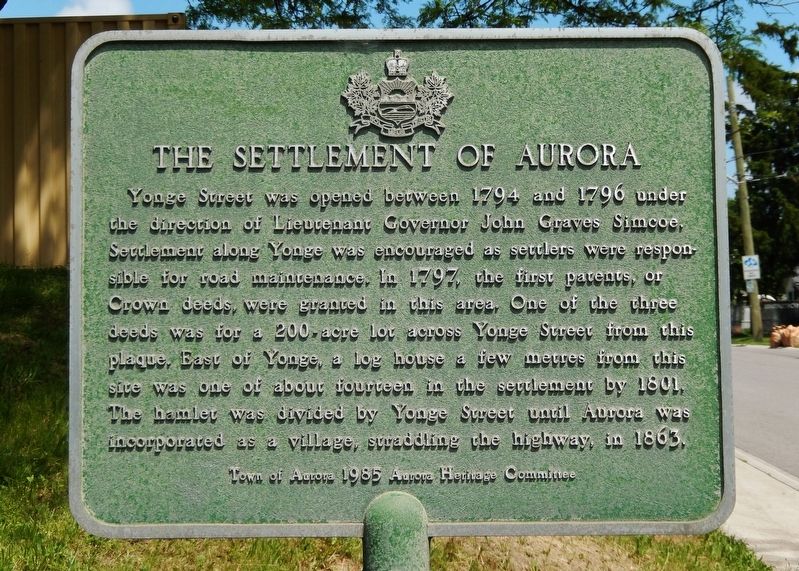
Yonge Street was opened between 1794 and 1796 under the direction of Lieutenant Governor John Graves Simcoe. Settlement along Yonge was encouraged as settlers were responsible for road maintenance. In 1797, the first patents, or Crown deeds, were granted in this area. One of the three deeds was for a 200-acre lot across Yonge Street from this plaque. East of Yonge, a log house a few metres from this site was one of about fourteen in the settlement by 1801. The hamlet was divided by Yonge Street until Aurora was incorporated as a village, straddling the highway, in 1863.
Erected 1985 by Town of Aurora and Aurora Heritage Committee.
Topics. This historical marker is listed in these topic lists: Roads & Vehicles • Settlements & Settlers. A significant historical year for this entry is 1865.
Location. 44° 0.099′ N, 79° 28.07′ W. Marker is in Aurora, Ontario, in York Region. It is at the intersection of Yonge Street (Regional Road 1) and Catherine Avenue, on the right when traveling north on Yonge Street (Regional Road 1). The marker is located in the Lion's Park at the northeast corner of the intersection. Touch for map.
this page online

Regionally, this marker is in Greater Toronto, specifically on the Golden Horseshoe, in the York, Durham and Headwaters Area, and in the Toronto Metropolitan Area. It is also in Central Canada. Globally, it is in North America, the Western Hemisphere, the Western World, and the Anglosphere. Historically, it finds itself in what was once a British colony, the Viceroyalty of New France, the Haudenosaunee (Iroquois) Confederacy, and Rupert’s Land.
Other nearby markers. At least 8 other markers are within walking distance of this marker: The Barn: a Necessity for Rural Doctors (about 120 meters away, measured in a direct line); A Place to Relax and Celebrate (about 120 meters away); A Historic Landscape (about 120 meters away); A Look Outside Hillary House (about 150 meters away); The Many Lives of Hillary House (about 150 meters away); It’s Love-All For Tennis in Aurora (about 150 meters away); Using the Grounds (about 150 meters away); Doan Hall (about 210 meters away). Touch for a list and map of all markers
Photographed by Cosmos Mariner, June 3, 2024
2. The Settlement of Aurora Marker
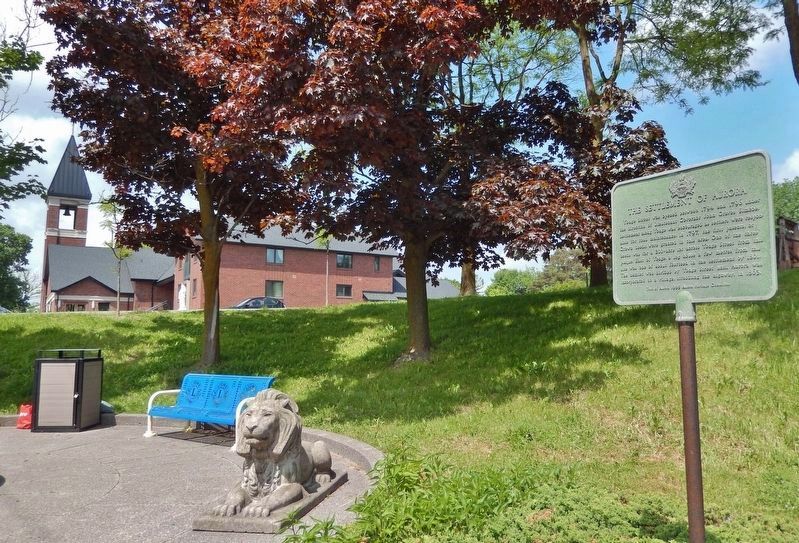
Looking north through Lion's Park from Catherine Avenue; Our Lady of Grace Church is in the background.
Also see . . .
1. Aurora, Ontario History. Wikipedia entry:
Excerpt: Lieutenant-Governor John Graves Simcoe gave the order for Yonge Street to be extended to Holland Landing in 1793, the first step toward the establishment of a community where Aurora now stands. Yonge Street opened between 1794 and 1796. In 1795, the first house in Aurora was built at Yonge Street and Catherine Avenue. The government began granting deeds to land in 1797. By 1801 there were fourteen homes.(Submitted on August 29, 2024, by Cosmos Mariner of Cape Canaveral, Florida.)
2. The Story of Aurora. Aurora Museum & Archives website entry:
Excerpt: The mid-1800's saw further expansion with the arrival of the railway in 1853, making the area more attractive for settlement and industry. Farmlands were divided into building lots to accommodate the influx of new settlers, and Richard Machell filed the first plan for “Matchville” in May of that year. The next year, Postmaster Charles Doan renamed the post office after the Roman goddess of the Dawn, and the community took on the name of Aurora. In 1859, Joseph Fleury arrived and established The Aurora Agricultural Works (later J. Fleury's Sons), which became a central part of Aurora's economy as its largest employer.(Submitted on August 29, 2024, by Cosmos Mariner of Cape Canaveral, Florida.)In 1863, Aurora was incorporated as a village, with Charles Doan serving as its first Reeve. The village continued to expand and on January 1, 1888, the Village of Aurora became officially became a Town.
Credits. This page was last revised on July 12, 2025. It was originally submitted on August 29, 2024, by Cosmos Mariner of Cape Canaveral, Florida. This page has been viewed 233 times since then and 43 times this year. Photos: 1, 2. submitted on August 29, 2024, by Cosmos Mariner of Cape Canaveral, Florida.
