Near L'Anse in Baraga County, Michigan — The American Midwest (Great Lakes)
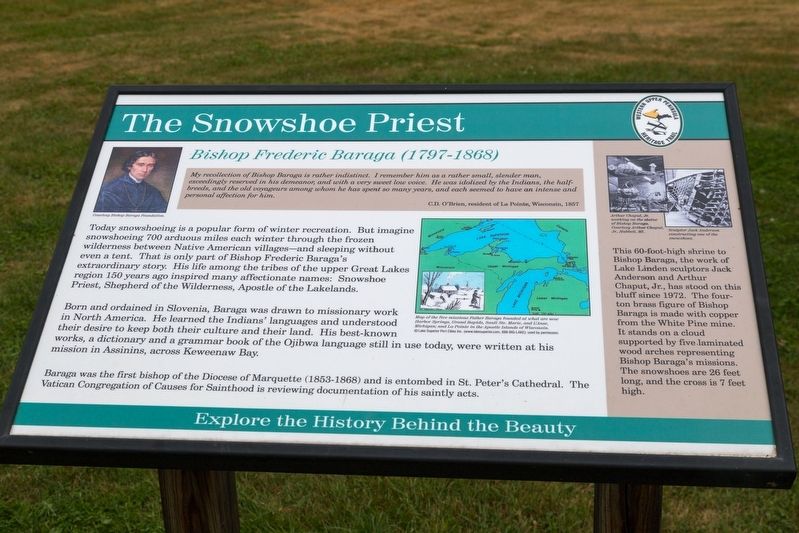
The Snowshoe Priest
Bishop Frederic Baraga (1797-1868)
| — | Western Upper Peninsula Heritage Trail | — |
Photographed by J. J. Prats, August 3, 2024
1. The Snowshoe Priest Marker
My recollection of Bishop Baraga is rather indistinct. I remember him as a rather small, slender man exceedingly reserved in his demeanor, and with a very sweet low voice. He was idolized by the Indians, the half-breeds, and the old voyageurs among whom he has spent so many years, and each seemed to have an intense and personal affection for him.
— C. O'Brien, resident of Le Pointe, Wisconsin, 1857
Today snowshoeing is a popular form of winter recreation. But imagine snowshoeing 700 arduous miles each winter through the frozen wilderness between Native American villages—and sleeping without even a tent. That is only part of Bishop Frederic Baraga’s extraordinary story. His life among the tribes of the upper Great Lakes region 150 years ago inspired many affectionate names: Snowshoe Priest, Shepherd of the Wilderness, Apostle of the Lakelands.
Born and ordained in Slovenia, Baraga was drawn to missionary work in North America. He learned the Indians’ languages and understood their desire to keep both their culture and their land. His best-known works, a dictionary and a grammar book of the Ojibwa language
this page online
Baraga was the first bishop of the Diocese of Marquette (1853-1868) and is entombed in St. Peter’s Cathedral. The Vatican Congregation of Causes for Sainthood is reviewing documentation of his saintly acts.
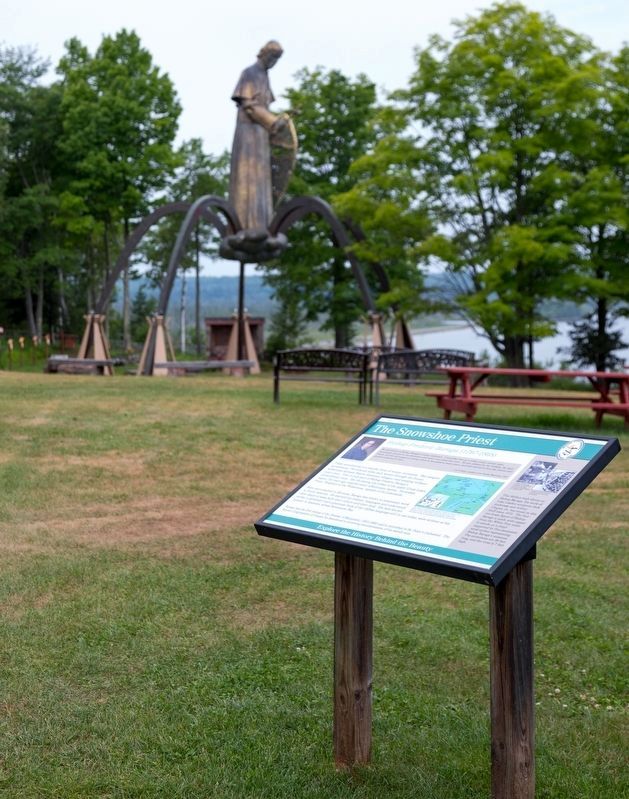
(sidebar) This 60-foot-high shrine to Bishop Baraga, the work of Lake Linden sculptors Jack Anderson and Arthur Chaput, Jr., has stood on this bluff since 1972. The four-ton brass figure of Bishop Baraga is made with copper from the White Pine mine. It stands on a cloud supported by five laminated wood arches representing Bishop Baraga’s missions. The snowshoes are 26 feet long, and the cross is 7 feet high.
Topics. This historical marker is listed in these topic lists: Charity & Public Work • Indigenous Peoples and Communities. A significant historical year for this entry is 1857.
Location. 46° 44.955′ N, 88° 28.415′ W. Marker is near L'Anse, Michigan, in Baraga County. It is on Lambert Road south of U.S. 41. It is on the grounds of the Bishop Baraga Shrine. The shrine is no longer accessible directly from U.S. 41. It is well
Photographed by J. J. Prats, August 3, 2024
2. The Snowshoe Priest Marker and Status
Father Baraga’s statue is in the distance. The waters of Lake Superior’s L’anse Bay are visible beyond the trees.

Regionally, this marker is on the Upper Peninsula and in Copper Country. It is also in the American Midwest and on Lake Superior’s South Shore Region. Globally, it is in North America, in the Great North Woods, on the Great Lakes, in the Western Hemisphere, in the Western World, and in the Anglosphere. Historically, it finds itself in what was once the Northwest Territory.
Other nearby markers. At least 8 other markers are within walking distance of this marker: Departure from Metlika (here, next to this marker); Celebration of Holy Mass (here, next to this marker); Unum Est Necessarium (here, next to this marker); Storm On Lake Superior (here, next to this marker); Arrival at LaPointe (here, next to this marker); L’Anse-Lac Vieux Desert Trail (a few steps from this marker); Dog Sled Episode (within shouting distance of this marker); Adrift on Ice Floe

1972 sculpture by Jack Anderson and Arthur Chaput, Jr. Photographed by J.J. Prats, August 3, 2024
3. The Snowshoe Priest
The Smithsonian American Art Museum’s Art Inventories Catalog reports that this 1974 sculpture stands approximately 35 feet tall and weighs 4 tons. The sculptors were Jack Anderson and Arthur Chaput, Jr. and it is officially titled “Bishop Baraga Shrine.” The sculpture is made of brass “floating on a cloud” of stainless steel, and its base is made of sheet metal sheathing on wood and cast concrete. It is described as follows,
Full-length portrait Bishop Frederic Baraga, in brass, standing on a stainless steel cloud formation. Five arches extrude from the cloud and each ends on its own concrete tepee, which serves as the base. The figure wears a long cleric's robe, sash and cape. A large cross pendant hangs from his neck and he holds a larger, jeweled Cross in his proper right hand. He carries a pair of snowshoes in his proper left hand. The figure is posed to look down at the viewer. The five arches and five tepees represent Bishop Baraga's five missions among the American Indians.
Also see . . . Wikipedia entry for Frederic Baraga. Excerpt:
In 1843 Baraga founded a mission at L’Anse, Michigan. During this time, he earned the nickname “the Snowshoe Priest” because he would travel hundreds of miles each year on snowshoes during the harsh winters. He worked to protect the Indians from being forced to relocate, as well as publishing a dictionary and grammar of the Ojibway language. Although these works have important historical value, they are not recommended as basic resources for the language today.(Submitted on August 29, 2024.)
With the collaboration of many native speakers, Fr. Baraga also composed around 100 Catholic hymns in the Ojibwe language, which were published in a hymnal and still continue to be used by the Ojibwe people in Roman Catholic worship in both Canada and the United States.
Through the texts Baraga published in his missionary years, the Slovenes learned about aspects of Native American culture and the United States.

1972 sculpture by Jack Anderson and Arthur Chaput, Jr. Photographed by J.J. Prats, August 3, 2024
4. Father Frederic Baraga, the Snowshoe Priest

Gold-toned daguerrotype produced by Mathew Brady’s Studio (Public Domain) Library of Congress collection, circa 1853/1896
5. Frederic Baraga, Bishop of Marquette
He is holding his book, Dictionary of the Otchipwe Language.
Credits. This page was last revised on February 5, 2025. It was originally submitted on August 29, 2024, by J. J. Prats of Powell, Ohio. This page has been viewed 1,275 times since then and 65 times this year. Photos: 1, 2, 3, 4, 5. submitted on August 29, 2024, by J. J. Prats of Powell, Ohio.
