
Cross Keys in Rockingham County, Virginia — The American South (Mid-Atlantic)
Battle of Cross Keys
The Civilians of Cross Keys
| — | 1862 Valley Campaign | — |
Photographed by J. J. Prats, September 25, 2007
1. Battle of Cross Keys Marker
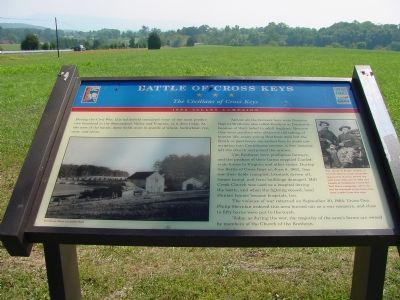
Almost all the farmers here were German Baptist Brethren, also called Dunkers or Dunkards because of their belief in adult baptism. Because they were pacifists who abhorred the taking of human life, many young Brethren men left the South or paid heavy exemption fees to avoid conscription into Confederate service. A few, however, left the church and joined the armies.
The Brethren were prodigious farmers, and the produce of their farms supplied Confederate forces in Virginia and other states. During the Battle of Cross Keys on June 8, 1862, they saw their fields trampled, livestock driven off, homes looted, and farm buildings damaged. Mill Creek Church was used as a hospital during the battle, and when the fighting ceased, local Dunker houses became hospitals, too.
The violence of war returned on September 30, 1864. Union Gen. Philip Sheridan ordered this area
this page online
Today, as during the war, the majority of the area’s farms are owned by members of the Church of the Brethren.
Erected by Virginia Civil War Trails.
Topics and series. This historical marker is listed in this topic list: War, US Civil. In addition, it is included in the Virginia Civil War Trails series list. A significant historical month for this entry is June 1888.
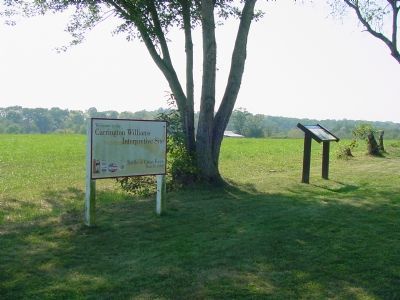
Location. Marker has been reported missing. It was located near 38° 21.008′ N, 78° 49.624′ W. Marker was in Cross Keys, Virginia, in Rockingham County. It was on Port Republic Road (County Route 659) south of Cross Keys Road (Virginia Route 276), on the right when traveling south. Marker is at the Carrington Williams Interpretive Site. Touch for map. Marker was in this post office area: Harrisonburg VA 22801, United States of America. Touch for directions.

Regionally, this marker was in Virginia’s Shenandoah Valley. It was also in the American South and specifically in the Upper South. Globally, it was in North America, the Western Hemisphere, the Western World, and the Anglosphere.
Photographed by J. J. Prats, September 25, 2007
2. Marker at the Carrington Williams Interpretive Site
Other nearby markers. At least 8 other markers are within walking distance of this location: Cross Keys Battlefield (a few steps from this marker); The Slaughter of the 8th New York (approx. 0.2 miles away); The Battlefields Today (approx. 0.2 miles away); Visiting the Battlefields (approx. 0.2 miles away); Lying in Wait (approx. 0.2 miles away); a different marker also named Cross Keys Battlefield (approx. 0.2 miles away); Death in the Clover (approx. 0.2 miles away); Marching to Disaster (approx. 0.2 miles away). Touch for a list and map of all markers in Cross Keys.
Other markers no longer nearby. Battle of Cross Keys (was a few steps from this marker but has been confirmed missing); a different marker also named Battle of Cross Keys (was a few steps from this marker but has been confirmed missing); a different marker also named Battle of Cross Keys (was about 400 feet away, measured in a direct line but has been permanently
Photographed by J. J. Prats, September 25, 2007
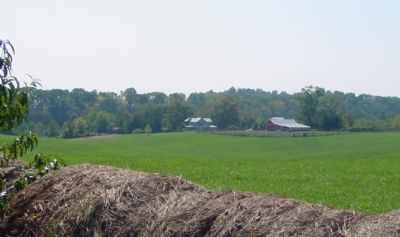
3. View of the Battlefield Today
More about this marker. On the left there is a photograph of two barns, a hay pile, and fields recently harvested captioned, “Bretheren Farm on battlefield.”. On the right a photograph of two men of captioned, “Pvt. Jacob P. Kyger (right), a local Brethren youth staunchly opposed to slavery, joined the 35th Iowa Infantry in 1862 and fought at Vicksburg and in the Red River campaign. After the war he returned to his farm, less than a mile from this sign.”
Also see . . .
1. The Brethren. (Submitted on December 13, 2007.)
2. Battle of Cross Keys. National Park Service summary of the battle. (Submitted on December 15, 2007, by Craig Swain of Leesburg, Virginia.)
Credits. This page was last revised on August 9, 2023. It was originally submitted on December 13, 2007, by J. J. Prats of Powell, Ohio. This page has been viewed 2,940 times since then and 40 times this year. Last updated on December 14, 2009. Photos: 1, 2, 3. submitted on December 13, 2007, by J. J. Prats of Powell, Ohio. • Craig Swain was the editor who published this page.
