Belleville in Hastings County, Ontario — Central Canada (North America)
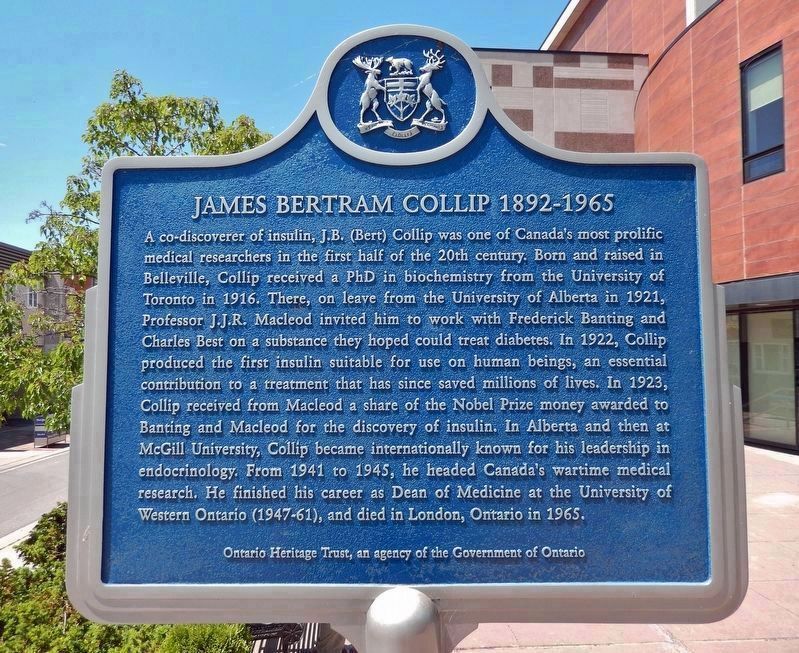
James Bertram Collip 1892-1965
Photographed by Cosmos Mariner, May 30, 2024
1. James Bertram Collip 1892-1965 Marker
(east side • English)
(east side • English)

this page online
Erected by Ontario
Photographed by Cosmos Mariner, May 30, 2024
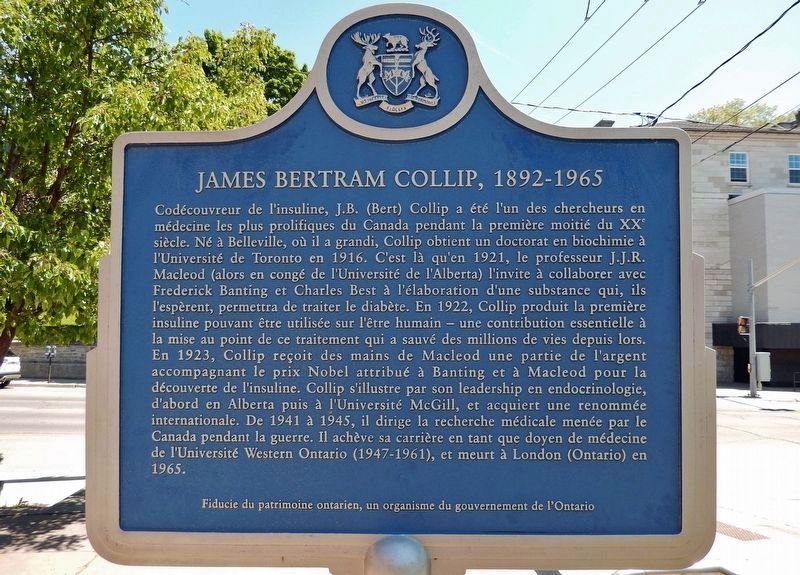
2. James Bertram Collip 1892-1965 Marker
(west side • Français)
(west side • Français)
Topics and series. This historical marker is listed in these topic lists: Education • Science & Medicine • War, World II. In addition, it is included in the Canada, Ontario Heritage Trust series list. A significant historical date for this entry is November 20, 1892.
Location. 44° 9.909′ N, 77° 23.002′ W. Marker is in Belleville, Ontario, in Hastings County. It is at the intersection of Pinnacle Street (Provincial Highway 62) and Campbell Street, on the right when traveling south on Pinnacle Street. The marker is located near the southeast corner of the Belleville Public Library. Touch for map. Marker is at or near this postal address: 254 Pinnacle Street, Belleville ON K8N 3B1, Canada. Touch for directions.

Regionally, this marker is in Eastern Ontario and specifically in Southeastern Ontario. It is also in Central Canada. Globally, it is in North America, on the Great Lakes, in the Western Hemisphere, in the Western World, and in the Anglosphere. Historically, it finds itself in what was once a British colony, the Viceroyalty of New France, the Haudenosaunee (Iroquois)
Photographed by Cosmos Mariner, May 30, 2024
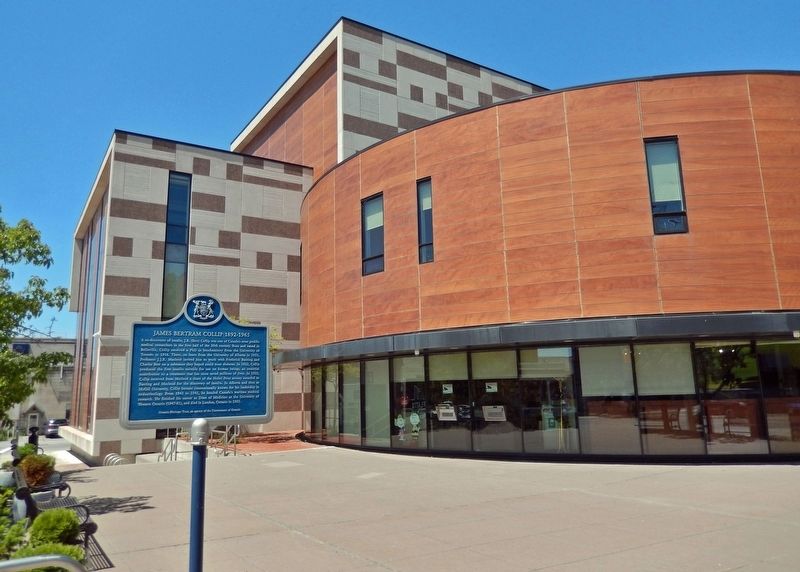
3. James Bertram Collip 1892-1965 Marker (east side)
Looking west; the Belleville Public Library is on the right.
Other nearby markers. At least 8 other markers are within walking distance of this marker: Pinnacle Playhouse (within shouting distance of this marker); Great Belleville Floods (about 120 meters away, measured in a direct line); Formation of the Methodist Church (Canada, Newfoundland, Bermuda) 1884 (about 150 meters away); Belleville Collegiate Institute & Vocational School (about 180 meters away); Griffin Opera House (about 180 meters away); George Zegouras Market Square (approx. 0.2 kilometers away); Belleville City Hall / L'Hôtel de ville de Belleville (approx. 0.3 kilometers away); Market Square (approx. 0.3 kilometers away). Touch for a list and map of all markers in Belleville.
Related markers. Click here for a list of markers that are related to this marker.
Also see . . . James Bertram Collip CBE FRS FRSC FRCP FRCPC (Wikipedia).
Excerpt: MacLeod was overseeing the work of Frederick Banting and Charles Best in their search for a treatment for diabetes which they had begun in May 1921. In December, when Banting and Best were having difficulties in refining the pancreatic(Submitted on August 31, 2024, by Cosmos Mariner of Cape Canaveral, Florida.)extract, MacLeod freed Collip from his other research to enable him to join the research team. Collip's task was to prepare insulin in a more pure, usable form than Banting and Best had been able to achieve to date. In January 1922, after 14-year-old Leonard Thompson suffered a severe allergic reaction to an injection of insulin, Collip achieved the goal of preparing a pancreatic extract pure enough for Thompson to recover and to use in clinical trials.Photographed by Cosmos Mariner, May 30, 20244. James Bertram Collip 1892-1965 Marker (west side)Looking east along Campbell Street; Pinnacle Street crosses in the background.Banting, Best and Collip subsequently shared the patent for insulin, which they sold to the University of Toronto for one dollar. The Nobel Prize for Medicine was awarded to Banting and MacLeod in 1923. Feeling that Best had been overlooked in the award, Banting shared his portion with Best. In response, MacLeod shared his portion with Collip. Nonetheless, Collip is often overlooked as a co-discoverer of insulin, in part due to Best's public relations campaign that downplayed Collip's crucial role.

Credits. This page was last revised on August 31, 2024. It was originally submitted on August 30, 2024, by Cosmos Mariner of Cape Canaveral, Florida. This page has been viewed 196 times since then and 21 times this year. Photos: 1, 2, 3, 4. submitted on August 31, 2024, by Cosmos Mariner of Cape Canaveral, Florida.
