Melrose in Putnam County, Florida — The American South (South Atlantic)
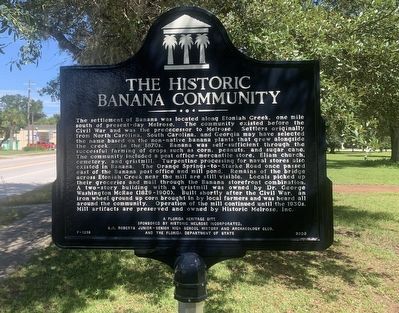
The Historic Banana Community
Photographed by Tim Fillmon, August 31, 2024
1. The Historic Banana Community Marker
this page online
A Florida Heritage Site
Erected 2023 by Historic Melrose Incorporated, Q.I. Roberts Junior-Senior High School History and Archaeology Club, and the Florida Department of State. (Marker Number F-1218.)
Topics. This historical marker is listed in these topic lists: Agriculture • Settlements & Settlers. A significant historical year for this entry is 1870.
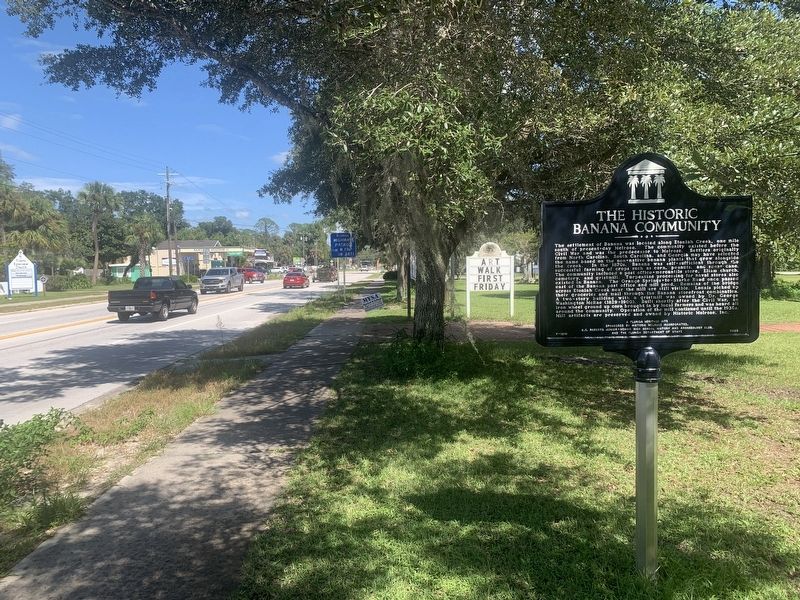
Location. 29° 42.58′ N, 82° 2.935′ W. Marker is in Melrose, Florida, in Putnam County. It is on Florida Route 26 just east of Cypress Avenue, on the right when traveling east. Marker is located in Melrose Heritage Park. Touch for map. Marker is at or near this postal address: 300 SR 26, Melrose FL 32666, United States of America. Touch for directions.

Regionally, this marker is in Florida’s First Coast. It is also in the American South. Globally, it is in the North Atlantic Region, North America, a Gulf of Mexico state, the Western Hemisphere, the Western World, and the Anglosphere. Historically, it finds itself in what was once New Spain, the territory of the Mississippian Culture, one of the Confederate States of America, and the Antebellum South.
Photographed by Tim Fillmon, August 31, 2024
2. The Historic Banana Community Marker
Other nearby markers. At least 8 other markers are within walking distance of this marker: Trinity Episcopal Church (a few steps from this marker); Melrose (within shouting distance of this marker); Melrose World War II Memorial (within shouting distance of this marker); Melrose World War I Memorial (within shouting distance of this marker); Melrose Civil War Memorial (within shouting distance of this marker); Melrose United Methodist Church (about 600 feet away, measured in a direct line); Melrose Woman's Club (approx. 0.2 miles away); Melrose High School (approx. 0.3 miles away). Touch for a list and map of all markers in Melrose.
Also see . . . Banana, Florida. Grokipedia website entry (Submitted on July 31, 2026, by Larry Gertner of New York, New York.)
Credits. This page was last revised on July 31, 2026. It was originally submitted on September 1, 2024, by Tim Fillmon of Webster, Florida. This page has been viewed 1,417 times since then and 195 times this year. Photos: 1, 2. submitted on September 1, 2024, by Tim Fillmon of Webster, Florida.
