Delta Junction in Southeast Fairbanks Census Area, Alaska — Northwest (North America)
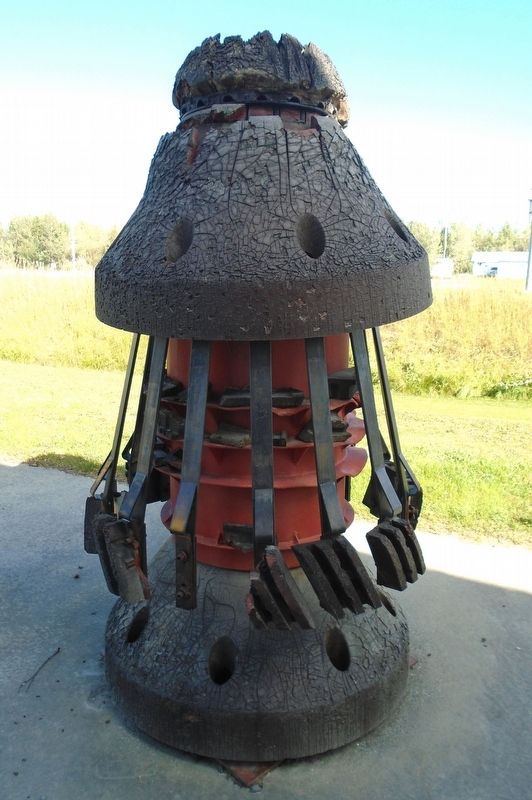
Trans Alaska Pipeline "Pig"

Photographed by William Fischer, Jr., August 16, 2024
1. Trans Alaska Pipeline "Pig" Marker
Devices called "pigs" are routinely used in pipelines around the world. The first pigs, used to clean the inside walls of early small-diameter lines, were short and squat, suggesting the shape of the common barnyard animal. The name was applied by some early pipeliner, and the description stuck. It persists today, although the modern device retains little of the original pig-like contours. Pigs used to clean pipelines by scraping away interior deposits are called "scraper" pigs. Later pipeline engineers developed additional uses for the internal devices, but even the most sophisticated of these is called a pig.
URETHANE SCRAPER PIG
The urethane scraper pig pictured above is the ty[?, probably "typical"] [marker broken] trans Alaska pipeline.
Its predecessor was the urethane-and-steel device sta[?] display. The all-urethane pig is more resilient and flexes as it [?] the pipeline valves. This design places minimum strain on the p[?, probably "pipeline"]
WHY ARE SCRAPER PIGS REQUIRED?
Crude oil enters the trans Alaska pipeline at about 125 degrees Fahrenheit at Prudhoe Bay. As the oil flows through the line it gradually
this page online
TRADITIONAL SCRAPER PIG
Traditional scraper pigs like the one in this display were constructed primarily of steel, but employed urethane in the molded cups that are used to push it through the line by the flowing oil. The scrapers used to clean the deposits from the interior pipe walls were also made of urethane.
["Pig" Diagram, left to right, reads]
Bumper Nose • Support/Drive Cup • 255 Ultrasonic Transducers • Pig Location Transmitter
INSTRUMENT PIG
This tool is more complex than the scraper pigs. The instrument pig moves through the pipeline with the oil and is launched and retrieved just like the scraper

Photographed by William Fischer, Jr., August 16, 2024
2. Trans Alaska Pipeline "Pig" and Marker
Erected by Alyeska Pipeline Service Company.
Topics. This historical marker is listed in this topic list: Man-Made Features.
Location. 64° 2.223′ N, 145° 43.888′ W. Marker is in Delta Junction in Southeast Fairbanks Census Area, Alaska. It is at the intersection of Richardson Highway (State Highway 4 at milepost 266) and the Alaska Highway (State Route 2), on the right when traveling north on Richardson Highway. Marker is on the Delta Junction Visitor Center grounds. Touch for map.
Photographed by William Fischer, Jr., August 16, 2024
3. Trans Alaska Pipeline "Pig"

Regionally, this marker is in the Athabascan Region and in Interior Alaska. It is also on the American Pacific Coast. Globally, it is in North America, on the Pacific Rim, in the Western Hemisphere, in the Western World, and in the Anglosphere. Historically, it finds itself in what was once the Russian Empire.
Other nearby markers. At least 8 other markers are within walking distance of this marker: Pipeline Passageway (here, next to this marker); Delta Junction, Alaska (a few steps from this marker); Alaska Proudly Honors Purple Heart Recipients (a few steps from this marker); Agricultural Development in Delta (within shouting distance of this marker); "Two in the Far North" (about 500 feet away, measured in a direct line); Construction of the Sullivan Roadhouse (about 500 feet away); Gardening at the Sullivan Roadhouse (about 500 feet away); Historic Location of the Sullivan Roadhouse (about 600 feet away). Touch for a list and map of all markers in Delta Junction.
Credits. This page was last revised on September 2, 2024. It was originally submitted on September 1, 2024, by William Fischer, Jr. of Reynoldsburg, Ohio. This page has been viewed 601 times since then and 83 times this year. Photos: 1, 2, 3. submitted on September 1, 2024, by William Fischer, Jr. of Reynoldsburg, Ohio.
