College in Fairbanks North Star Borough, Alaska — Northwest (North America)
Boreal forest: living around Thompson Drive

Photographed by William Fischer, Jr., August 17, 2024
1. Boreal forest: living around Thompson Drive Marker
Life in the boreal forest
Boreal forest forms a belt that circles the northern part of the globe, including Canada, Russia, Scandinavia and Alaska. The location of boreal forest ecosystems is generally determined by soil temperature, the amount of warmth accumulated during the growing season and the lowest temperature regularly experienced during winter. Cold is a dominant factor of this region's climate due to low sun angles, long winter nights and persistent winter snow pack.
Boreal forest often occurs on permafrost, or continuously frozen ground. Cold soil temperatures limit the primary productivity, or amount of photosynthesis, of the forest plants. The forest's major tree species are well adapted to the cold soils, extreme winter temperatures, a cool growing season and low annual precipitation.
Animals that live in the boreal forest have adapted to survive the long, cold winter. Some of these adaptations are hibernation, migration, caching food and nighttime torpor or shallow hypothermia.
Land of little sticks
True boreal forest is often referred to as taiga, a Russian word meaning "little
this page online
Forest fauna
Hundreds of species of migratory birds, like the Wilson's Warbler (left), rely upon the boreal forest for breeding habitat. Resident bird species include crossbills, chickadees and Boreal Owls.
The forest is also home to many species of mammals, including moose, red squirrels (right), brown and black bears, beavers, snowshoe hares and lynx.
Forests on fire
The boreal forest is well adapted for growth following fire, the major type of natural disturbance, which is frequently caused by lightning. Other significant natural disturbances are floods, snow breakage and insect outbreaks. Large scale outbreaks of insects like the spruce bark beetle can weaken or kill trees over vast areas, making them more vulnerable to forest fires.
UAF in the boreal forest
University of Alaska Fairbanks researchers study forest growth and yield, forest soils, boreal plants and animals, carbon storage and forest response to wildland
Photographed by William Fischer, Jr., August 17, 2024
2. Boreal forest: living around Thompson Drive Marker
The boreal region contains more than 30 percent of the earth's terrestrial carbon as non-decomposed or partly decomposed organic matter. Warming at high latitudes could increase the rate of decomposition, which could lead to less carbon storage and the release of more carbon dioxide into the atmosphere.
Erected by University of Alaska Fairbanks.
Topics. This historical marker is listed in this topic list: Natural Features.
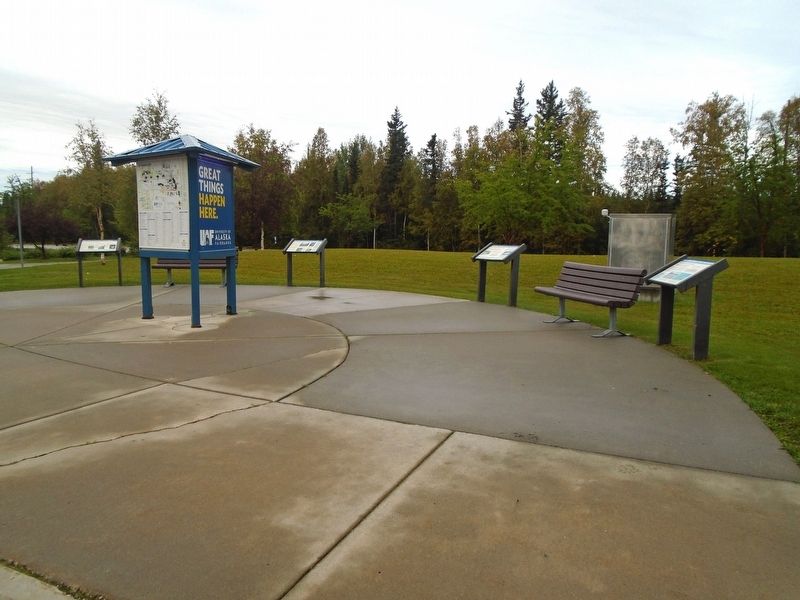
Location. 64° 51.07′ N, 147° 50.549′ W. Marker is in College, Alaska, in Fairbanks North Star Borough. It is on Thompson Drive 0.1 miles north of Geist Road, on the right when traveling north. Marker is at an informational pulloff on the UAF campus. Touch for map. Marker is at or near this postal address: 821 Thompson Dr, Fairbanks AK 99709, United States of America. Touch for directions.

Regionally, this marker is in the Alaska Railroad Corridor, in the Athabascan Region, and in Interior Alaska. It is also on the American Pacific Coast. Globally, it is in North America, on the Pacific Rim, in the Western Hemisphere, in the Western
Photographed by William Fischer, Jr., August 17, 2024
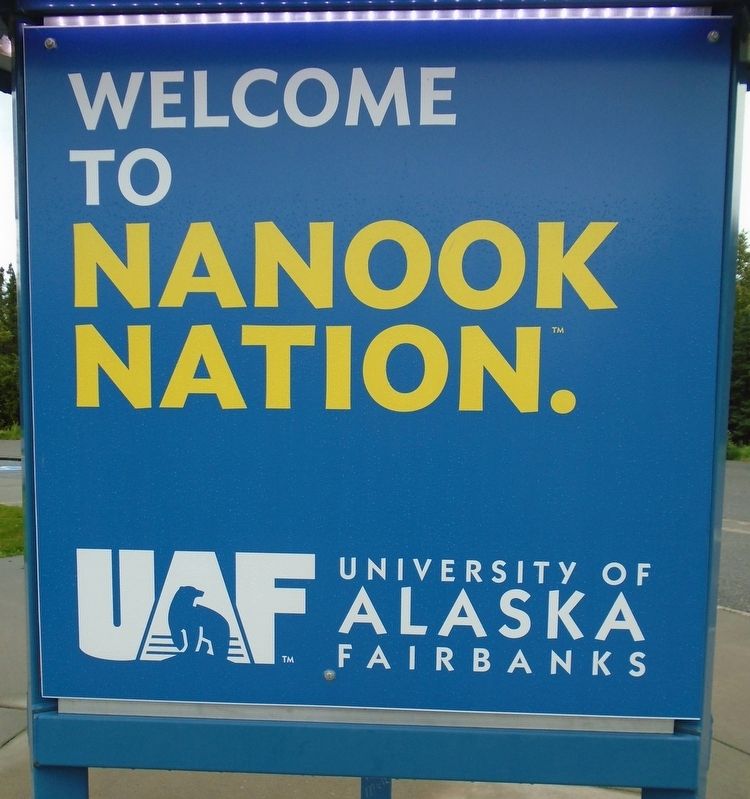
3. Welcome to Nanook Nation Sign
Other nearby markers. At least 8 other markers are within walking distance of this marker: UAF: a Land, Sea and Space Grant institution (here, next to this marker); Engineering challenge: preserve the permafrost (here, next to this marker); Engineering challenge: build a road on permafrost (a few steps from this marker); Chief Phil Rounds (approx. half a mile away); Welcome to the UAF Planet Walk! (approx. 0.6 miles away); The Only University-Owned Rocket Range in the World (approx. 0.6 miles away); What goes up must come down! (approx. 0.6 miles away); What is the Aurora? (approx. 0.6 miles away). Touch for a list and map of all markers in College.
Regarding Boreal forest: living around Thompson Drive. The marker has limited historical information but does address climate change, its possible impact of humanity, and that UAF researchers are seeking redress. It also complements the other markers at this UAF campus gateway.
Also see . . .
1. Tiaga (National Geographic). (Submitted on September 8, 2024, by William Fischer, Jr. of Reynoldsburg, Ohio.)
2. University of Alaska Fairbanks. (Submitted on September 8, 2024, by William Fischer, Jr. of Reynoldsburg, Ohio.)
Credits. This page was last revised on September 23, 2024. It was originally submitted on September 8, 2024, by William Fischer, Jr. of Reynoldsburg, Ohio. This page has been viewed 184 times since then and 39 times this year. Photos: 1, 2, 3. submitted on September 8, 2024, by William Fischer, Jr. of Reynoldsburg, Ohio.
