College in Fairbanks North Star Borough, Alaska — Northwest (North America)
What goes up must come down!
Photographed by William Fischer, Jr., August 17, 2024
1. What goes up must come down! Marker
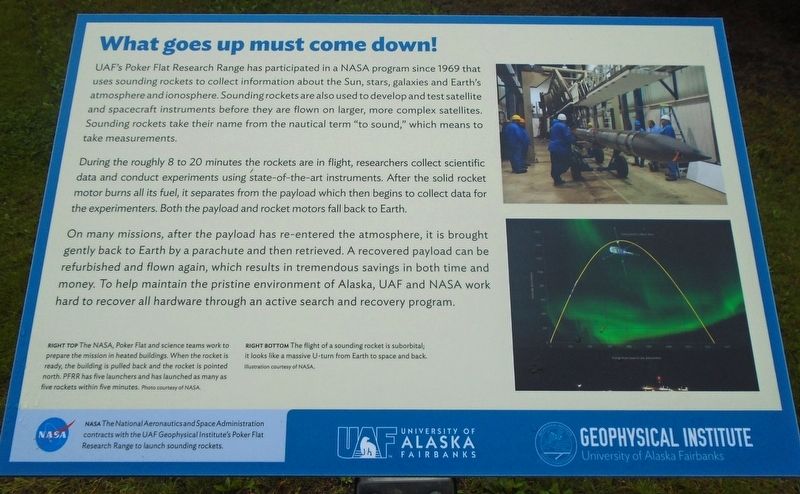
UAF's Poker Flat Research Range has participated in a NASA program since 1969 that uses sounding rockets to collect information about the Sun, stars, galaxies and Earth's atmosphere and ionosphere. Sounding rockets are also used to develop and test satellite and spacecraft instruments before they are flown on larger, more complex satellites. Sounding rockets take their name from the nautical term "to sound," which means to take measurements.
During the roughly 8 to 20 minutes the rockets are in flight, researchers collect scientific data and conduct experiments using state-of-the-art instruments. After the solid rocket motor burns all its fuel, it separates from the payload which then begins to collect data for the experimenters. Both the payload and rocket motors fall back to Earth.
On many missions, after the payload has re-entered the atmosphere, it is brought gently back to Earth by a parachute and then retrieved. A recovered payload can be refurbished and flown again, which results in tremendous savings in both time and money. To help maintain the pristine environment of Alaska, UAF and NASA work hard to recover
this page online
RIGHT TOP [photo caption reads] The NASA, Poker Flat and science teams work to prepare the mission in heated buildings. When the rocket is ready, the building is pulled back and the rocket is pointed north. PFRR has five launchers and has launched as many as five rockets within five minutes.
RIGHT BOTTOM [photo caption reads] The flight of a sounding rocket is suborbital; it looks like a massive U-turn from Earth to space and back.
NASA The National Aeronautics and Space Administration contracts with the UAF Geophysical Institute's Poker Flat Research Range to launch sounding rockets.
Erected by University of Alaska Fairbanks.
Topics. This historical marker is listed in these topic lists: Air & Space • Education • Environment. A significant historical year for this entry is 1969.
Location. 64° 51.538′ N, 147° 50.939′ W. Marker is in College, Alaska, in Fairbanks North Star Borough. It is on North Koyukuk Drive, on the left when traveling west. Marker and rocket are northwest of the Arctic Health Research Building, on the University of Alaska Fairbanks campus.

Photographed by William Fischer, Jr., August 17, 2024
2. What goes up must come down! Marker and Rocket

Regionally, this marker is in the Alaska Railroad Corridor, in the Athabascan Region, and in Interior Alaska. It is also on the American Pacific Coast. Globally, it is in North America, on the Pacific Rim, in the Western Hemisphere, in the Western World, and in the Anglosphere. Historically, it finds itself in what was once the Russian Empire.
Other nearby markers. At least 8 other markers are within walking distance of this marker: The Only University-Owned Rocket Range in the World (here, next to this marker); What is the Aurora? (here, next to this marker); What is This Rocket? (here, next to this marker); Helga Wilm (within shouting distance of this marker); ASF Corner Reflector (within shouting distance of this marker); Chief Phil Rounds (about 600 feet away, measured in a direct line); Welcome to the UAF Planet Walk! (about 700 feet away); The Middle Kuskokwim River (approx. ¼ mile away). Touch for a list and map of all markers in College.
Also see . . . A Brief History of Poker Flat (UAF Geophysical Institute). (Submitted on September 8, 2024, by William Fischer, Jr. of Reynoldsburg, Ohio.)
Credits. This page was last revised on September 23, 2024. It was originally submitted on September 8, 2024, by William Fischer, Jr. of Reynoldsburg, Ohio. This page has been viewed 213 times since then and 28 times this year. Photos: 1, 2. submitted on September 8, 2024, by William Fischer, Jr. of Reynoldsburg, Ohio.
