Midtown in Nashville in Davidson County, Tennessee — The American South (East South Central)
Understanding the Past
Monument to the Private Confederate Soldier

Photographed by Darren Jefferson Clay, September 2, 2024
1. Understanding the Past Marker
In December 1901, the Frank Cheatham Bivouac Number 1, founded in Nashville in 1887, launched a fundraising campaign for the purpose of erecting a monument honoring Confederate soldiers. In June 1904, with only a portion of the $4,000 needed to complete the monument, the bivouac laid the cornerstone of the pedestal during an elaborate ceremony. Five years later, hundreds of spectators attended the monument's unveiling. Judge S. F. Wilson's words that day captured the conflicting sentiments felt by many former Confederates. I have no apologies to make for the humble part I played in the Civil War," he stated, "Under the same conditions
this page online
Over the next few decades, organizations such as the United Daughters of the Confederacy and the Sons of Confederate Veterans, held programs at the monument honoring Confederate Memorial Day and Jefferson Davis. By the latter half of the 20th century, the monument became a rallying point for those struggling to accept and adapt to increasing demands for equal rights. The Ku Klux Klan held a rally in Centennial Park protesting school desegregation in 1957. In 1995, the League of South, recognized as a hate group by the Southern Poverty Law Center in 2000, celebrated Jefferson Davis birthday at the monument during a two day conference in Nashville.
In June 2019, vandalization in reaction to the shootings of unarmed African American men across the nation prompted public discussion regarding the monument's interpretation of the Confederacy. Although the Private Confederate Soldier Monument appears to simply honor the service and sacrifice of common soldiers,
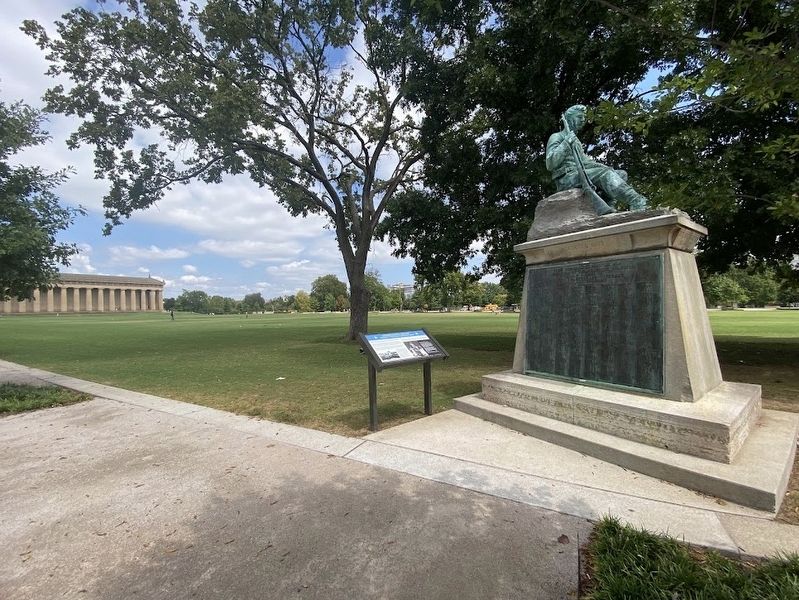
Photographed by Darren Jefferson Clay, September 2, 2024
2. Understanding the Past Marker
The Lost Cause
An ideology and social movement originated by Edward Pollard in 1866 that created a version of the Civil War, slavery, and Klan violence more favorable to the south. Adherents argued that factors other than preserving slavery led to secession, slavery was beneficial to whites and blacks and that emancipation was a mistake. They claimed that the south lost the war due to the north's overwhelming industrial strength rather than poor Confederate leadership and losses on the battlefield and that the Ku Klux Klan saved the south from the dangers of racial equality.
(sidebar)
George Julian Zolnay (1863-1949)
In 1902, the bivouac contracted George Julian Zolnay who was often referred to as the "sculptor of the Confederacy." Admired for his work on Confederate monuments across the south, Zolnay also sculpted the Sam Davis monument (1909) located on the Tennessee State Capitol grounds and assisted with ornamentation for the Parthenon recreated in Centennial Park for the Tennessee Centennial Exposition (1897).
In 1923, the Kiwanis Club of Nashville dedicated Zolnay's Gold Star Monument to World War 1 Veterans. Also located in Centennial Park, the monument features a bronze sculpture of a woman partially cradling the body of a soldier. In contrast to Zolnay's steadfast Confederate soldiers, the figures capture the horrors of war and the fragility of human life.
"Tribute Paid Rank and File: Monument to Confederate Private is Unveiled," The Nashville American, June 29, 1909
The Tennessee Heritage Protection Act, Tenn Code Ann. section 4-1-412, "prohibits the removal, relocation, or renaming of a memorial that is or is located on, public property."
Topics. This historical marker is listed in these topic lists: Arts, Letters, Music • War, US Civil. A significant historical month for this entry is June 1904.
Location. 36° 8.873′ N, 86° 48.758′ W. Marker is in Nashville, Tennessee, in Davidson County. It is in Midtown. It is on 27th Avenue North north of Poston Avenue, on the right when traveling north. Touch for map. Marker is at or near this postal address: 211 27th Ave N, Nashville TN 37203, United States of America. Touch for directions.

Regionally, this marker is in Middle Tennessee. It is also in the American South and specifically in the Upper South. Globally, it is in North America, the Western Hemisphere, the Western World, and the Anglosphere. Historically, it finds itself in what was once the territory of the Mississippian Culture, one of the Confederate States of America, and the Antebellum South.
Other nearby markers. At least 8 other markers are within walking distance of this marker: Confederate Private Monument (here, next to this marker); United Nations Visit To Nashville (about 400 feet away, measured in a direct line); John W. Thomas (about 400 feet away); Lieutenant James Simmons Timothy (about 500 feet away); Lois Marie DeBerry (about 500 feet away); Beth Halteman Harwell (about 500 feet away); Jane Greenebaum Eskind (about 600 feet away); Tennessee Woman Suffrage Monument (about 600 feet away). Touch for a list and map of all markers in Nashville.
Another marker is no longer nearby. Battle of Nashville (was about 500 feet away but has been confirmed missing).
Credits. This page was last revised on September 9, 2024. It was originally submitted on September 9, 2024, by Darren Jefferson Clay of Duluth, Georgia. This page has been viewed 353 times since then and 47 times this year. Photos: 1, 2. submitted on September 9, 2024, by Darren Jefferson Clay of Duluth, Georgia. • Bernard Fisher was the editor who published this page.
