Fairbanks in Fairbanks North Star Borough, Alaska — Northwest (North America)
Clay Street Cemetery Pioneers of Alaska

Photographed by William Fischer, Jr., August 17, 2024
1. Robert Joseph "Bob" Geis Marker
Robert Joseph "Bob" Geis
Born June 1859 Long Island, New York
Died 13 July 1916 Fairbanks
Locomotive Engineer / City Councilman
Husband of Minnie Dahl
Burial location: Eagles SE 1046.
[Other Alaskan pioneers are included below]
Erected by Clay Street Cemetery Commission and Others.
Topics. This historical marker is listed in these topic lists: Cemeteries & Burial Sites • Fraternal or Sororal Organizations • Settlements & Settlers. A significant historical month for this entry is June 1859.
Location. 64° 50.48′ N, 147° 42.356′ W. Marker is in Fairbanks, Alaska, in Fairbanks North Star Borough. It can be reached from Clay Street. The location listed are generic geocoords for the Clay Street entrance. Touch for map. Marker is at or near this postal address: 770 Clay Street, Fairbanks AK 99701, United States of America. Touch for directions.

Regionally, this marker is in the Alaska Railroad Corridor, in the Athabascan Region, and in Interior Alaska. It is also on the American Pacific Coast. Globally, it is in North America, on the Pacific Rim, in the Western Hemisphere,
this page online
Other nearby markers. At least 8 other markers are within walking distance of this marker: Clay Street Cemetery (here, next to this marker); Clay Street Cemetery Gateway (here, next to this marker); a different marker also named Clay Street Cemetery (within shouting distance of this marker); The White Crosses (within shouting distance of this marker); Peter W. Conley (within shouting distance of this marker); Col. James Hiram McLaughlin (within shouting distance of this marker); Robert W. Tompkins (within shouting distance of this marker); Mary Pedro (within shouting distance of this marker). Touch for a list and map of all markers in Fairbanks.
More about this marker. Pioneers of Alaska are located throughout the cemetery, and include many who were not members of the 1907 fraternal organization of the same name which originally only allowed membership for white men who arrived in Alaska before January 1, 1900 (later changed to include all who had lived in Alaska for a minimum of 20 years). Other pioneers can be

Photographed by William Fischer, Jr., August 17, 2024
2. Clay Street Cemetery View
Regarding Clay Street Cemetery Pioneers of Alaska. Excerpt from the Pioneers of Alaska website:
History is often considered to be a collection of dates, old photographs, buildings and events. However, dates and events fade in memory, photographs are lost, and buildings burn down or are torn down. There is another type of history which lives forever. It is the record of the deeds of men. Their dreams, the life they followed, their accomplishments, their families. On the vast ocean of time, history that is made of dates, events, photos, buildings is a ripple on the water but history based on the people whose hearts and blood and spirit of adventure who settled this Alaska is a great tsunami of the sea of years. It is to these people that the Pioneers of Alaska Fraternity is dedicated. The organization seeks to preserve the names and memory of those who have gone before and have crossed the great divide and those who are still on the trail and are making a difference in our State. People are the history of our Great Land.
The Pioneers of Alaska was and still is an organization formed from the
Photographed by William Fischer, Jr., August 17, 2024
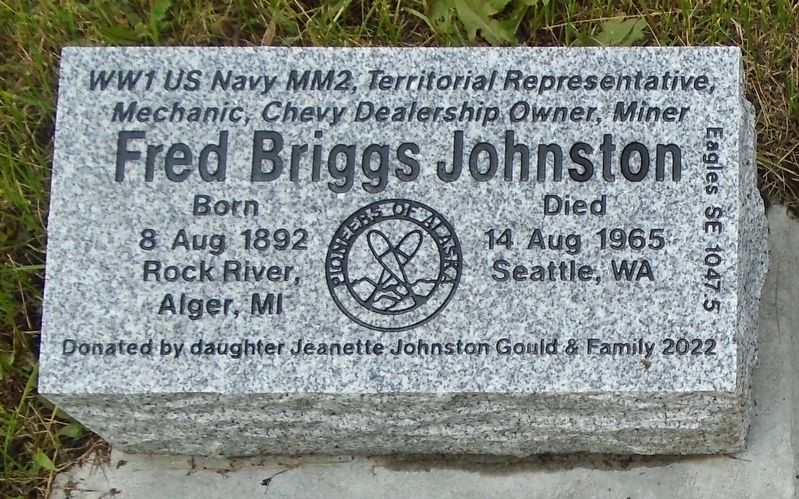
3. Fred Briggs Johnston Marker
Died 14 Aug 1965 Seattle, WA
WW1 US Navy MM2, Territorial Representative,
Mechanic, Chevy Dealership Owner, Miner
Burial location: Eagles SE 1047.5
The Pioneers of Alaska was not the first of its kind in the North. Several organizations formed in the early Territorial days to meet the civic and social needs of the growing population. At that time there are a notable lack of government, both Territorial and local and an absence of a viable court system. The affairs of people and their community were handled by themselves, often through miners meetings. These organizations provided physical help--food, shelter, medical, and other assistance, while also promoting civic order--government, courts, and education.
Early organizations included the ‘Sons of the Northwest’, founded in Sitka in 1887; ’Alaska Pioneers’, founded in Kodiak in 1887; ‘87 Pioneers Association’ founded in Juneau in 1887; and ‘Yukon Order of the Pioneers’,
Photographed by William Fischer, Jr., August 17, 2024
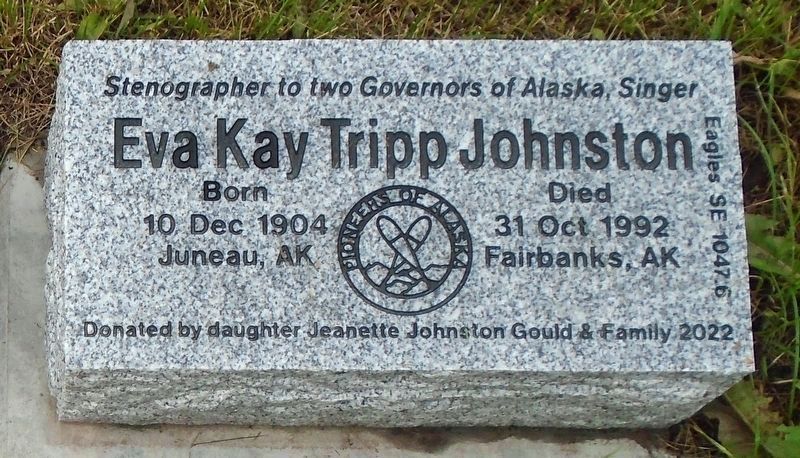
4. Eva Kay Tripp Johnston Marker
Died 31 Oct 1992 Fairbanks, AK
Stenographer to two Governors of Alaska, Singer
Burial location: Eagles SE 1047.6
Photographed by William Fischer, Jr., August 17, 2024
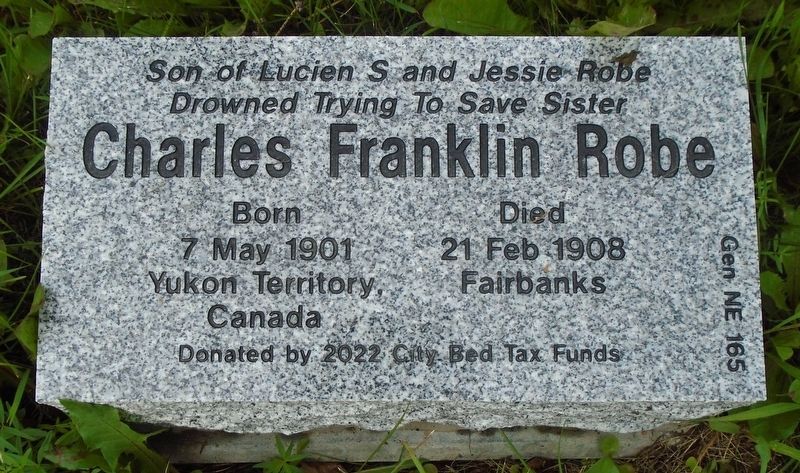
5. Charles Franklin Robe Marker
Died 21 Feb 1908 Fairbanks
Son of Lucien S and Jessie Robe
Drowned Trying To Save Sister
Burial location: Gen NE 165

Photographed by William Fischer, Jr., August 17, 2024
6. Michael Hallisey Marker
Died 29 Jan 1932 Fairbanks
Alaska Railroad employee; Roll #285 Nenana Igloo #17
Burial location: Catholic SE 1442

Photographed by William Fischer, Jr., August 17, 2024
7. Florence Hamburg Sullivan Marker
Died 27 Jan 1924 Fairbanks
Road House Operator; Women's Igloo #3 roll #95C
Burial location: Catholic SE 1364

Photographed by William Fischer, Jr., August 17, 2024
8. Giovanni "John" Clignoni Marker
Died 6 July 1927 Fairbanks
Miner & Blacksmith
Burial location: Catholic SE 1370

Photographed by William Fischer, Jr., August 17, 2024
9. Evo Leenknecht Marker
West Flanders, Belgium
Died 6 Aug 1926 Fairbanks
Brought Herd of Cattle to Dawson in 1898
Burial location: Catholic SE 1355
Photographed by William Fischer, Jr., August 17, 2024
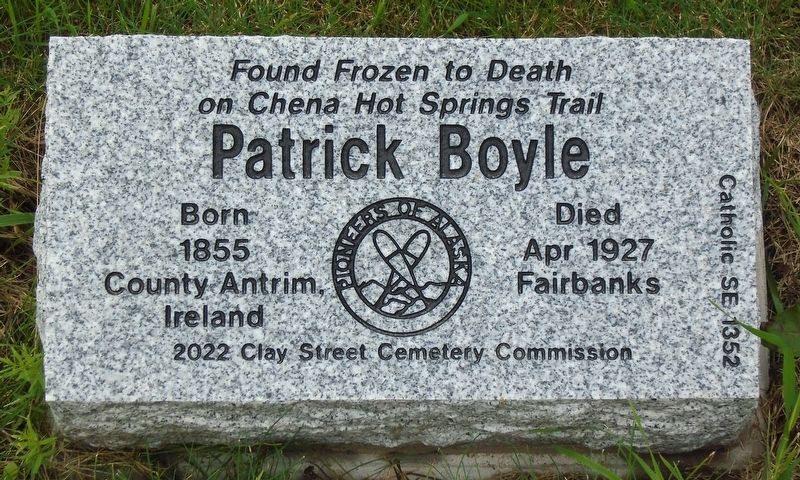
10. Patrick Boyle Marker
Died April 1927 Fairbanks
Found Frozen to Death on Chena Hot Springs Trail
Burial location: Catholic SE 1352

Photographed by William Fischer, Jr., August 17, 2024
11. William Joseph Bittner Marker
Died 16 Nov 1924 Fairbanks
Owner Bittner Soda Works/Harmonie Society Member
Husband of Ida Haltzmuller Bittner
Burial location: Catholic SE 1324

Photographed by William Fischer, Jr., August 17, 2024
12. Dyer L. Squier Marker
Died 23 July 1923 Murdered near Steel Creek
US Army Veteran
Son of Sylvenus King & Mary Ann Harrington Squier
Burial location: Gen NE 35
Credits. This page was last revised on May 22, 2025. It was originally submitted on September 9, 2024, by William Fischer, Jr. of Reynoldsburg, Ohio. This page has been viewed 205 times since then and 22 times this year. Photos: 1. submitted on September 9, 2024, by William Fischer, Jr. of Reynoldsburg, Ohio. 2. submitted on September 10, 2024, by William Fischer, Jr. of Reynoldsburg, Ohio. 3. submitted on September 9, 2024, by William Fischer, Jr. of Reynoldsburg, Ohio. 4. submitted on September 10, 2024, by William Fischer, Jr. of Reynoldsburg, Ohio. 5. submitted on September 9, 2024, by William Fischer, Jr. of Reynoldsburg, Ohio. 6, 7, 8, 9, 10, 11, 12. submitted on September 10, 2024, by William Fischer, Jr. of Reynoldsburg, Ohio.
