Front Royal in Warren County, Virginia — The American South (Mid-Atlantic)
The Bridges
“Torch the Bridges!”
| — | Battle of Front Royal - May 23, 1862 | — |
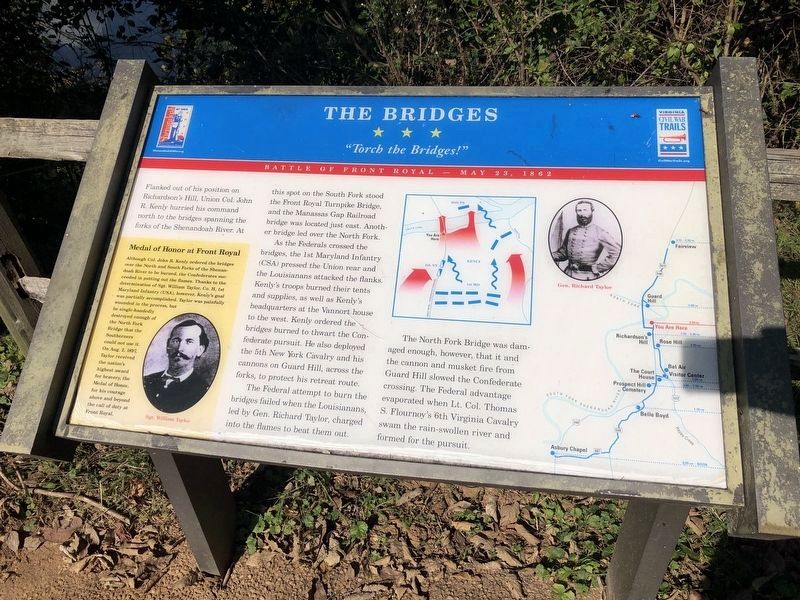
Flanked out of his position on Richardson's Hill, Union Col. John R. Kenly hurried his command north to the bridges spanning the forks of the Shenandoah River. At this spot on the South Fork stood the Front Royal Turnpike Bridge, and the Manassas Gap Railroad bridge was located just east. Another bridge led over the North Fork.
As the Federals crossed the bridges, the 1st Maryland Infantry (CSA) pressed the Union rear and the Louisianans attacked the flanks. Kenly's troops burned their tents and supplies, as well as Kenly's headquarters at the Vannort house to the west. Kenly ordered the bridges burned to thwart the Confederate pursuit. He also deployed the 5th New York Cavalry and his cannons on Guard Hill, across the forks, to protect his retreat route.
The Federal attempt to burn the bridges failed when the Louisianans, led by Gen. Richard Taylor, charged into the flames to beat them out.
The North Fork Bridge was damaged enough, however, that it and the cannon and musket fire from Guard Hill slowed the Confederate crossing. The Federal advantage evaporated when Lt. Col. Thomas S. Flournoy's 6th Virginia Cavalry
this page online
(sidebar)
Medal of Honor at Front Royal
Although Col. John R. Kenly ordered the bridges over the North and South Forks of the Shenandoah River to be burned, the Confederates succeeded in putting out the flames. Thanks to the determination of Sgt. William Taylor, Co. H, 1st Maryland Infantry (USA), however, Kenly's goal was partially accomplished. Taylor was painfully wounded in the process, but he single-handedly destroyed enough of the North Fork Bridge that the Southerners could not use it. On Aug. 2, 1897, Taylor received the nation's highest award for bravery, the Medal of Honor, for his courage above and beyond the call of duty at Front Royal.
(captions)
Sgt. William Taylor
Gen. Richard Taylor
Erected by Virginia Civil War Trails.
Topics and series. This historical marker is listed in these topic lists: Bridges & Viaducts • War, US Civil. In addition, it is included in the Virginia Civil War Trails series list. A significant historical date for this entry is May 23, 1862.
Location. This marker has been replaced by another marker nearby. It was located near 38° 56.535′ N, 78° 11.659′ W.

Photographed by Craig Swain, October 7, 2007
2. The Bridges Marker
This is a previous iteration of the marker.

Regionally, this marker was in the Washington Metropolitan Area and in the Shenandoah Valley. It was also in the American South, specifically in the Upper South, and in the Mid-Atlantic. Globally, it was in North America, the Western Hemisphere, the Western World, and the Anglosphere. Historically, it found itself in what was once the territory of the Mississippian Culture, one of the original Thirteen Colonies, one of the Confederate States of America, and the Antebellum South.
Other nearby markers. At least 8 other markers are within 2 miles of this location, measured as the crow flies: Race For The River (here, next to this marker); a different marker also named Richardson's Hill (approx. 0.4 miles away);
Other markers no longer nearby. Richardson’s Hill (was approx. 0.4 miles away but has been replaced with another marker now near it); Execution of Mosby’s Rangers (was approx. 0.4 miles away but has been permanently removed); Guard Hill (was approx. half a mile away but has been replaced with another marker now near it).
More about this marker. On the right is a map detailing the Battle of Front Royal with Civil War Trails sites linked to the battle time line. In the upper center, a map illustrates the tactical maneuvers described on the marker.
Regarding The Bridges. This marker is one of several from a driving tour of the Front Royal Battlefield. The markers are listed in sequence on the Battle of Front Royal Virtual Tour by Markers link below.
Related marker.

Photographed by Bill Coughlin, April 26, 2007
4. Marker in Front Royal
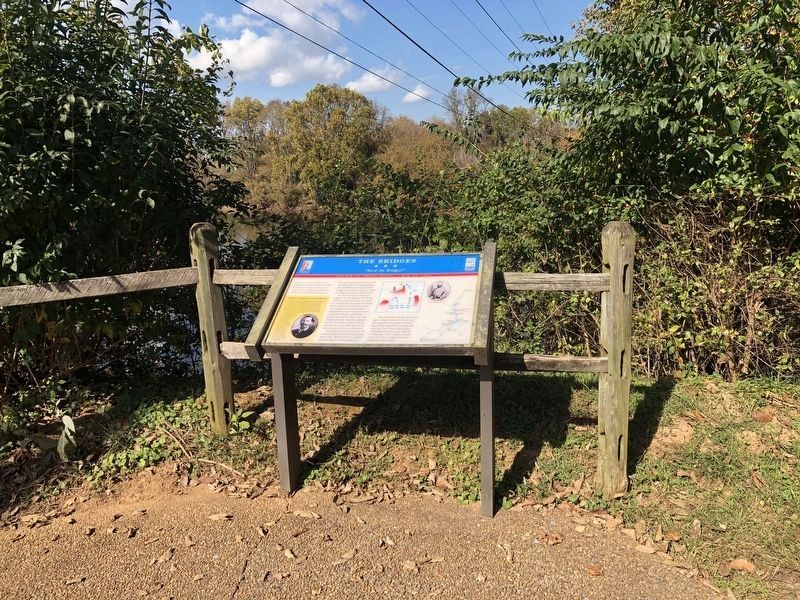
The South Fork of the Shenandoah River can be seen here behind the marker.
Also see . . . Battle of Front Royal. National Parks Service summary of the battle. The action discussed on the marker is related to phase 5 of the battle summary. (Submitted on October 14, 2007, by Craig Swain of Leesburg, Virginia.)

Photographed by Craig Swain, October 7, 2007
5. Dead End of Royal Avenue
At the time of the battle, the south end of the bridge stood where the marker stands today.

Photographed by Craig Swain, October 7, 2007
6. Ruins of the Old Bridge
The old pilings are clearly visible, and the opposite shore shows traces of the old roadbed.

Photographed by Craig Swain, October 7, 2007
7. South Fork Railroad Bridge
The railroad bridge was replaced by a newer structure over time. The ruins of the Pike bridge are visible in the foreground. This photo was taken from the modern US Highway 340/522 bridge.

Photographed by Craig Swain, October 7, 2007
8. North Fork Bridge Site
The bridge site is now a boat landing on the north shore of the river. An old dam stands just below the modern highway bridge. This was the location of Sgt. William Taylor action that lead to the award of the Medal of Honor.
Credits. This page was last revised on September 15, 2024. It was originally submitted on October 14, 2007, by Craig Swain of Leesburg, Virginia. This page has been viewed 3,466 times since then and 87 times this year. Last updated on September 15, 2024, by Carl Gordon Moore Jr. of North East, Maryland. Photos: 1. submitted on October 24, 2020, by Devry Becker Jones of Washington, District of Columbia. 2. submitted on October 14, 2007, by Craig Swain of Leesburg, Virginia. 3. submitted on October 24, 2020, by Devry Becker Jones of Washington, District of Columbia. 4. submitted on May 12, 2011, by Bill Coughlin of Woodland Park, New Jersey. 5, 6, 7, 8. submitted on October 14, 2007, by Craig Swain of Leesburg, Virginia. • Bernard Fisher was the editor who published this page.
