Marbach am Neckar in Ludwigsburg, Baden-Württemberg, Germany — Central Europe
Tobias Mayer
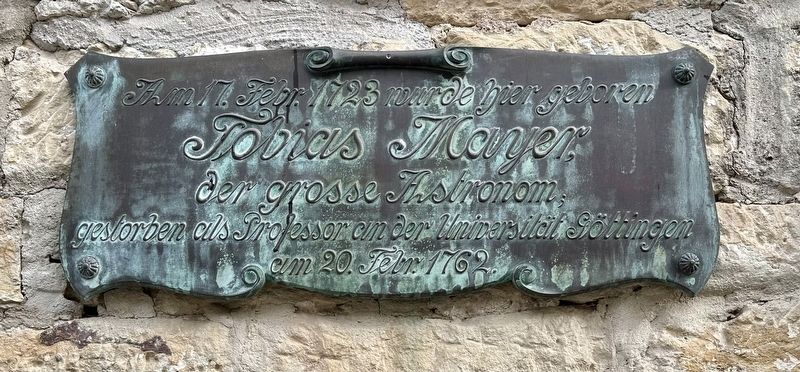
Photographed by Andrew Ruppenstein, September 14, 2024
1. Tobias Mayer Marker

Tobias Mayer, der Grosse Astronom; gestorben als Professor an der Universität Göttingen am 20. Februar 1762.
Topics. This historical marker is listed in this topic list: Science & Medicine. A significant historical date for this entry is February 20, 1723.
Location. 48° 56.429′ N, 9° 15.529′ E. Marker is in Marbach am Neckar, Baden-Württemberg, in Ludwigsburg. It is on Torgasse. Touch for map. Marker is at or near this postal address: Torgasse 13, Marbach am Neckar BW 71, Germany. Touch for directions.

Regionally, this marker is in German Swabia. Globally, it is in Europe, the European Union, Atlantic Europe, Central Europe, the Schengen Area, Western Europe, and the Western World. Historically, it finds itself in what was once the Roman Empire, the Holy Roman Empire, and the former West Germany.
Other nearby markers. At least 8 other markers are within 16 kilometers of this marker, measured as the crow flies: A different
this page online
Also see . . .
1. Tobias Mayer (Wikipedia). Overview: Tobias Mayer (17 February 1723 – 20 February 1762) was a German astronomer famous for his studies of the Moon. He was born at Marbach, in Württemberg, and brought up at Esslingen in poor circumstances. A self-taught mathematician, he earned a living by teaching mathematics while still a youth. He had already published two original geometrical works when, in 1746, he entered J. B. Homann's cartographic establishment at Nuremberg. Here he introduced many improvements in mapmaking, and gained a scientific reputation which
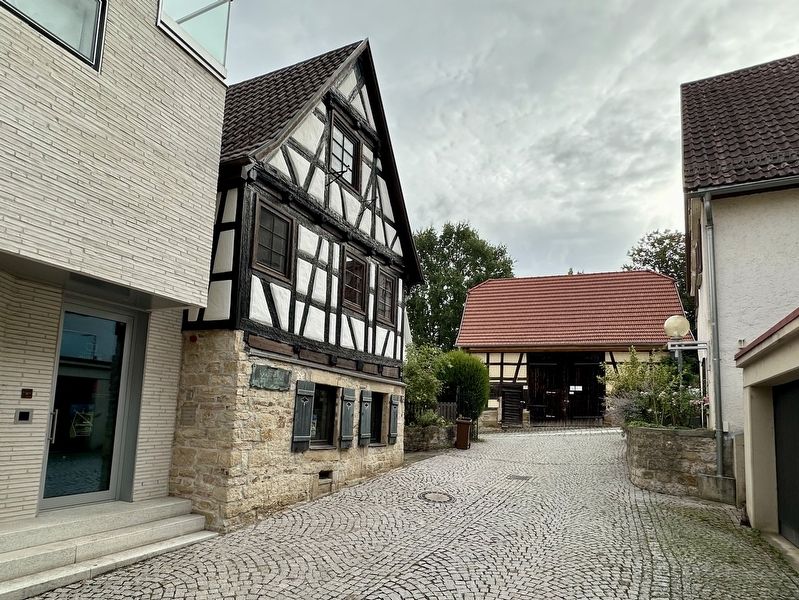
Photographed by Andrew Ruppenstein, September 14, 2024
2. Tobias Mayer place of birth and marker
2. Die wichtigsten Werke des Tobias Mayer (YouTube, 2:51). A German-language slideshow of Mayer’s most important works, published by the Tobias-Mayer-Museum (a small portion of which is visible in Photo 2). (Submitted on September 15, 2024.)
Additional keywords. Astronomy
Credits. This page was last revised on September 15, 2024. It was originally submitted on September 15, 2024, by Andrew Ruppenstein of Lamorinda, California. This page has been viewed 154 times since then and 47 times this year. Photos: 1, 2. submitted on September 15, 2024, by Andrew Ruppenstein of Lamorinda, California.
