Comanche in Comanche County, Texas — The American South (West South Central)
J.C. Dingwall Overpass
Photographed by James Hulse, September 12, 2024
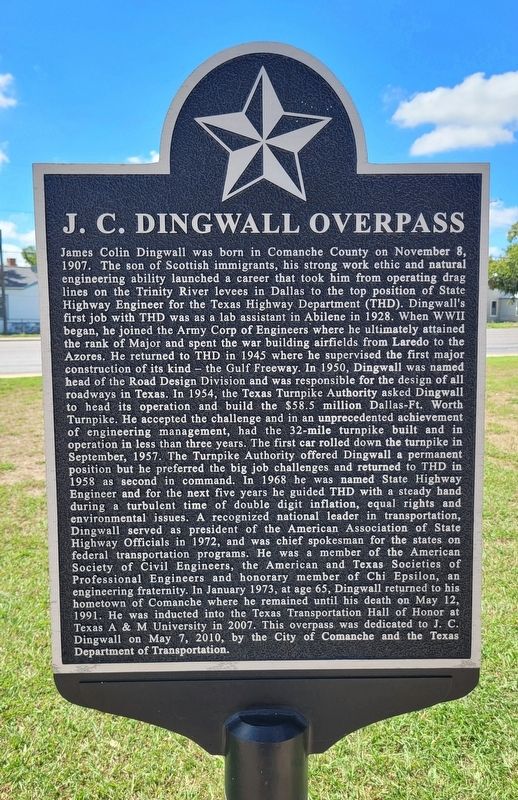
1. J.C. Dingwall Overpass Marker
Inscription.
James Colin Dingwall was born in Comanche County on November 8, 1907. The son of Scottish immigrants, his strong work ethic and natural engineering ability launched a career that took him from operating drag lines on the Trinity River levees in Dallas to the top position of State Highway Engineer for the Texas Highway Department (THD). Dingwall's first job with THD was as a lab assistant in Abilene in 1928. When WWII began, he joined the Army Corp of Engineers where he ultimately attained the rank of Major and spent the war building airfields from Laredo to the Azores. He returned to THD in 1945 where he supervised the first major construction of its kind the Gulf Freeway. In 1950, Dingwall was named head of the Road Design Division and was responsible for the design of all roadways in Texas. In 1954, the Texas Turnpike Authority asked Dingwall to head its operation and build the $58.5 million Dallas-Ft. Worth Turnpike. He accepted the challenge and in an unprecedented achievement of engineering management, had the 32-mile turnpike built and in operation in less than three years. The first car rolled down the turnpike in September, 1957. The Turnpike Authority offered Dingwall a permanent position but he preferred the big job challenges and returned to THD in 1958 as second in command. In 1968 he was named State Highway Engineer and for the next five years he guided THD with a steady hand during a turbulent time of double digit inflation, equal rights and environmental issues. A recognized national leader in transportation, Dingwall served as president of the American Association of State Highway Officials in 1972, and was chief spokesman for the states on federal transportation programs. He was a member of the American Society of Civil Engineers, the American and Texas Societies of Professional Engineers
Click or scan to see this page online
and honorary member of Chi Epsilon, an engineering fraternity. In January 1973, at age 65, Dingwall returned to his hometown of Comanche where he remained until his death on May 12, 1991. He was inducted into the Texas Transportation Hall of Honor at Texas A & M University in 2007. This overpass was dedicated to J. C. Dingwall on May 7, 2010, by the City of Comanche and the Texas Department of Transportation.
Topics. This historical marker is listed in this topic list: Roads & Vehicles. A significant historical month for this entry is January 1973.
Location. 31° 53.857′ N, 98° 36.847′ W. Marker is in Comanche, Texas, in Comanche County. It is at the intersection of West Central Avenue (U.S. 377) and State Highway 36 on West Central Avenue. The marker is located at the corner of the intersection. Touch for map. Marker is at or near this postal address: 901 W Central Ave, Comanche TX 76442, United States of America. Touch for directions.
Regionally, this marker is in Big Country. Globally, it is in North America, a Gulf of Mexico state, the Western Hemisphere, the Western World, and the Anglosphere. Historically, it finds itself in what
Photographed by James Hulse, September 12, 2024
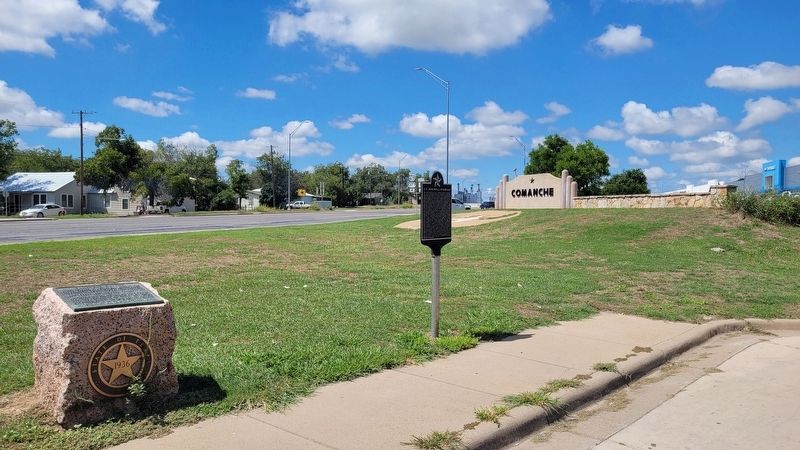
2. The view of the J.C. Dingwall Overpass Marker along the highway before the overpass
was once New Spain, the Comanchería, the Republic of Texas, and one of the Confederate States of America.
Credits. This page was last revised on September 18, 2024. It was originally submitted on September 18, 2024, by James Hulse of Medina, Texas. This page has been viewed 543 times since then and 57 times this year. Photos:1, 2, 3, 4. submitted on September 18, 2024, by James Hulse of Medina, Texas.