Tinbridge Hill in Lynchburg, Virginia — The American South (Mid-Atlantic)
Gravemarkers in the Old City Cemetery
Lynchburg, Virginia
Photographed by Bernard Fisher, May 26, 2014
1. Gravemarkers in the Old City Cemetery Marker
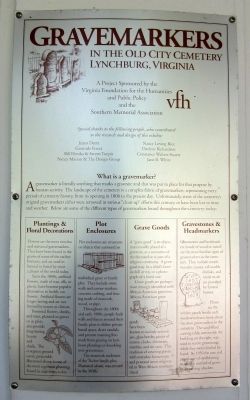
A Project Sponsored by the Virginia Foundation for the Humanities and Public Policy and the Southern Memorial Association
Special thanks to the following people, who contributed to the research and design of this exhibit: James Deetz • Gertrude Fraser • Bill Henika & Steven Turpin • Nancy Marion & The Design Group • Nancy Loving Rice • Darlene Richardson • Constance Walters Swartz • Jane B. White
What is a gravemarker?
A gravemarker is literally anything that marks a gravesite and that was put in place for that purpose by human activity. The landscape of the cemetery is a complex fabric of gravemarkers, representing every period of cemetery history, from its opening in 1806 to the present day. Unfortunately, most of the cemetery’s original gravemarkers either were removed in various “clean-up” efforts this century, or have been lost to time and weather. Below are some of the different types of gravemarkers found throughout the cemetery today:
Plantings & Floral Decorations
Flowers are the most timeless and universal gravemarkers. They have been found in the graves of some of the earliest humans, and are used in funeral or burial by most cultures of the world today.
Since the 1880s, artificial flowers, made of wax, silk, or plastic, have become popular alternatives to freshly cut flowers. Artificial flowers are longer-lasting and are not limited by season or climate.
Perennial flowers, shrubs, and trees, planted on graves or in plots, also provide long-lasting beauty and shade. The evergreen ground cover, periwinkle, illustrated above, is one of the most common plantings found in the cemetery today.
Plot Enclosures
Plot enclosures are structures or objects that surround an individual grave or family plot. They include stone walls and corner-markers, concrete curbing, and fencing
this page online
Throughout the 1800s and early 1900s, people built walls and fences around their family plots to define private burial space, deter vandals, and prevent roaming livestock from grazing on heirloom plantings or knocking over gravestones.
The ironwork enclosure of the Tucker family plot, illustrated above, was erected in the 1830s.
Grave Goods
A “grave good” is an object intentionally placed at a gravesite, as a memento of the deceased or as part of a religious ceremony. A grave good may be a child’s favorite doll or toy, or a photograph of a loved one.
Grave goods are perhaps most strongly identified with African-American gravesites. African-American grave goods have been known to include ceramic jars, glass bottles, pieces of mirror, clocks, silverware, marbles, and tin cans. This tradition of covering graves with everyday housewares and personal originated in West African mortuary ritual.
Gravestones & Headmarkers
Gravestones and headmarkers (made of wood or metal) are the most familiar types of gravemarkers in the cemetery. They include simple wooden crosses, tall marble obelisks,
Photographed by Bernard Fisher
2. Hearse House and Caretakers' Museum
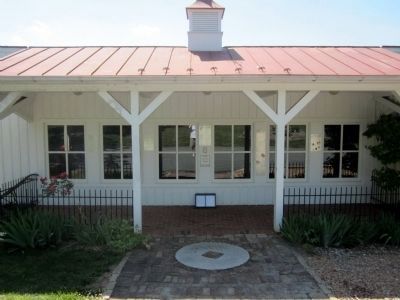
Please see the exhibit panels beside each window to learn more about the stone gravemarkers in the cemetery. The sand-filled carving table, seen inside the building on the right, was used to secure gravestones while they were chiseled by hand. By 1950 the ease and popularity of sandblasting made this method of gravestone carving obsolete.
Erected by Southern Memorial Association.
Topics. This historical marker is listed in these topic lists: Cemeteries & Burial Sites • Industry & Commerce. A significant historical year for this entry is 1806.
Location. 37° 24.924′ N, 79° 9.507′ W. Marker is in Lynchburg, Virginia. It is in Tinbridge Hill. It can be reached from Taylor Street near 4th Street. Touch for map. Marker is at or near this postal address: 401 Taylor Street, Lynchburg VA 24501, United States of America. Touch for directions.

Regionally, this marker is in Central Virginia. It is also in the American South and specifically in the Upper South. Globally, it is in North America, the Western Hemisphere, the Western World, and the Anglosphere. Historically, it
Photographed by Bernard Fisher, May 26, 2014
3. Gravestone Style & Material
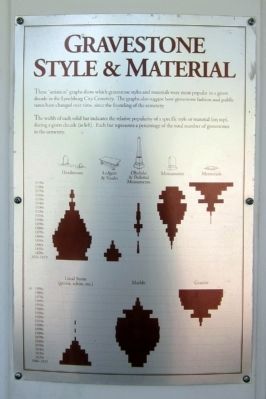
These “seriation” graphs show which gravestone styles and materials were most popular in a given decade in the Lynchburg City Cemetery. The graphs also suggest how gravestone fashion and public tastes have changed over time, since the founding of the cemetery.
The width of each solid bar indicates the relative popularity of a specific style or material (on top), during a given decade (at left). Each bar represents a percentage of the total number of gravestones in the cemetery.
The width of each solid bar indicates the relative popularity of a specific style or material (on top), during a given decade (at left). Each bar represents a percentage of the total number of gravestones in the cemetery.
Other nearby markers. At least 8 other markers are within walking distance of this marker: Cemetery Caretakers (here, next to this marker); Gravestone Carvers in the Old City Cemetery (here, next to this marker); African Burial Customs (a few steps from this marker); Gravestone Style & Material (a few steps from this marker); Julia Whitely Branch Family (a few steps from this marker); Julia Whiteley Branch (a few steps from this marker); Hearse House & Caretakers' Museum (within shouting distance of this marker); Old City Cemetery (within shouting distance of this marker). Touch for a list and map of all markers in Lynchburg.
Also see . . . Hearse House and Caretakers' Museum at the Old City Cemetery. The oldest public cemetery in Virginia still in use today - Central Virginia's most unique public garden. (Submitted on May 30, 2014.)
Credits. This page was last revised on September 19, 2024. It was originally submitted on May 30, 2014, by Bernard Fisher of Richmond, Virginia. This page has been viewed 819 times since then and 13 times this year. Last updated on September 18, 2024, by Carl Gordon Moore Jr. of North East, Maryland. Photos: 1, 2, 3. submitted on May 30, 2014, by Bernard Fisher of Richmond, Virginia.
