Downtown in Fairbanks in Fairbanks North Star Borough, Alaska — Northwest (North America)
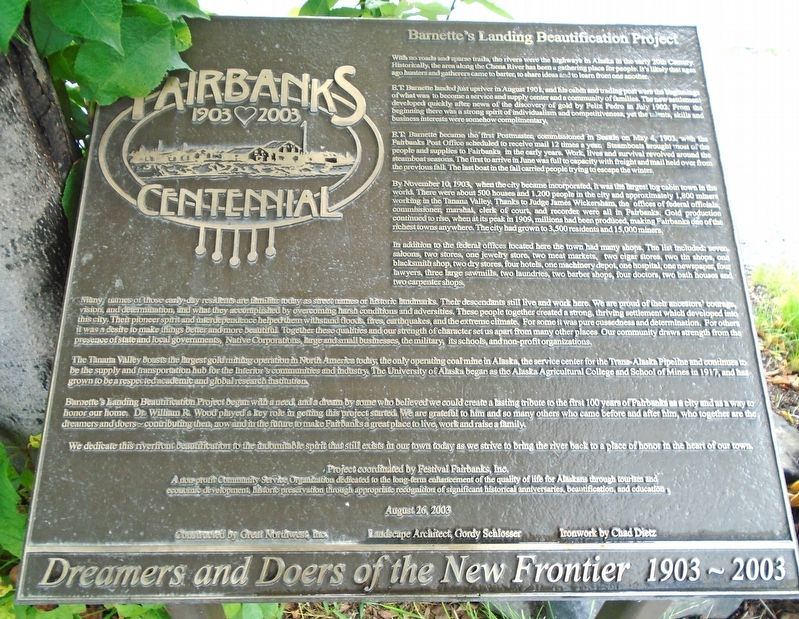
Barnette's Landing Beautification Project
1903 • Fairbanks Centennial • 2003
| — | Dreamers and Doers of the New Frontier 1903 ~ 2003 | — |
Photographed by William Fischer, Jr., August 17, 2024
1. Barnette's Landing Beautification Project Marker
With no roads and sparse trails, the rivers were the highways in Alaska in the early 20th Century. Historically, the area along the Chena River has been a gathering place for people. It's likely that ages ago hunters and gatherers came to barter, to share ideas and to learn from one another.
E.T. Barnette landed just upriver in August 1901, and his cabin and trading post were the beginnings of what was to become a service and supply center and a community of families. The new settlement developed quickly after news of the discovery of gold by Felix Pedro in July 1902. From the beginning there was a strong spirit of individualism and competitiveness, yet the talents, skills and business interests were somehow complimentary.
E.T. Barnette became the first Postmaster, commissioned in Seattle on May 4, 1903, with the Fairbanks Post Office scheduled to receive mail 12 times a year. Steamboats brought most of the people and supplies to Fairbanks in the early years. Work, lives and survival revolved around the steamboat seasons. The first to arrive in June was full to capacity with freight and mail held over from the previous
this page online
By November 10, 1903, when the city became incorporated, it was the largest log cabin town in the world. There were about 500 houses and 1,200 people in the city and approximately 1,800 miners working in the Tanana Valley. Thanks to Judge James Wickersham, the offices of federal officials, commissioner, marshal, clerk of court, and recorder were all in Fairbanks. Gold production continued to rise, when at its peak in 1909, millions had been produced, making Fairbanks one of the richest towns anywhere. The city had grown to 3,500 residents and 15,000 miners.
In addition to the federal offices located here the town had many shops. The list included: seven saloons, two stores, one jewelry store, two meat markets, two cigar stores, two tin shops, one blacksmith shop, two dry [goods] stores, four hotels, one machinery depot, one hospital, one newspaper, four lawyers, three large sawmills, two laundries, two barber shops, four doctors, two bath houses and two carpenter shops.
Many names of those early-day residents are familiar today as street names or historic
Photographed by William Fischer, Jr., August 17, 2024
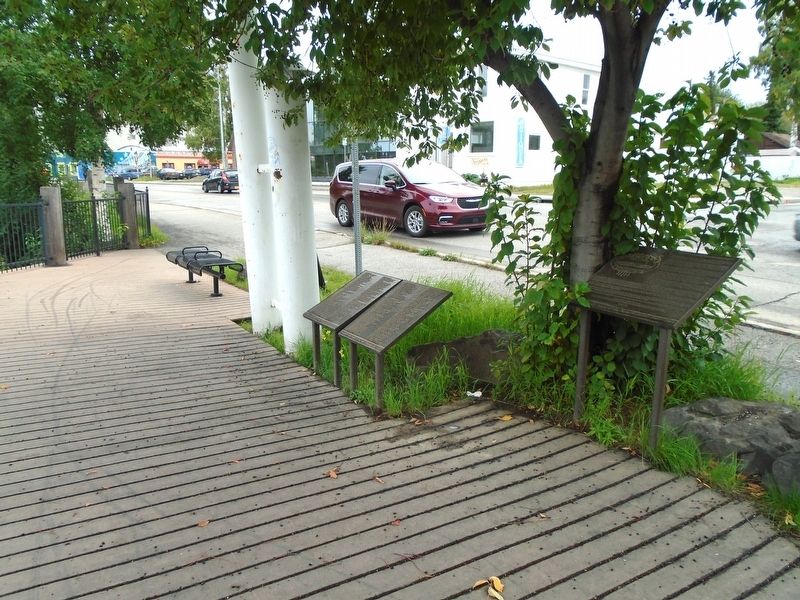
2. Barnette's Landing Beautification Project Markers
The Tanana Valley boasts the largest gold mining operation in North America today, the only operating coal mine in Alaska, the service center for the Trans-Alaska Pipeline and continues to be the supply and transportation hub for the Interior's communities and industry. The University of Alaska began as the Alaska Agricultural College and School
Photographed by William Fischer, Jr., August 17, 2024
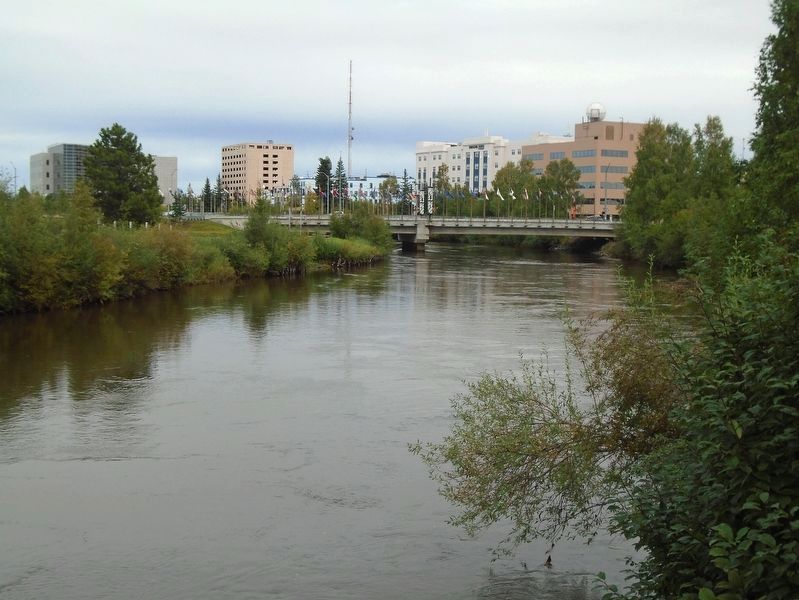
3. Chena River View
Burnette's Landing Beautification Project began with a need, and a dream by some who believed we could create a listing tribute to the first 100 years of Fairbanks as a city and as a way to honor our home. Dr. William R. Wood played a key role in getting this project started. We are grateful to him and so many others who came before and after him, who together are the dreamers and doers—contributing then, now and in the future to make Fairbanks a great place to live, work and raise a family.
We dedicate this riverfront beautification to the indomitable spirit that still exists in our town today as we strive to bring the river back to a place of honor in the heart of our town.
A non-profit Community Service Organization dedicated to the long-term enhancement of the quality of life for Alaskans through tourism and economic development, historic preservation through appropriate recognition of significant historical anniversaries, beautification, and education.
[Dedicated] August 26, 2003
Constructed by Great Northwest, Inc.
Landscape Architect, Gordy Schlosser
Ironwork by Chad Dietz
Erected 2003 by Festival Fairbanks, Inc.
Topics. This historical marker is listed in these topic lists: Indigenous Peoples and Communities • Industry & Commerce • Settlements & Settlers. A significant historical month for this entry is August 1903.
Location. 64° 50.687′ N, 147° 43.647′ W. Marker is in Fairbanks, Alaska, in Fairbanks North Star Borough. It is in Downtown. It is at the intersection of 1st Avenue and Cowles Street, on the right when traveling west on 1st Avenue. Touch for map. Marker is at or near this postal address: 901 1st Avenue, Fairbanks AK 99701, United States of America. Touch for directions.

Regionally, this marker is in the Alaska Railroad Corridor, in the Athabascan Region, and in Interior Alaska. It is also on the American Pacific Coast. Globally, it is in North America, on the Pacific Rim, in the Western Hemisphere, in the Western World, and in the Anglosphere. Historically, it finds itself in what was once the Russian Empire.
Other nearby markers. At least 8 other markers are within walking distance of this marker: George C. Thomas Memorial Library (within shouting distance of this marker); Historic Bath House and Oddfellows Hall (1907) (within shouting distance of this marker); Corporate Mining (about 600 feet away, measured in a direct line); The Episcopal Church in Fairbanks: St. Matthews (about 600 feet away); Fairbanks Area Rotary Projects "Service Above Self" (about 700 feet away); Mary Lee Davis House/Alaska Heritage House (1916) (about 800 feet away); The Falcon Joslin House (1904) (approx. 0.2 miles away); The Early Gold Rush (approx. 0.2 miles away). Touch for a list and map of all markers in Fairbanks.
Credits. This page was last revised on September 19, 2024. It was originally submitted on September 19, 2024, by William Fischer, Jr. of Reynoldsburg, Ohio. This page has been viewed 165 times since then and 27 times this year. Photos: 1, 2, 3. submitted on September 19, 2024, by William Fischer, Jr. of Reynoldsburg, Ohio.
