Oakville in Halton Region, Ontario — Central Canada (North America)
The Mississauga People
(1701-1800)
| — | Sixteen Mile Creek Trail | — |
Photographed by Tim Boyd, September 8, 2024
1. The Mississauga People Marker
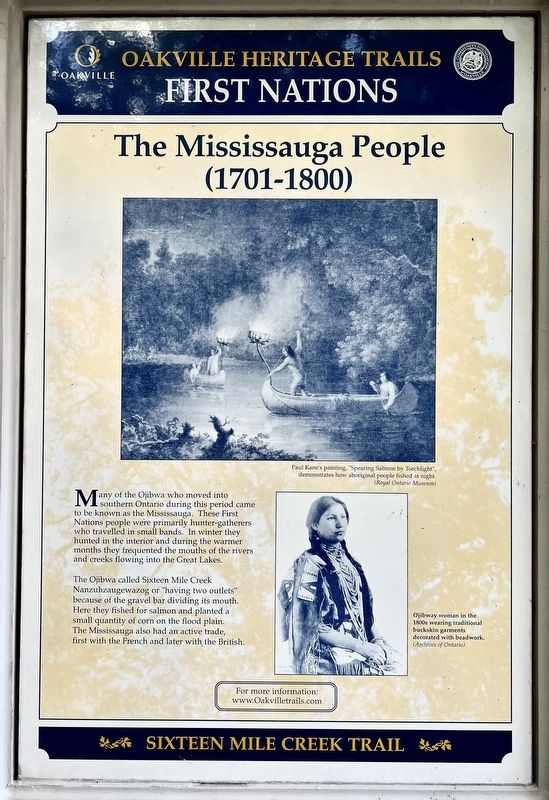
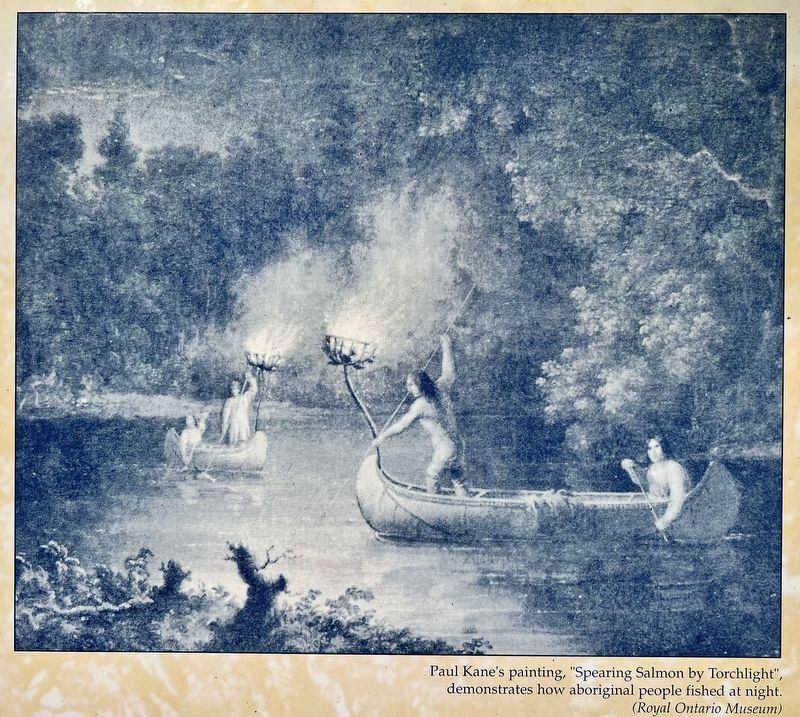
The Ojibwa called Sixteen Mile Creek Nanzuhzaugewazog or "having two outlets" because of the gravel bar dividing its mouth. Here they fished for salmon and planted a small quantity of corn on the flood plain. The Mississauga also had an active trade, first with the French and later with the British.
Erected by Town of Oakville.
Topics. This historical marker is listed in this topic list: Indigenous Peoples and Communities. A significant historical year for this entry is 1701.
Location. 43° 26.758′ N, 79° 40.247′ W. Marker is in Oakville, Ontario, in Halton Region. It is at the intersection of Randall Street and Thomas Street, on the right when traveling west on Randall Street. Touch for map. Marker is at or near this postal address: 165 Randall Street, Oakville ON L6J 1P5, Canada. Touch for directions.

Regionally, this marker is in Greater Toronto, specifically on the Golden Horseshoe, in the Hamilton-Halton-Brant Area, and specifically in the Toronto Metropolitan Area. It is also in Central Canada. Globally, it is in North America, on the Great Lakes, in the Western Hemisphere, in the Western World, and in the Anglosphere. Historically, it finds itself in what was once a British colony, the Viceroyalty of New France, the Haudenosaunee (Iroquois) Confederacy, and Rupert’s Land.
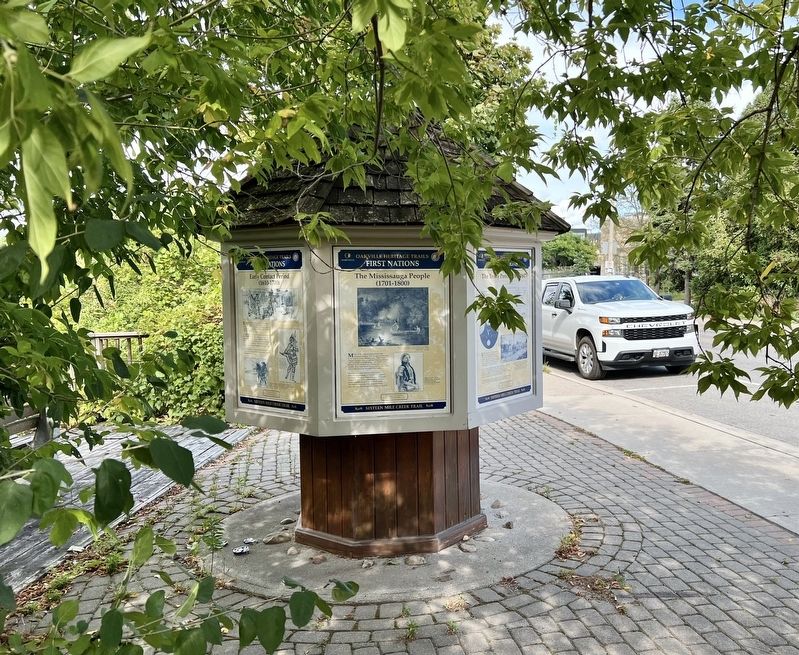
Other nearby markers. At least 8 other markers are within walking distance of this marker: Early Contact Period (1610-1700) (here, next to this marker); The Treaty Period (1801-1847)
this page online
Also see . . . Searching for the Mississauga of the Credit River: Treaties (heritagemississauga.com). “Treaty 22” relates to the surrender of land of the Mississaugas to the British Crown of present day Oakville in 1820.<blockquote>The Mississauga Nation kept three portions of land on the Credit River (also known as the Credit Indian Reserve), and the Twelve Mile and Sixteen Mile Creeks, which the Mississauga First Nation had previously been retained in Treaty 13a. Two years later, the Government negotiated for these lands as well; new settlers in the area wanted access to the creeks and river to establish mills. On February 28th, 1820, Treaties 22 and 23 were signed.
Photographed by Tim Boyd, September 8, 2024
2. The Mississauga People Marker
Photographed by Paul Kane (courtesy Royal Ontario Museum)
3. The Mississauga People marker photo detail
courtesy Archives of Ontario
4. The Mississauga People marker photo detail
Credits. This page was last revised on September 23, 2024. It was originally submitted on September 19, 2024, by Tim Boyd of Hamilton, Ontario. This page has been viewed 269 times since then and 34 times this year. Photos: 1, 2, 3, 4. submitted on September 19, 2024, by Tim Boyd of Hamilton, Ontario. • Andrew Ruppenstein was the editor who published this page.
