Quadrate in Mannheim, Baden-Württemberg, Germany — Central Europe
Friedrichsplatz
Photographed by James Hulse, February 20, 2024
1. Friedrichsplatz Marker

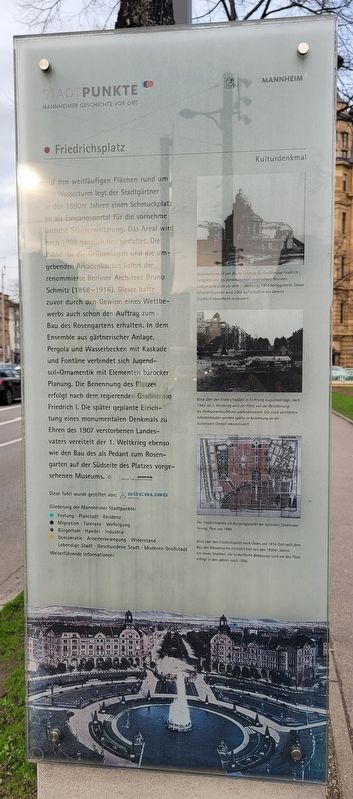
Auf den weitläufigen Flächen rund um Wasserturm legt der Stadtgärtner in den 1890er Jahren einen Schmuckplatz an als Eingangsportal für die vornehme östliche Staurerweiterung. Das Areal wird nach 1899 gänzlich neu gestaltet. Die Pläne für die Grünanlagen und die umgebenden Arkadenbauten liefert der renommierte Berliner Architekt Bruno Schmitz (1858-1916). Dieser hatte zuvor durch den Gewinn eines Wettbewerbs auch schon den Auftrag zum Bau des Rosengartens erhalten. In dem Ensemble aus gärtnerischer Anlage, Pergola und Wasserbecken mit Kaskade und Fontäne verbindet sich Jugendstil-Ornamentik mit Elementen barocker Planung. Die Benennung des Platzes erfolgt nach dem regierenden Großherzog Friedrich I. Die später geplante Errichtung eines monumentalen Denkmals zu Ehren des 1907 verstorbenen Landesvaters vereitelt der 1. Weltkrieg ebenso wie den Bau des als Pedant zum Rosengarten auf der Südseite des Platzes vorgesehenen Museums. © Stadtarchiv Mannheim Institut Für Stadtgeschichte
Diese Tafel wurde gestiftet von: RÖCHLING
Bildunterschriften
(Foto Nr. 1) Denkmalentwurf von Bruno Schmitz für Großherzog Friedrich I. Lediglich eine als Denkmaisockel vorgesehene Brunnenantage wird nach vor dem 1. Weltkrieg 1914 fertiggestellt. Dieser Atlantenbrunnen wird 2002 auf Initiative des Vereins Stadtbild Mannheim restauriert.
(Foto Nr. 2) Blick über den Friedrichsplatz in Richtung Augustaanlage, nach 1943. Im 2. Weltkrieg wird der Platz von der Bevölkerung als Gemüseanboufläche umfunktioniert. Die stark zerstörten Arkadenbauten werden später in Anlehnung an die historische Gestalt rekonstruiert.
(Foto Nr. 3) Der Friedrichsplatz als Ausgangspunkt der östlichen Stadterweiterung, Plan von 1888
(Foto Nr. 4) Blick über den Friedrichsplatz nach Osten, vor 1914. Erst nach dem Bau des Wasserturms entsteht hier seit den 1890er Jahren ein neuer Stadtteil. Die einheitliche Bebauung rund um den Platz erfolgt in den Jahren nach 1899.
In
this page online
This plaque was donated by: RÖCHLING
Captions
(Photo #1) Monument design by Bruno Schmitz for Grand Duke Friedrich I. Only one fountain intended as a memorial base was completed after the First World War in 1914. This Atlas fountain was restored in 2002 on the initiative of the Mannheim Cityscape Association.
(Photo #2) View over Friedrichsplatz towards Augustaanlage, after 1943. During World War II, the square was converted by the population into a vegetable garden. The heavily damaged arcade buildings were later reconstructed based on their historical appearance.
(Photo #3) Friedrichsplatz as the starting point for the eastern expansion of the city, plan from 1888.
(Photo #4) View over Friedrichsplatz to the east, before 1914. It was only after the water tower was built that a new district was created here in the 1890s. The uniform development around the square took place in the years after 1899.
Erected by Stadtpunkte
Photographed by James Hulse, February 20, 2024
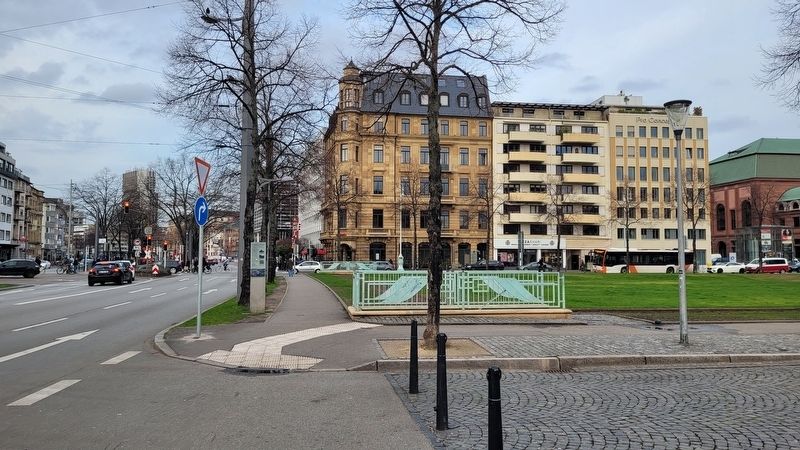
2. The view of the Friedrichsplatz Marker along the street
Topics. This historical marker is listed in this topic list: Parks & Recreational Areas. A significant historical year for this entry is 1899.
Location. 49° 29.079′ N, 8° 28.505′ E. Marker is in Mannheim, Baden-Württemberg. It is in Quadrate. It is on Friedrichsring south of Friedrichsplatz, on the right when traveling north. The marker is located northwest of the Wasserturm (Water Tower). Touch for map. Marker is at or near this postal address: P7 16, Mannheim BW 68161, Germany. Touch for directions.

Regionally, this marker is on the German Upper Rhine. Globally, it is in Europe, the European Union, Atlantic Europe, Central Europe, the Schengen Area, Western Europe, and the Western World. Historically, it finds itself in what was once the Roman Empire, the Holy Roman Empire, and the former West Germany.
Other nearby markers. At least 8 other markers are within walking distance of this marker: Wasserturm / Water Tower (here, next to this marker); Mannheimer Wasserturm / Mannheim Water Tower (about 90 meters away, measured in a direct line); Rosengarten / Rose Garden (about 150 meters away); The First Automobile / Das Erste Automobil (approx. 0.3 kilometers away); Oststadt, Christuskirche / East Town, Christ Church (approx. 0.4 kilometers away); Höhere Bürgerschule N6, 4a / Higher Citizens School N6, 4a (approx. 0.4 kilometers away); Rheinische Ingenieurschule / Rhineland Engineering School (approx. 0.4 kilometers away); Josef Hirschler (approx. 0.4 kilometers away). Touch for a list and map of all markers in Mannheim.
More about this marker. There is a non-related marker separately attached on the other side of the post.
Credits. This page was last revised on October 6, 2024. It was originally submitted on September 20, 2024, by James Hulse of Medina, Texas. This page has been viewed 145 times since then and 29 times this year. Photos: 1, 2. submitted on September 22, 2024, by James Hulse of Medina, Texas.
