Odéon in Paris in Département de Paris, Île-de-France, France — Western Europe
Le Jardin du Luxembourg
Photographed by J. Makali Bruton, June 13, 2024
1. Le Jardin du Luxembourg Marker

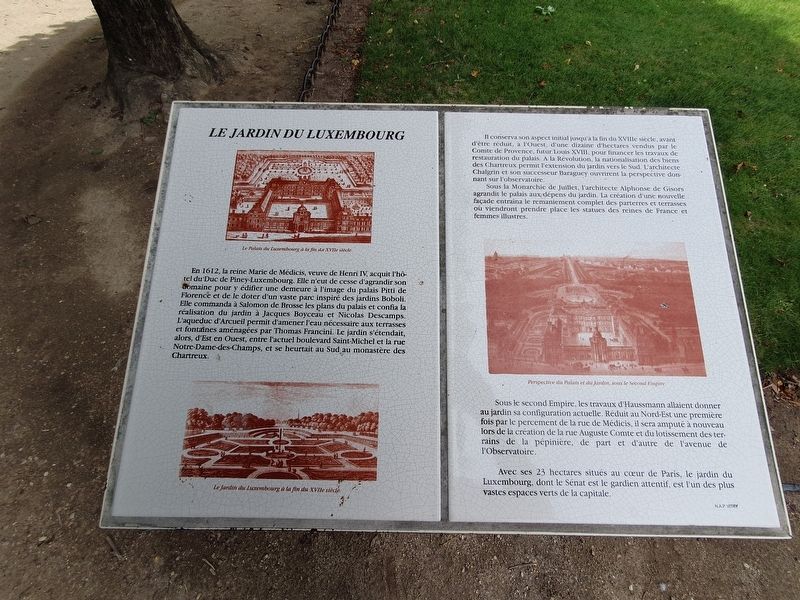
En 1612, la reine Marie de Médicis, veuve de Henri IV, acquit l'hôtel du Duc de Piney-Luxembourg. Elle n'eut de cesse d'agrandir son domaine pour y édifier une demeure à l'image du palais Pitti de Florence et de le doter d'un vaste parc inspiré des jardins Boboli. Elle commanda à Salomon de Brosse les plans du palais et confia la réalisation du jardin à Jacques Boyceau et Nicolas Descamps. L'aqueduc d'Arcueil permit d'amener l'eau nécessaire aux terrasses et fontaines aménagées par Thomas Francini. Le jardin s'étendait, alors, d'Est en Ouest, entre l'actuel boulevard Saint-Michel et la rue Notre-Dame-des-Champs, et se heurtait au Sud au monastère des Chartreux.
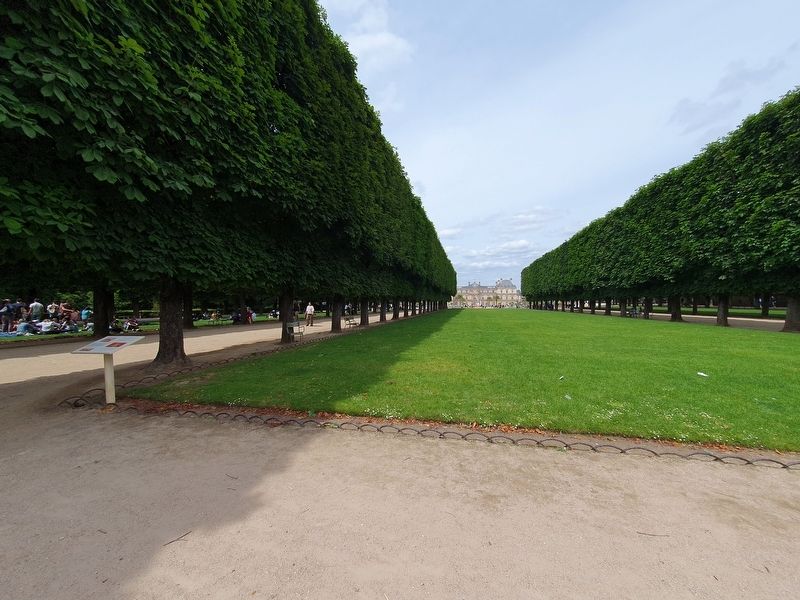
Il conserva son aspect initial jusqu'à la fin du XVIIIe siècle, avant d'être réduit, à l'Ouest, d'une dizaine d'hectares vendus par le Comte de Provence, futur Louis XVIII, pour financer les travaux de restauration du palais. A la Révolution, la nationalisation des biens des Chartreux permit l'extension du jardin vers le Sud. L'architecte Chalgrin et son successeur Baraguey ouvrirent la perspective donnant sur l'observatoire.
Sous
this page online
Sous le second Empire, les travaux d'Haussmann allaient donner au jardin sa configuration actuelle. Réduit au Nord-Est une première fois par le percement de la rue de Médicis, il sera amputé à nouveau lors de la création de la rue Auguste Comte et du lotissement des terrains de la pépinière, de part et d'autre de l'avenue de l'Observatoire.
Avec ses 23 hectares situés au cœur de Paris, le jardin du Luxembourg, dont le Sénat est le gardien attentif, est l'un des plus vastes espaces verts de la capitale.
Le Palais du Luxembourg à la fin da XVIe siècle
Le Jardin du Luxembourg à la fin du XVIIe siècle
Perspective du Palais et du Jardin, sous le Second Empire.
The Jardin du Luxembourg
In 1612, Queen Marie de Medici, widow of Henry IV, acquired the Hôtel of the Duke of Piney-Luxembourg. She never ceased to enlarge her Estate to build a
Photographed by J. Makali Bruton, June 13, 2024
2. Le Jardin du Luxembourg Marker
It retained its original appearance until the end of the eighteenth century, before being reduced, to the west, by about ten hectares sold by the Count of Provence, the future Louis XVIII, to finance the work of restoring the palace. During the Revolution, the nationalization of property of the Carthusians allowed the extension of the garden to the south. The architect Chalgrin and his successor Baraguey opened up the prospect of opening the gardens towards the observatory.
Under the July Monarchy, the architect Alphonse de Gisors enlarged the palace at the
Photographed by J. Makali Bruton, June 13, 2024
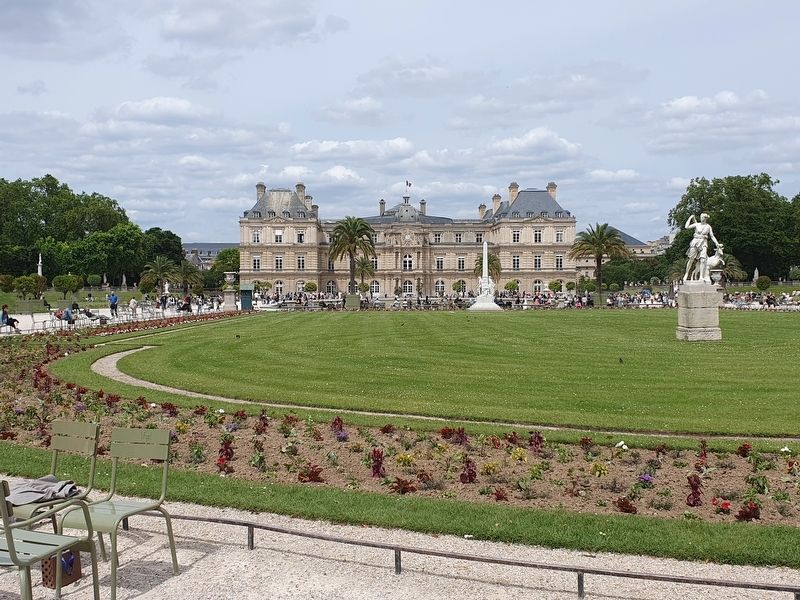
3. Le Palais du Luxembourg
Under the Second Empire, Haussmann's work was to give rise to the garden its current configuration. Reduced to the north-east for the first time by the opening of the rue de Medici, it will be reduced again at the time of the creation of the rue Auguste Comte and the subdivision of the nursery area, on either side of the Avenue de the Observatory.
With its 23 hectares located in the heart of Paris, the garden of the Luxembourg, of which the Senate is the watchful guardian, is one of the most important vast green spaces in the capital.
The Luxembourg Palace at the end of the sixteenth century
The Jardin du Luxembourg at the end of the seventeenth century
Perspective of the Palace and the Garden, under the Second Empire.
Topics. This historical marker is listed in this topic list: Parks & Recreational Areas. A significant historical year for this entry is 1612.
Location. 48° 50.676′ N, 2° 20.216′ E. Marker is in Paris, Île-de-France, in Département de Paris. It is in Odéon. It is on Rue Auguste Comte east of Avenue de l'Observatoire, on the left when traveling east. Touch for map. Marker is at or near this postal address: 12 Rue Auguste Comte, Paris, Île-de-France 75006, France. Touch for directions.

Regionally, it is in the North Atlantic Region, Europe, the European Union, Atlantic Europe, the Schengen Area, Western Europe, a coastal Mediterranean country, and the Western World. Historically, it finds itself in what was once a French colony and also the Roman Empire.
Other nearby markers. At least 8 other markers are within walking distance of this marker: A different marker also named Le Jardin du Luxembourg (within shouting distance of this marker); L'Ecole Coloniale (within shouting distance of this marker); Lieutenant Martinet (about 150 meters away, measured in a direct line); Jean de la Revers (about 150 meters away); Le Decouverte de la Quinine / The Discovery of Quinine (about 180 meters away); Esplanade Gaston-Monnerville (about 210 meters away); Edouard Branly (about 240 meters away); Cécile DeWitt-Morette (1922-2017) (about 240 meters away). Touch for a list and map of all markers in Paris.
Credits. This page was last revised on September 20, 2024. It was originally submitted on September 20, 2024, by J. Makali Bruton of Washington, District of Columbia. This page has been viewed 177 times since then and 32 times this year. Photos: 1, 2, 3. submitted on September 20, 2024, by J. Makali Bruton of Washington, District of Columbia.
