Quadrate in Mannheim, Baden-Württemberg, Germany — Central Europe
Handwerkskammer B 1,1
⎯⎯⎯
Chamber of Crafts B 1,1
Photographed by James Hulse, February 20, 2024
1. Handwerkskammer B 1,1 / Chamber of Crafts B 1,1 Marker

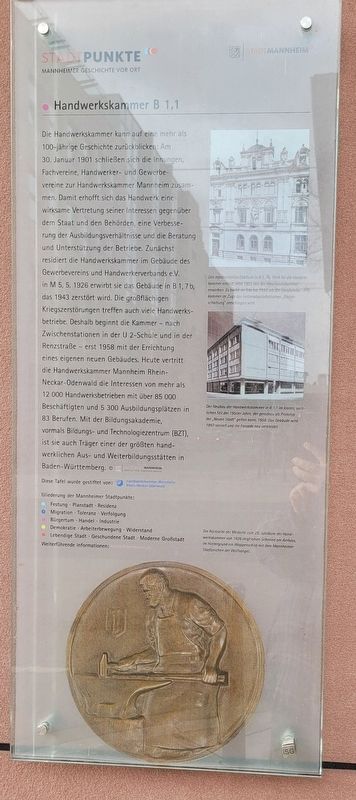
Die Handwerkskammer kann auf eine mehr als 100-jährige Geschichte zurückblicken: Am 30. Januar 1901 schließen sich die Innungen, Fachvereine, Handwerker- und Gewerbevereine zur Handwerkskammer Mannheim zusammen. Damit erhofft sich das Handwerk eine wirksame Vertretung seiner Interessen gegenüber dem Staat und den Behörden, eine Verbesserung der Ausbildungsverhältnisse und die Beratung und Unterstützung der Betriebe. Zunächst residiert die Handwerkskammer im Gebäude des Gewerbevereins und Handwerkerverbands e.V. in M 5, 5. 1926 erwirbt sie das Gebäude in B 1, 7b, das 1943 zerstört wird. Die großflächigen Kriegszerstörungen treffen auch viele Handwerksbetriebe. Deshalb beginnt die Kammer - nach Zwischenstationen in der U 2-Schule und in der Renzstraße erst 1958 mit der Errichtung eines eigenen neuen Gebäudes. Heute vertritt die Handwerkskammer Mannheim Rhein-Neckar-Odenwald die Interessen von mehr als 12 000 Handwerksbetrieben mit über 85 000 Beschäftigten und 5 300 Ausbildungsplätzen in 83 Berufen. Mit der Bildungsakademie, vormals Bildungs- und Technologiezentrum (BZT), ist sie auch Träger einer der größten handwerklichen Aus- und Weiterbildungsstätten in Baden-Württemberg. © Stadtarchiv Mannheim Institut Für Stadtgeschichte
Diese Tafel wurde gestiftet von: Handwerkskammer Mannheim Rhein-Neckar-Odenwald
Bildunterschriften
(Foto Nr. 1) Das repräsenative Gebäude in B 1, 7b, 1904 für die Handelskammer erbaut, wird 1926 von der Handverkskammer erworben. Es bleibt ihr Sitz his 1933, als der Handwerkskammer im Zuge der nationalsozialistischen „Giefchschaltung” zerschlagen wird.
(Foto Nr. 2) Der Neubau der Handwerkskammer in B 1,1 im klaren, sachlichen Stil der 1950er Jahre, der geradezu als Prototyp der „Neuen Stadt" gelten kann, 1958. Das Gebäude wird 1997 saniert und die Fassade neu verkleidet.
(Foto Nr. 3) Die Rückseite der Medaille zum 25. Jubiläum der Handwerkskammer von 1926 zeigt einen Schmied am Amboss, im Hintergrund ein Wappenschild mit dem Mannheimer Stadtzeichen der Wolfsangel.
The
this page online
Photographed by James Hulse, February 20, 2024
2. Handwerkskammer B 1,1 / Chamber of Crafts B 1,1 Marker
This plaque was donated by: Chamber of Crafts Mannheim Rhein-Neckar-Odenwald
Captions
(Photo #1) The representative building in B 1, 7b, built in 1904 for the Chamber of Commerce, was used by the Chamber of Commerce in 1926 acquired. It remained its seat until 1933, when the Chamber of Crafts was destroyed in the course of the National Socialist “Giefchschaltung”.
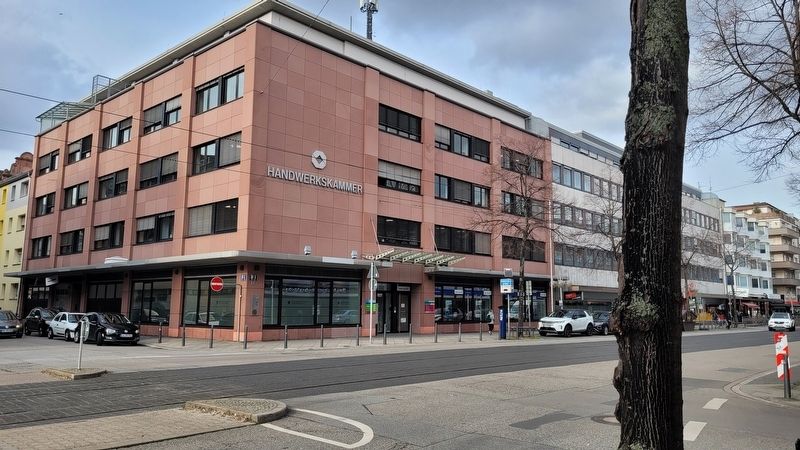
(Photo #2) The new building of the Chamber of Crafts in B 1.1 in the clear, objective style of the 1950s, which can almost be considered a prototype of the "New City", 1958. The building was renovated in 1997 and the facade was reclad.
(Photo #3) The back of the medal for the 25th anniversary of the Chamber of Crafts from 1926 shows a blacksmith at the anvil, in the background a coat of arms with the Mannheim city symbol of the Wolfsangel.
Erected by Stadtpunkte Mannheimer Geschichte Vor Ort and Stadt Mannheim.
Topics. This historical marker is listed in these topic lists: Industry & Commerce • Labor Unions. A significant historical year for this entry is 1901.
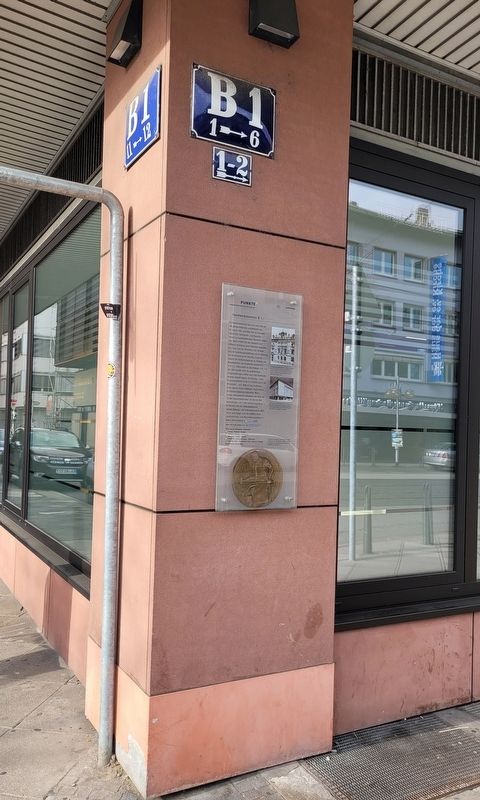
Location. 49° 29.12′ N, 8° 27.825′ E. Marker is in Mannheim, Baden-Württemberg. It is in Quadrate. It is at the intersection of Kurpflazstraße and B1, on the right when traveling south on Kurpflazstraße. The marker is located on the corner of the building. Touch for map. Marker is at or near this postal address: B1 1-2, Mannheim BW 68159, Germany. Touch for directions.

Regionally, this marker is on the German Upper Rhine. Globally, it is in Europe, the European Union, Atlantic Europe, Central Europe, the Schengen Area, Western Europe, and the Western World. Historically, it finds itself in what was once the Roman Empire, the Holy Roman Empire, and the former West Germany.
Other nearby markers. At least 8 other markers are within
Photographed by James Hulse, February 20, 2024
3. The view of the marker from across the street
Credits. This page was last revised on September 25, 2024. It was originally submitted on September 21, 2024, by James Hulse of Medina, Texas. This page has been viewed 153 times since then and 21 times this year. Photos: 1, 2, 3. submitted on September 22, 2024, by James Hulse of Medina, Texas.
