Near Modoc in Randolph County, Illinois — The American Midwest (Great Lakes)
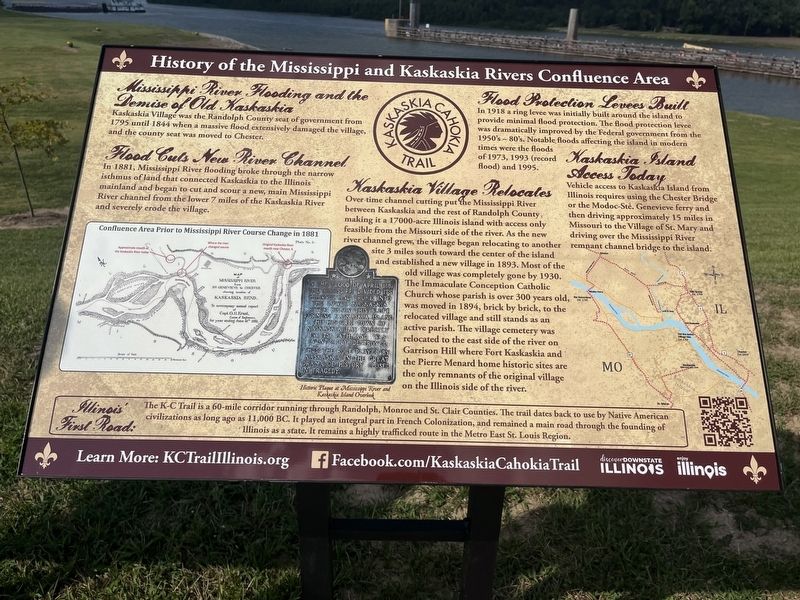
History of the Mississippi and Kaskaskia Rivers Confluence Area
| — | Kaskaskia Cahokia Trail | — |
Photographed by Thomas Smith, September 6, 2024
1. History of the Mississippi and Kaskaskia Rivers Confluence Area Marker
Mississippi River Flooding and the Demise of Old Kaskaskia
Kaskaskia Village was the Randolph County seat of government from 1795 until 1844 when a massive flood extensively damaged the village, and the county seat was moved to Chester.
Flood Cuts New River Channel
In 1881, Mississippi River flooding broke through the narrow isthmus of land that connected Kaskaskia to the Illinois mainland and began to cut and scour a new, main Mississippi River channel from the lower 7 miles of the Kaskaskia River and severely erode the village.
Kaskaskia Village Relocates
Over time channel cutting put the Mississippi River between Kaskaskia and the rest of Randolph County, making it a 17000-acre Illinois island with access only feasible from the Missouri side of the river. As the new river channel grew, the village began relocating to another site 3 miles south toward the center of the island and established a new village in 1893. Most of the old village was completely gone by 1930. The Immaculate Conception Catholic Church whose parish is over 300 years old, was moved in 1894, brick by brick, to the relocated village
this page online
Flood Protection Levees Built
In 1918 a ring levee was initially built around the island to provide minimal flood protection. The flood protection levee was dramatically improved by the Federal government from the 1950's - 80's. Notable floods affecting the island in modern times were the floods of 1973, 1993 (record flood) and 1995.
Kaskaskia Island Access Today
Vehicle access to Kaskaskia Island from Illinois requires using the Chester Bridge or the Modoc Ste. Genevieve ferry and then driving approximately 15 miles in Missouri to the Village of St. Mary and driving over the Mississippi River remnant channel bridge to the island.
Illinois' First Road:
The K-C Trail is a 60-mile corridor running through Randolph, Monroe and St. Clair Counties. The trail dates back to use by Native American civilizations as long ago as 11,000 BC. It played an integral part in
Photographed by Thomas Smith, September 6, 2024
2. History of the Mississippi and Kaskaskia Rivers Confluence Area Marker
Erected by Discover Downtown Illinois; Enjoy Illinois.
Topics. This historical marker is listed in these topic lists: Disasters • Exploration • Settlements & Settlers • Waterways & Vessels. A significant historical year for this entry is 1795.
Location. 37° 59.055′ N, 89° 56.823′ W. Marker is near Modoc, Illinois, in Randolph County. It is on Levee Road 3.3 miles south of Roots Road, on the left when traveling south. Touch for map. Marker is at or near this postal address: 4800 Lock and Dam Rd, Modoc IL 62261, United States of America. Touch for directions.

Regionally, this marker is in Southern Illinois — Little Egypt. It is also in the American Midwest, in the Corn Belt, and in the Great River Road Region. Globally, it is in North America, the Western Hemisphere, the Western World, and the Anglosphere. Historically, it finds itself in what was once the Viceroyalty of New France, the territory of the Mississippian Culture, and the Northwest Territory.
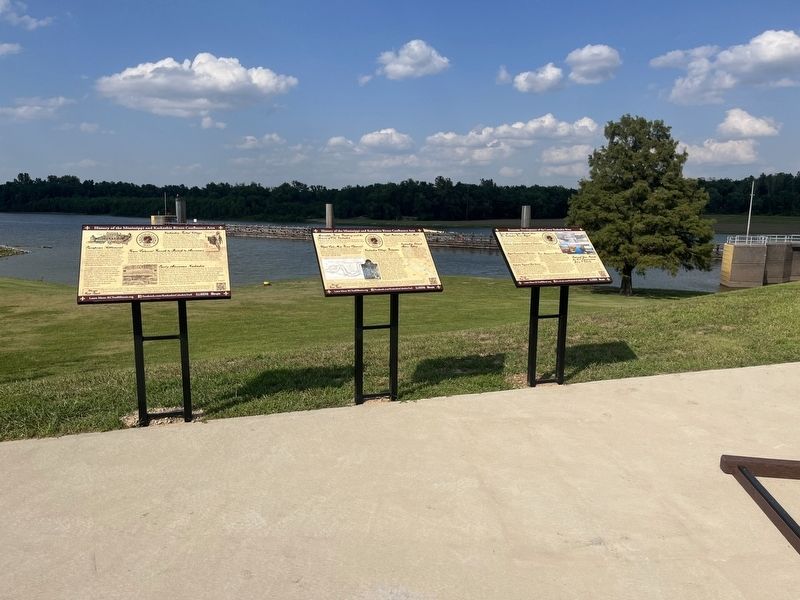
Other nearby markers. At least 8 other markers are within 3 miles of this marker, measured as the crow flies: A different marker also named History of the Mississippi and Kaskaskia Rivers Confluence Area (here, next to this marker); Economic Development of the Lower Kaskaskia River (here, next to this marker); Kaskaskia Confluence Area (approx. ¼ mile away); Reily Lake (approx. 1.8 miles away); Lewis and Clark in Illinois (approx. 2.2 miles away); Kaskaskia Island (approx. 2.3 miles away); Dedicated in Memory of George Rogers Clark (approx. 2.3 miles away); Kaskaskia Village (approx. 2.3 miles away). Touch for a list and map of all markers in Modoc.
Another marker is no longer nearby. Beaver Island (was approx. 2.3 miles away but has been confirmed missing).
Credits. This page was last revised on October 15, 2024. It was originally submitted on September 22, 2024, by Thomas Smith of Waterloo, Ill. This page has been viewed 528 times since then and 129 times this year. Photos: 1, 2. submitted on September 22, 2024, by Thomas Smith of Waterloo, Ill. • Devry Becker Jones was the editor who published this page.
