Downtown in Fairbanks in Fairbanks North Star Borough, Alaska — Northwest (North America)
Pioneer Missionary Activity In Interior Alaska
A Select Chronology of
| — | Vignettes of History • Proud to be Alaskan | — |
Photographed by William Fischer, Jr., August 17, 2024
1. Pioneer Missionary Activity In Interior Alaska Marker
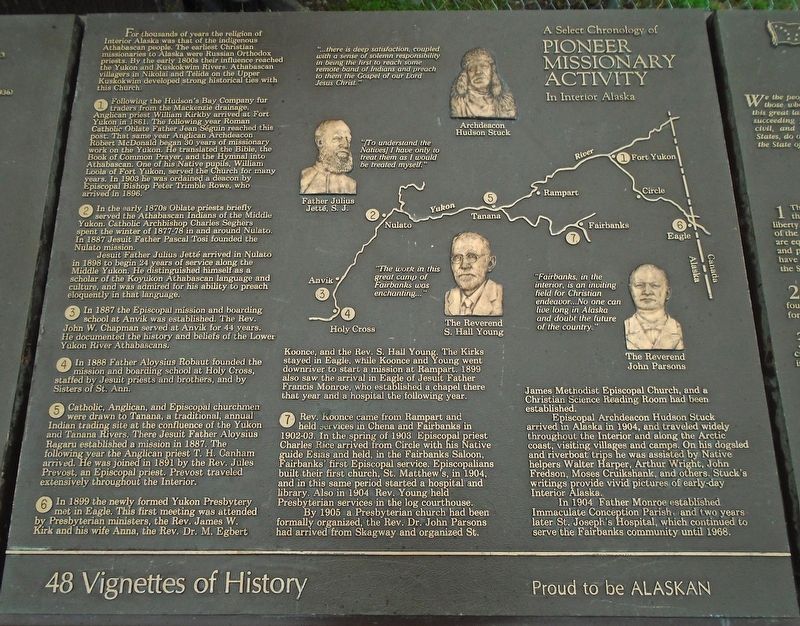
For thousands of years the religion of Interior Alaska was that of the indigenous Athabascan people. The earliest Christian missionaries to Alaska were Russian Orthodox priests. By the early 1800s their influence reached the Yukon and Kuskokwim Rivers. Athabascan villagers in Nikolai and Telida on the Upper Kuskokwim developed strong historical ties with this Church.
① Following the Hudson's Bay Company fur traders from the Mackenzie drainage, Anglican priest William Kirkby arrived at Fort Yukon in 1861. The following year Roman Catholic Oblate Father Jean Séguin reached this post. That same year Anglican Archdeacon Robert McDonald began 30 years of missionary work on the Yukon. He translated the Bible, the Book of Common Prayer, and the Hymnal into Athabascan. One of his Native pupils, William Loola of Fort Yukon, served the Church for many years. In 1903 he was ordained a deacon by Episcopal Bishop Peter Trimble Rowe, who arrived in 1896.
②In the early 1870s Oblate priests briefly served the Athabascan Indians of the Middle Yukon. Catholic Archbishop Charles Seghers spent the winter of 1877-78 in and around
this page online
Jesuit Father Julius Jetté arrived in Nulato in 1898 to begin 24 years of service along the Middle Yukon. He distinguished himself as a scholar of the Koyukon Athabascan language and culture, and was admired for his ability to preach eloquently in that language.
③In 1887 the Episcopal mission and boarding school at Anvik was established. The Rev. John W. Chapman served at Anvik for 44 years. He documented the history and beliefs of the Lower Yukon River Athabascans.
④In 1888 Father Aloysius Robaut founded the mission and boarding school at Holy Cross, staffed by Jesuit priests and brothers, and by Sisters of St. Ann.
⑤Catholic, Anglican, and Episcopal churchmen were drawn to Tanana, a traditional, annual Indian trading site at the confluence of the Yukon and Tanana Rivers. There Jesuit Father Aloysius Ragaru established a mission in 1887. The following year the Anglican priest T. H. Canham arrived. He was joined in 1891 by the Rev. Jules Prevost, an Episcopal priest. Prevost traveled extensively throughout the Interior.
⑥In 1899 the
Photographed by William Fischer, Jr., August 17, 2024
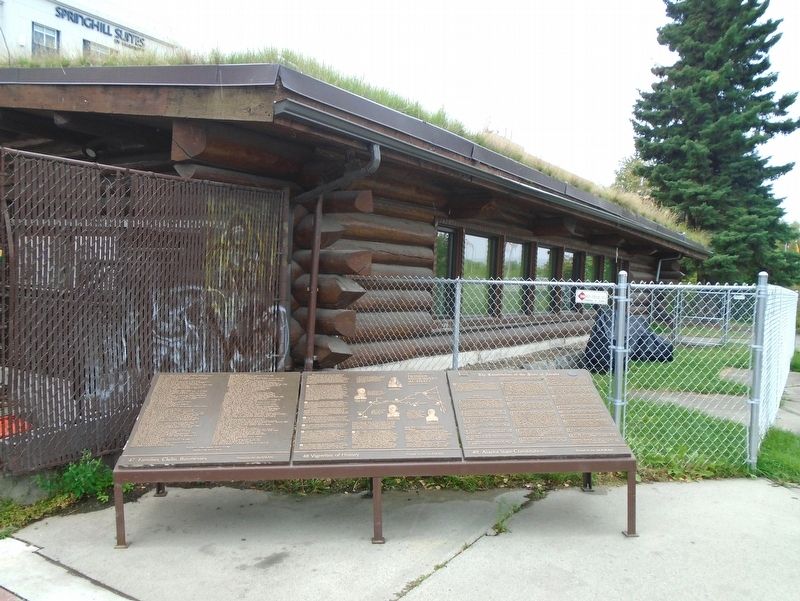
2. Pioneer Missionary Activity In Interior Alaska Marker
⑦Rev. Koonce came from Rampart and held service in Chena and Fairbanks in 1902-03. In the spring of 1903 Episcopal priest Charles Rice arrived from Circle with his Native guide Esias and held, in the Fairbanks Saloon, Fairbanks' first Episcopal service. Episcopalians built their first church, St. Matthew's, in 1904, and in this same period started a hospital and library. Also in 1904 Rev. Young held Presbyterian services in the log courthouse.
By 1905 a Presbyterian church had been formally organized, the Rev. Dr. John Parsons had arrived from Skagway and organized St. James Methodist Episcopal Church, and a Christian Science Reading Room had been established.
Episcopal Archdeacon Hudson Stuck arrived in Alaska in 1904, and traveled widely throughout the Interior and along the Arctic coast, visiting villages and camps. On his dogsled and riverboat trips he was assisted by Native helpers Walter Harper, Arthur Wright, John Fredson, Moses Cruikshank, and others. Stuck's writings provide vivid pictures of early-day Interior Alaska.
In 1904 Father Monroe established Immaculate Conception Parish, and two years later St. Joseph's Hospital, which continued to serve the Fairbanks community until 1968.
[Missionary bas reliefs and quotes, top to bottom, read]
"...there is deep satisfaction, coupled with a sense of solemn responsibility in being the first to reach some remote band of Indians and preach to them the Gospel of our Lord Jesus Christ."
-Archdeacon Hudson Stuck
"[To understand the Natives] I have only to treat them as I would be treated myself."
-Father Julius Jetté, S.J.
"The work in this great camp of Fairbanks was enchanting..."
-The Reverend S. Hall Young
"Fairbanks, in the interior, is an inviting field for Christian endeavor...No one can live long in Alaska and doubt the future of the country."
-The Reverend John Parsons
Erected by Festival Fairbanks '84. (Marker Number 48.)
Topics. This historical marker is listed in these topic lists: Indigenous Peoples and Communities • Religion & Religious Structures • Settlements & Settlers. A significant historical year for this entry is 1861.
Location. 64° 50.649′ N, 147° 43.2′ W. Marker is in Fairbanks, Alaska, in Fairbanks North Star Borough. It is in Downtown. It is on 1st Avenue east of Cushman Street, on the left when traveling east. Marker is in Golden Heart Plaza, adjacent east of the Yukon Quest headquarters. Touch for map. Marker is at or near this postal address: 516 1st Avenue, Fairbanks AK 99701, United States of America. Touch for directions.

Regionally, this marker is in the Alaska Railroad Corridor, in the Athabascan Region, and in Interior Alaska. It is also on the American Pacific Coast. Globally, it is in North America, on the Pacific Rim, in the Western Hemisphere, in the Western World, and in the Anglosphere. Historically, it finds itself in what was once the Russian Empire.
Other nearby markers. At least 8 other markers are within walking distance of this marker: First National Bank of Fairbanks (here, next to this marker); Fairbanks Aerie No. 1037 and Ladies Auxiliary (here, next to this marker); Sled Dogs in the History of the Interior (here, next to this marker); The Military in the Interior (a few steps from this marker); North Slope Oil Benefits All Of Us (a few steps from this marker); Construction Affecting Fairbanks (a few steps from this marker); A History of Interior Alaska's Transportation (a few steps from this marker); The Trans Alaska Pipeline: An Epic Construction Effort (a few steps from this marker). Touch for a list and map of all markers in Fairbanks.
Credits. This page was last revised on January 3, 2025. It was originally submitted on September 23, 2024, by William Fischer, Jr. of Reynoldsburg, Ohio. This page has been viewed 767 times since then and 236 times this year. Photos: 1, 2. submitted on September 23, 2024, by William Fischer, Jr. of Reynoldsburg, Ohio.
