Downtown West in Minneapolis in Hennepin County, Minnesota — The American Midwest (Upper Plains)
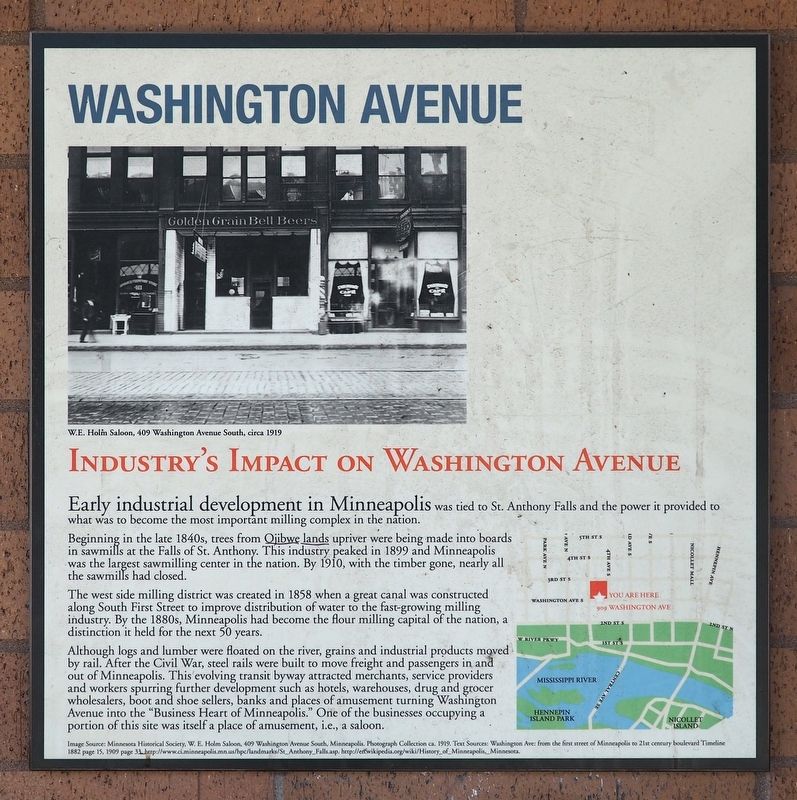
Industry's Impact on Washington Avenue
| — | Washington Avenue | — |
Photographed by McGhiever, May 12, 2024
1. Industry's Impact on Washington Avenue Marker
[Caption:] W.E. Holm Saloon, 409 Washington Avenue South, circa 1919
Early industrial development in Minneapolis was tied to St. Anthony Falls and the power it provided to what was to become the most important milling complex in the nation.
Beginning in the late 1840s, trees from Ojibwe lands upriver were being made into boards in sawmills at the Falls of St. Anthony. This industry peaked in 1899 and Minneapolis was the largest sawmilling center in the nation. By 1910, with the timber gone, nearly all the sawmills had closed.
The west side milling district was created in 1858 when a great canal was constructed along South First Street to improve distribution of water to the fast-growing milling industry. By the 1880s, Minneapolis had become the flour milling capital of the nation, a distinction it held for the next 50 years.
Although logs and lumber were floated on the river, grains and industrial products moved by rail. After the Civil War, steel rails were built to move freight and passengers in and out of Minneapolis. This evolving transit byway attracted merchants, service providers and workers spurring
this page online
Image Source: Minnesota Historical Society, W.E. Holm Saloon, 409 Washington Avenue South, Minneapolis. Photograph Collection ca. 1919. Text Sources: Washington Ave: from the first street of Minneapolis to 21st century boulevard Timeline 1882 page 15, 1909 page 33. http://www.ci.minneapolis.mn.us/hpc/landmarks/St_Anthony_Falls.asp. http://en.wikipedia.org/wiki/History_of_Minneapolis,_Minnesota.
Topics. This historical marker is listed in these topic lists: Industry & Commerce • Railroads & Streetcars • Waterways & Vessels. A significant historical year for this entry is 1858.
Location. 44° 58.741′ N, 93° 15.728′ W. Marker is in Minneapolis, Minnesota, in Hennepin County. It is in Downtown West. It is on Washington Avenue S. near 4th Avenue S., on the right when traveling east. The marker is in an alcove on the north side of the

Photographed by McGhiever, May 12, 2024
2. Industry's Impact on Washington Avenue Marker (left) on the north side of the Gateway Parking Ramp

Regionally, this marker is in the Twin Cities Metropolitan Area. It is also in the American Midwest, in the Corn Belt, and in the Great River Road Region. Globally, it is in North America, the Western Hemisphere, the Western World, and the Anglosphere. Historically, it finds itself in what was once Rupert’s Land, the territory of the Mississippian Culture, and the Louisiana Purchase.
Other nearby markers. At least 8 other markers are within walking distance of this marker: Transportation on Washington Avenue (here, next to this marker); The Genesis of Washington Avenue (here, next to this marker); The Decline of Washington Avenue (here, next to this marker); The Resurrection of Washington Avenue (here, next to this marker); Changing Times (about 500 feet away, measured in a direct line); Welcome to the Rail Maze (about 500 feet away); Trains Can't Swim (about 700 feet away); Cataract House / 607 Washington (about 700 feet away). Touch for a list and map of all markers in Minneapolis.
Credits. This page was last revised on September 23, 2024. It was originally submitted on September 23, 2024, by McGhiever of Minneapolis, Minnesota. This page has been viewed 126 times since then and 10 times this year. Photos: 1, 2. submitted on September 23, 2024, by McGhiever of Minneapolis, Minnesota.
