
Chena Native Village in Chena Ridge in Fairbanks North Star Borough, Alaska — Northwest (North America)
Trapper's Log Cabin
The Classic Alaskan Structure
Photographed by William Fischer, Jr., August 19, 2024
1. Trapper's Log Cabin Marker
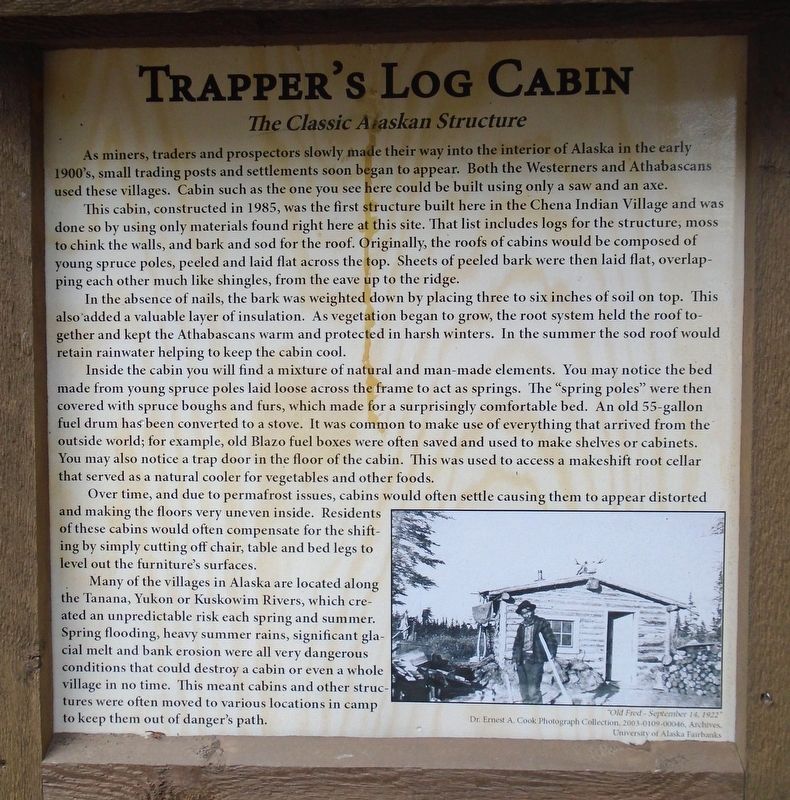
As miners, traders and prospectors slowly made their way into the interior of Alaska in the early 1900's, small trading posts and settlements soon began to appear. Both the Westerners and Athabascans used these villages. Cabin such as the one you see here could be built using only a saw and an axe.
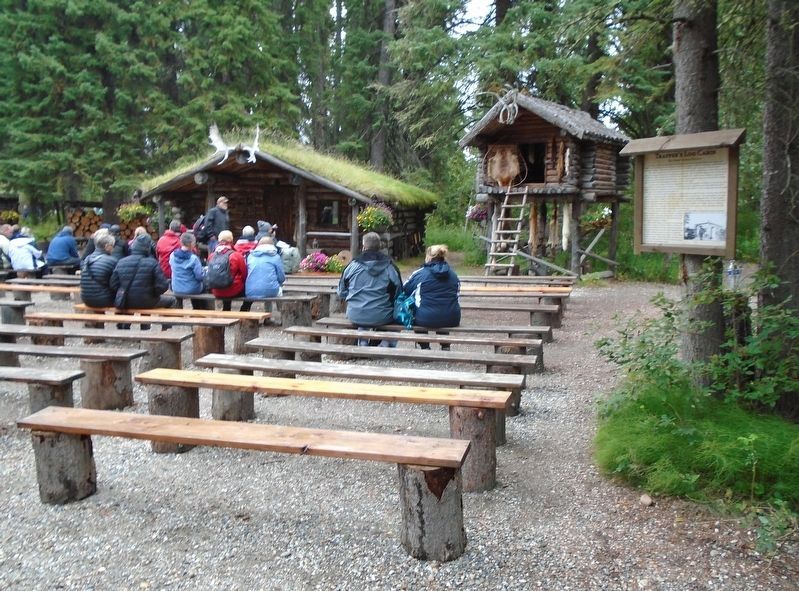
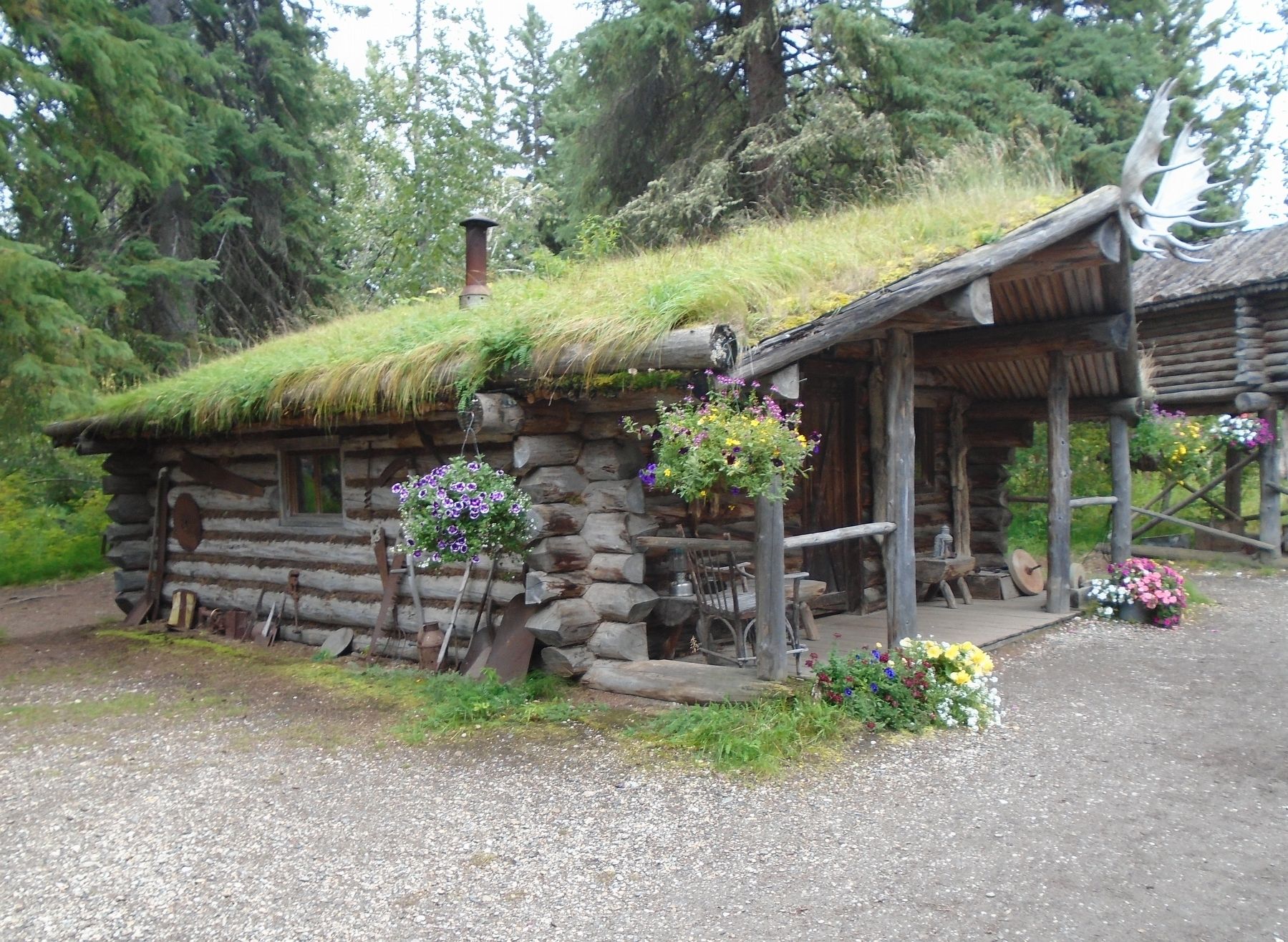
This cabin, constructed in 1985, was the first structure built here in the Chena Indian Village and was done so by using only materials found right here at this site. That list includes logs for the structure, moss to chink the walls, and bark and sod for the roof. Originally, the roofs of cabins would be composed of young spruce poles, peeled and laid flat across the top. Sheets of peeled bark were then laid flat, overlapping each other much like shingles, from the eave up to the ridge.
In the absence of nails, the bark was weighted down by placing three to six inches of soil on top. This also added a valuable layer of insulation. As vegetation began to grow, the root system held the roof together and kept the Athabascans warm and protected in harsh winters. In the summer the sod roof would retain rainwater helping to keep
this page online
Inside the cabin you will find a mixture of natural and man-made elements. You may notice the bed made from young spruce poles laid loose across the frame to act as springs. The "spring poles" were then covered with spruce boughs and furs, which made for a surprisingly comfortable bed. An old 55-gallon fuel drum has been converted to a stove. It was common to make use of everything that arrived from the outside world; for example, old Blazo fuel boxes were often saved and used to make shelves or cabinets. You may also notice a trap door in the floor of the cabin. This was used to access a makeshift root cellar that served as a natural cooler for vegetables and other foods.
Over time, and due to permafrost issues, cabins would often settle causing them to appear distorted and making the floors very uneven inside. Residents of these cabins would often compensate for the shifting by simply cutting off chair, table and bed legs to level out the furniture's surfaces.
Many of the villages in Alaska are located along the Tanana, Yukon or Kusko[k]wim Rivers, which created an unpredictable risk each spring and summer. Spring
Photographed by William Fischer, Jr., August 19, 2024
2. Trapper's Log Cabin and Marker
[Photo caption reads] "Old Fred-September 14, 1922"
Erected by Riverboat Discovery.
Topics. This historical marker is listed in these topic lists: Indigenous Peoples and Communities • Settlements & Settlers. A significant historical year for this entry is 1985.
Location. 64° 47.996′ N, 147° 54.978′ W. Marker is in Chena Ridge, Alaska, in Fairbanks North Star Borough. It is in Chena Native Village. It can be reached from Tall Spruce Road. Touch for map. Marker is at or near this postal address: 2655 Tall Spruce Rd, Fairbanks AK 99709, United States of America. Touch for directions.

Regionally, this marker is in the Alaska Railroad Corridor, in the Athabascan Region, and in Interior Alaska. It is also on the American Pacific Coast. Globally, it is in North America, the Pacific Rim, the Western Hemisphere, the Western World, and the
Photographed by William Fischer, Jr., August 19, 2024
3. Trapper's Log Cabin
Other nearby markers. At least 8 other markers are within walking distance of this marker: Trapper's Line Cabin (within shouting distance of this marker); Sod Roof Construction (within shouting distance of this marker); The Heyday of Snowmobiling (within shouting distance of this marker); The Iron Dog (within shouting distance of this marker); Early Alaskan Riverboats (within shouting distance of this marker); Piper Super Cub (within shouting distance of this marker); Locked to the End (within shouting distance of this marker); a different marker also named Locked to the End (within shouting distance of this marker). Touch for a list and map of all markers in Chena Ridge.
More about this marker. Although a modern construction, the Chena Native Village is a living history open air museum highlighting historic Athabascan culture, and is reached by Riverboat Discovery tours.
Also see . . . China Native Village. (Submitted on September 25, 2024, by William Fischer, Jr. of Reynoldsburg, Ohio.)
Credits. This page was last revised on September 26, 2024. It was originally submitted on September 25, 2024, by William Fischer, Jr. of Reynoldsburg, Ohio. This page has been viewed 275 times since then and 44 times this year. Photos: 1, 2, 3. submitted on September 25, 2024, by William Fischer, Jr. of Reynoldsburg, Ohio.
