Bainbridge in Decatur County, Georgia — The American South (South Atlantic)
Civil War Cannon
Photographed by Cosmos Mariner, September 21, 2024
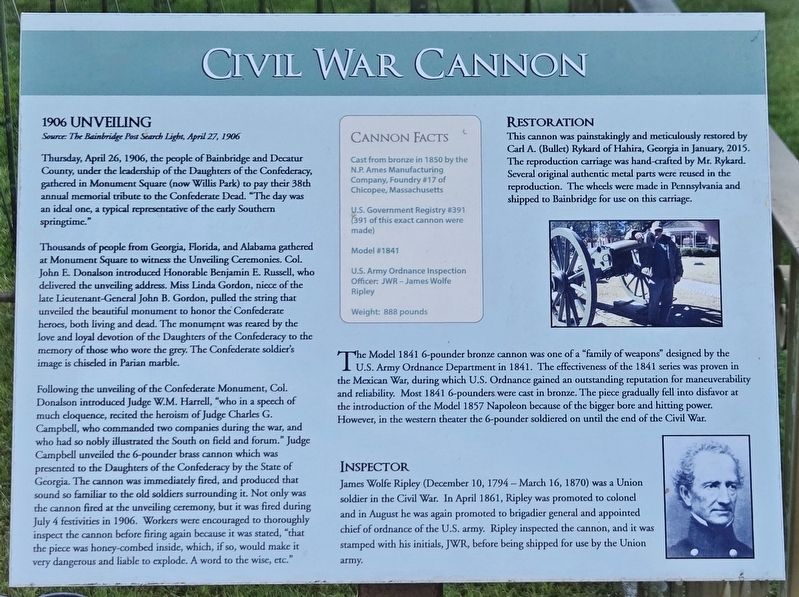
1. Civil War Cannon Marker
1906 Unveiling
Source: The Bainbridge Post Search Light, April 27, 1906
Thursday, April 26, 1906, the people of Bainbridge and Decatur County, under the leadership of the Daughters of the Confederacy, gathered in Monument Square (now Willis Park) to pay their 38th annual memorial tribute to the Confederate Dead. “The day was an ideal one, a typical representative of the early Southern springtime.”
Thousands of people from Georgia, Florida, and Alabama gathered at Monument Square to witness the Unveiling Ceremonies. Col. John E. Donalson introduced Honorable Benjamin E. Russell, who delivered the unveiling address. Miss Linda Gordon, niece of the late Lieutenant-General John B. Gordon, pulled the string that unveiled the beautiful monument to honor the Confederate heroes, both living and dead. The monument was reared by the love and loyal devotion of the Daughters of the Confederacy to the memory of those who wore the grey. The Confederate soldier's image is chiseled in Parian marble.
Following the unveiling of the Confederate Monument, Col. Donalson introduced Judge W.M. Harrell, “who in a speech of much eloquence, recited
this page online
Cannon Facts
Cast from bronze in 1850 by the N.P. Ames Manufacturing Company, Foundry #17 of Chicopee, Massachusetts
U.S. Government Registry #391 (391 of this exact cannon were made)
Model #1841
U.S. Army Ordnance Inspection Officer: JWR - James Wolfe Ripley
Weight: 888 pounds
Restoration
This cannon was painstakingly and meticulously restored by Carl A. (Bullet) Rykard of Hahira, Georgia in January, 2015. The reproduction
Photographed by Cosmos Mariner, September 21, 2024
2. Civil War Cannon Marker
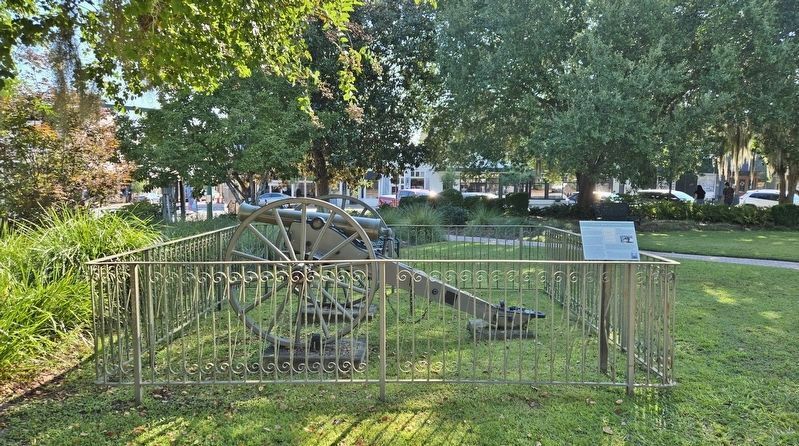
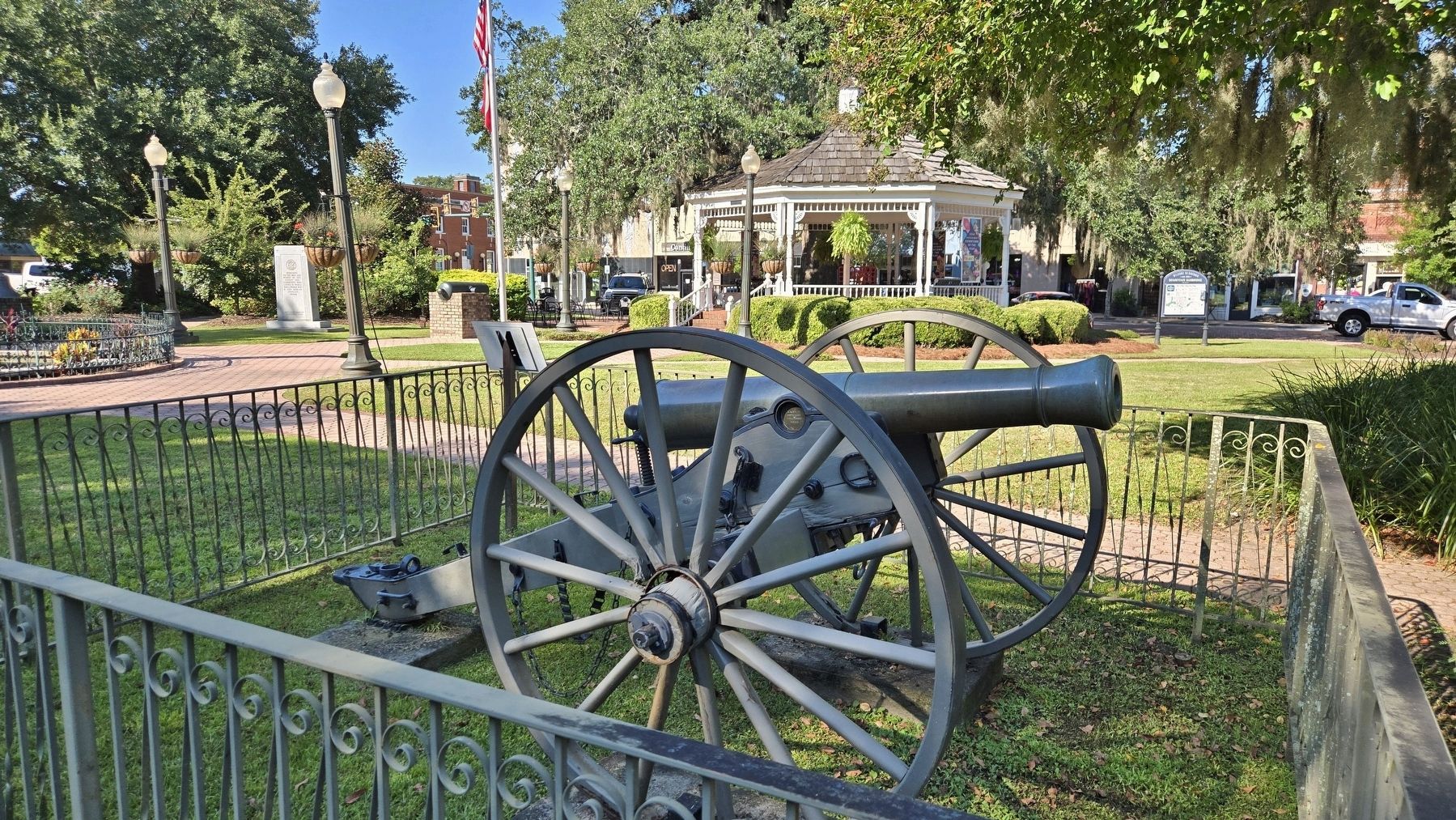
Looking east across the north side of Willis Park. The cannon and marker are protected by a waist-high wrought iron fence.
The Model 1841 6-pounder bronze cannon was one of a “family of weapons” designed by the U.S. Army Ordnance Department in 1841. The effectiveness of the 1841 series was proven in the Mexican War, during which U.S. Ordnance gained an outstanding reputation for maneuverability and reliability. Most 1841 6-pounders were cast in bronze. The piece gradually fell into disfavor at the introduction of the Model 1857 Napoleon because of the bigger bore and hitting power. However, in the western theater the 6-pounder soldiered on until the end of the Civil War.
Inspector
James Wolfe Ripley (December 10, 1794 — March 16, 1870) was a Union soldier in the Civil War. In April 1861, Ripley was promoted to colonel and in August he was again promoted to brigadier general and appointed chief of ordnance of the U.S. army. Ripley inspected the cannon, and it was stamped with his initials, JWR, before being shipped for use by the Union army.
Topics. This
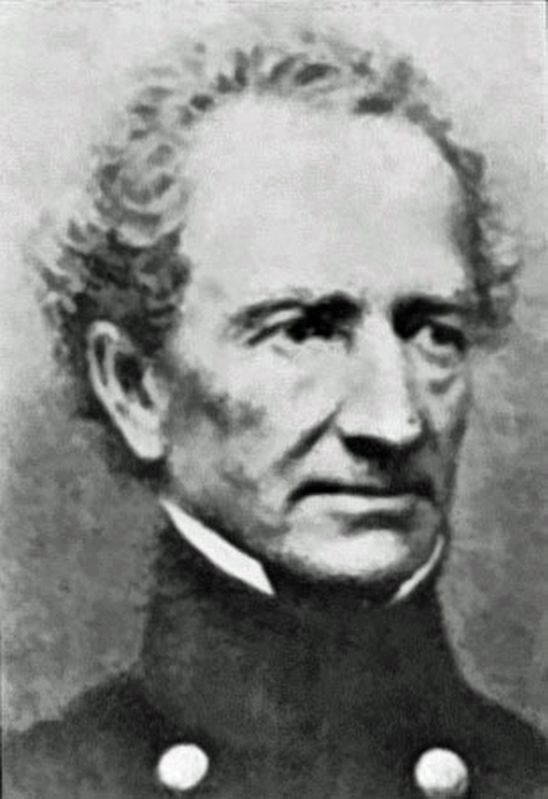
3. Marker detail: James Wolfe Ripley
Location. 30° 54.378′ N, 84° 34.563′ W. Marker is in Bainbridge, Georgia, in Decatur County. It is on East Water Street just east of North West Street, on the right when traveling east. The marker and cannon are located on the north side of Willis Park. Touch for map. Marker is at or near this postal address: 105 East Water Street, Bainbridge GA 39817, United States of America. Touch for directions.

Regionally, this marker is on the Coastal Plain. It is also in the American South and specifically in the Deep South. Globally, it is in North America, the Western Hemisphere, the Western World, and the Anglosphere. Historically, it finds itself in what was once the territory of the Mississippian Culture, one of the original Thirteen Colonies, one of the Confederate States of America, and the Antebellum South.
Other nearby markers. At least 8 other markers are within walking distance of this marker: Samuel Marvin Griffin (here, next to this marker); The Bainbridge Volunteers (a few steps from this marker); Decatur County War Memorial (a few steps from this marker); Winecoff Memorial (within shouting distance of this marker); De Soto Trail (within shouting distance of this marker); El Camino Real (within shouting distance of this marker); In Memory of Revolutionary Soldiers (within shouting distance of this marker); Decatur County (within shouting distance of this marker). Touch for a list and map of all markers in Bainbridge.
Photographed by Cosmos Mariner, September 21, 2024
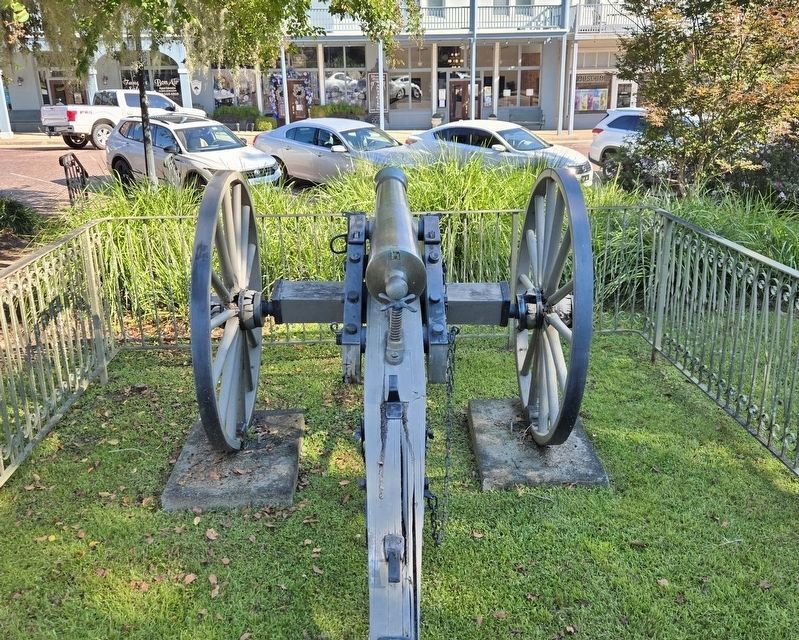
4. Civil War Cannon
Looking north; East Water Street crosses in the background.
Photographed by Cosmos Mariner, September 21, 2024
5. Civil War Cannon
Looking southwest across Willis Park.
Credits. This page was last revised on October 4, 2024. It was originally submitted on September 30, 2024, by Cosmos Mariner of Cape Canaveral, Florida. This page has been viewed 342 times since then and 77 times this year. Photos: 1, 2, 3, 4, 5. submitted on October 4, 2024, by Cosmos Mariner of Cape Canaveral, Florida.
