Quadrate in Mannheim, Baden-Württemberg, Germany — Central Europe
Karl Drais und seine Laufmaschine
Karl Drais and his Running Machine
Photographed by James Hulse, September 23, 2024
1. Karl Drais und seine Laufmaschine / Karl Drais and his running Machine Marker

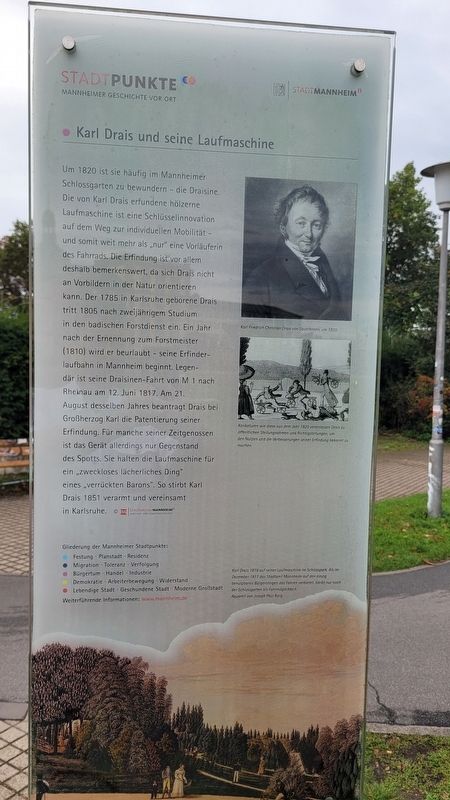
Um 1820 ist sie häufig im Mannheimer Schlossgarten zu bewundern - die Draisine. Die von Karl Drais erfundene hölzerne Laufmaschine ist eine Schlüsselinnovation auf dem Weg zur individuellen Mobilität - und somit weit mehr als „nur" eine Vorläuferin des Fahrrads. Die Erfindung ist vor allem deshalb bemerkenswert, da sich Drais nicht an Vorbildern in der Natur orientieren kann. Der 1785 in Karlsruhe geborene Drais tritt 1805 nach zweijährigem Studium in den badischen Forstdienst ein. Ein Jahr nach der Ernennung zum Forstmeister (1810) wird er beurlaubt - seine Erfinderlaufbahn in Mannheim beginnt. Legendär ist seine Draisinen-Fahrt von M 1 nach Rheinau am 12. Juni 1817. Am 21. August desselben Jahres beantragt Drais bei Großherzog Karl die Patentierung seiner Erfindung. Für manche seiner Zeitgenossen ist das Gerät allerdings nur Gegenstand des Spotts. Sie halten die Laufmaschine für ein „zweckloses lächerliches Ding" eines „verrückten Barons". So stirbt Karl Drais 1851 verarmt und vereinsamt in Karlsruhe. © Stadtarchiv Mannheim Institut Für Stadtgeschichte
Bildunterschriften
(Foto Nr. 1) Karl Friedrich Christian Drais von Sauerbronn, um 1820.
(Foto Nr. 2) Karikaturen wie diese aus dem Jahr 1820 veranlassen Drais zu öffentlichen Stellungnahmen und Richtigstellungen, um den Nutzen und die Verbesserungen seiner Erfindung bekannt zu machen.
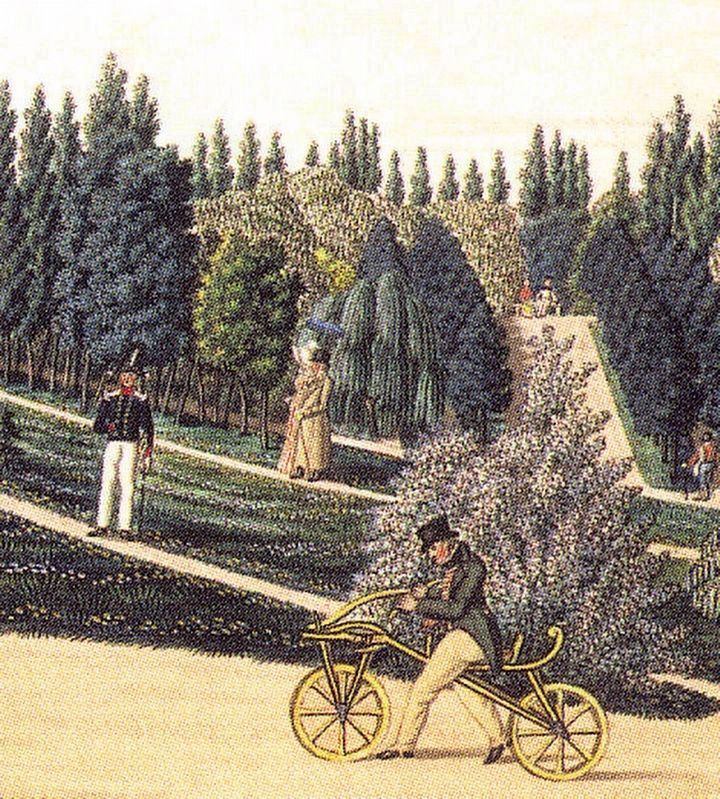
(Foto Nr. 3) Karl Drais 1819 auf seiner Laufmaschine im Schlosspark. Als im Dezember 1817 das Stadtamt Mannheim auf den einzig benutzbaren Bürgersteigen das Fahren verbietet, bleibt nur noch der Schlossgarten als Fahrmöglichkeit. Aquarell von Joseph Paul Karg.
Around 1820 it could often be admired in the Mannheim Palace Gardens - the Draisine. The wooden running machine invented by Karl Drais is a key innovation on the way
this page online
Captions
(Photo #1) Karl Friedrich Christian Drais von Sauerbronn, around 1820.
(Photo #2) Caricatures like this one from 1820 prompt Drais to make public statements and corrections to make the benefits and improvements of his invention known.
(Photo #3) Karl Drais on his running machine in the castle park in 1819. When the Mannheim city council banned riding on the only usable sidewalks in December 1817, the only option left was the castle garden. Watercolor by Joseph Paul Karg.
Erected by Stadtpunkte
Photographed by James Hulse, September 23, 2024
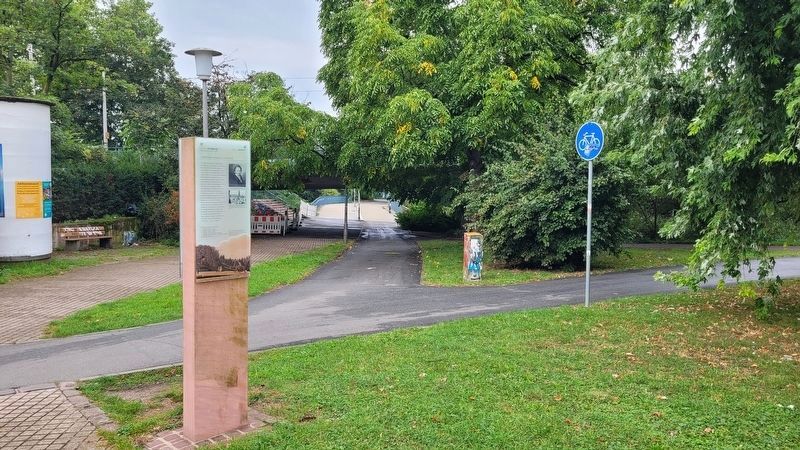
2. The view of the marker along the trail on the campus of the University of Mannheim
Topics. This historical marker is listed in this topic list: Roads & Vehicles. A significant historical date for this entry is June 12, 1817.
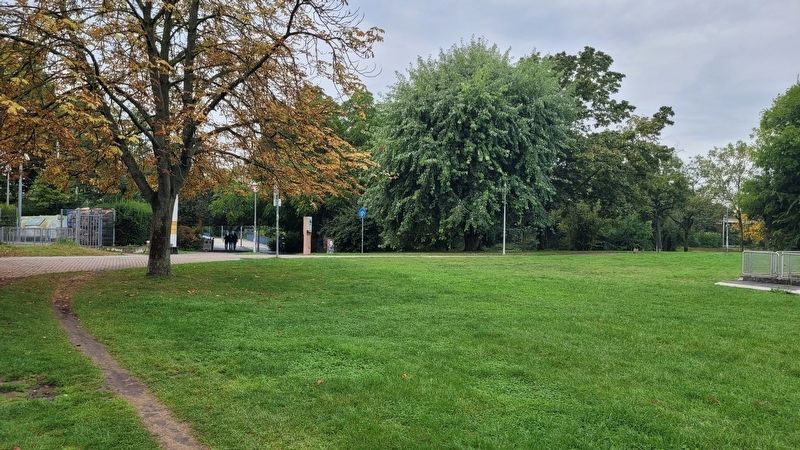
Location. 49° 29.018′ N, 8° 27.622′ E. Marker is in Mannheim, Baden-Württemberg. It is in Quadrate. It is on Bismarckstraße just south of A2. The marker is located on the campus of the University of Mannheim in Friedrichs Park. Touch for map. Marker is at or near this postal address: Bismarckstraße 10, Mannheim BW 68159, Germany. Touch for directions.

Regionally, this marker is on the German Upper Rhine. Globally, it is in Europe, the European Union, Atlantic Europe, Central Europe, the Schengen Area, Western Europe, and the Western World. Historically, it finds itself in what was once the Roman Empire, the Holy Roman Empire, and the former West Germany.
Other nearby markers. At least 8 other markers are within walking distance of this marker: Wechselnde Schlossbewohner / Changing Palace Residents (here, next to this marker); Stadt- und Festungsgründung 1606/07 / City and Fortress Foundation in 1606/07 (within shouting distance
Photographed by James Hulse, September 23, 2024
3. The view of the marker in Friedrichs Park
More about this marker. There is a non-related marker separately attached on the other side of the post.
Also see . . . Karl Drais. Wikipedia
Drais was a prolific inventor, who invented the Laufmaschine ("running machine"), also later called the velocipede, draisine (English) or draisienne (French), also nicknamed the hobby horse or dandy horse. This was his most popular and widely recognized invention. It incorporated the two-wheeler principle that is basic to the bicycle and motorcycle and was the beginning of mechanized personal transport. This was the earliest form(Submitted on October 2, 2024, by James Hulse of Medina, Texas.)of a bicycle, without pedals.Public Domain - Joseph Paul Karg, 18194. Mannheim Palace Garden and Palace by J P Karg 1819 with handcar (draisine)Karl von Drais riding his draisine
Credits. This page was last revised on December 6, 2024. It was originally submitted on October 1, 2024, by James Hulse of Medina, Texas. This page has been viewed 545 times since then and 47 times this year. Photos: 1, 2, 3, 4. submitted on October 2, 2024, by James Hulse of Medina, Texas.
