Ketchikan in Ketchikan Gateway Borough, Alaska — Northwest (North America)
J.R. Heckman Buildings
1920s
| — | The Man Who Made Ketchikan the "Salmon Capital of the World" | — |
Photographed by William Fischer, Jr., August 26, 2024
1. J.R. Heckman Buildings Marker
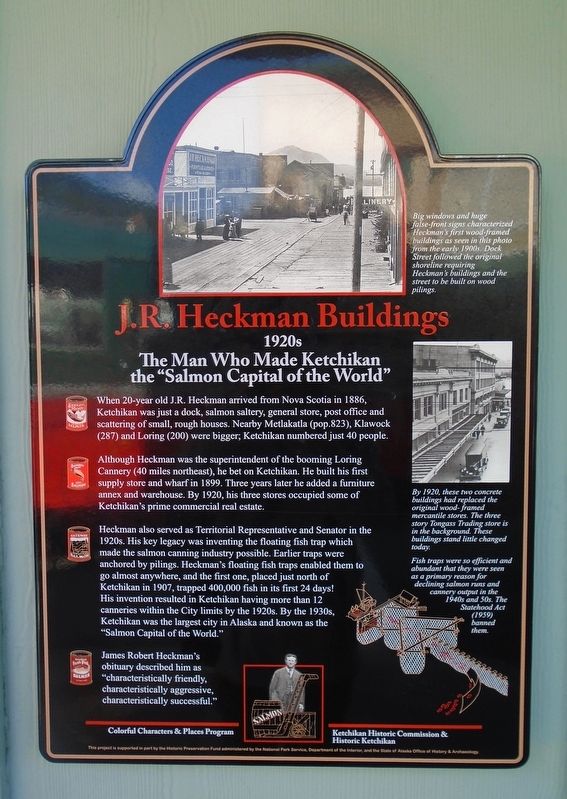
When 20-year old J.R. Heckman arrived from Nova Scotia in 1886, Ketchikan was just a dock, salmon saltery, general store, post office and scattering of small, rough houses. Nearby Metlakatla (pop.823), Klawock (287) and Loring (200) were bigger; Ketchikan numbered just 40 people.
Although Heckman was the superintendent of the booming Loring Cannery (40 miles northeast), he bet on Ketchikan. He built his first supply store and wharf in 1899. Three years later he added a furniture annex and warehouse. By 1920, his three stores occupied some of Ketchikan's prime commercial real estate.
Heckman also served as Territorial Representative and Senator in the 1920s. His key legacy was inventing the floating fish trap which made the salmon canning industry possible. Earlier traps were anchored by pilings. Heckman's floating fish traps enabled them to go almost anywhere, and the first one, placed just north of Ketchikan in 1907, trapped 400,000 fish in its first 24 days! His invention resulted in Ketchikan having more than 12 canneries within the City limits by the 1920s. By the 1930s, Ketchikan was the largest city in Alaska
this page online
James Robert Heckman's obituary described him as "characteristically friendly, characteristically aggressive, characteristically successful."
[Photo captions, top to bottom, read]
• Big windows and huge false-front signs characterized Heckman's first wood-framed buildings as seen in this photo from the early 1900s. Dock Street followed the original shoreline requiring Heckman's buildings and the street to be built on wood pilings.
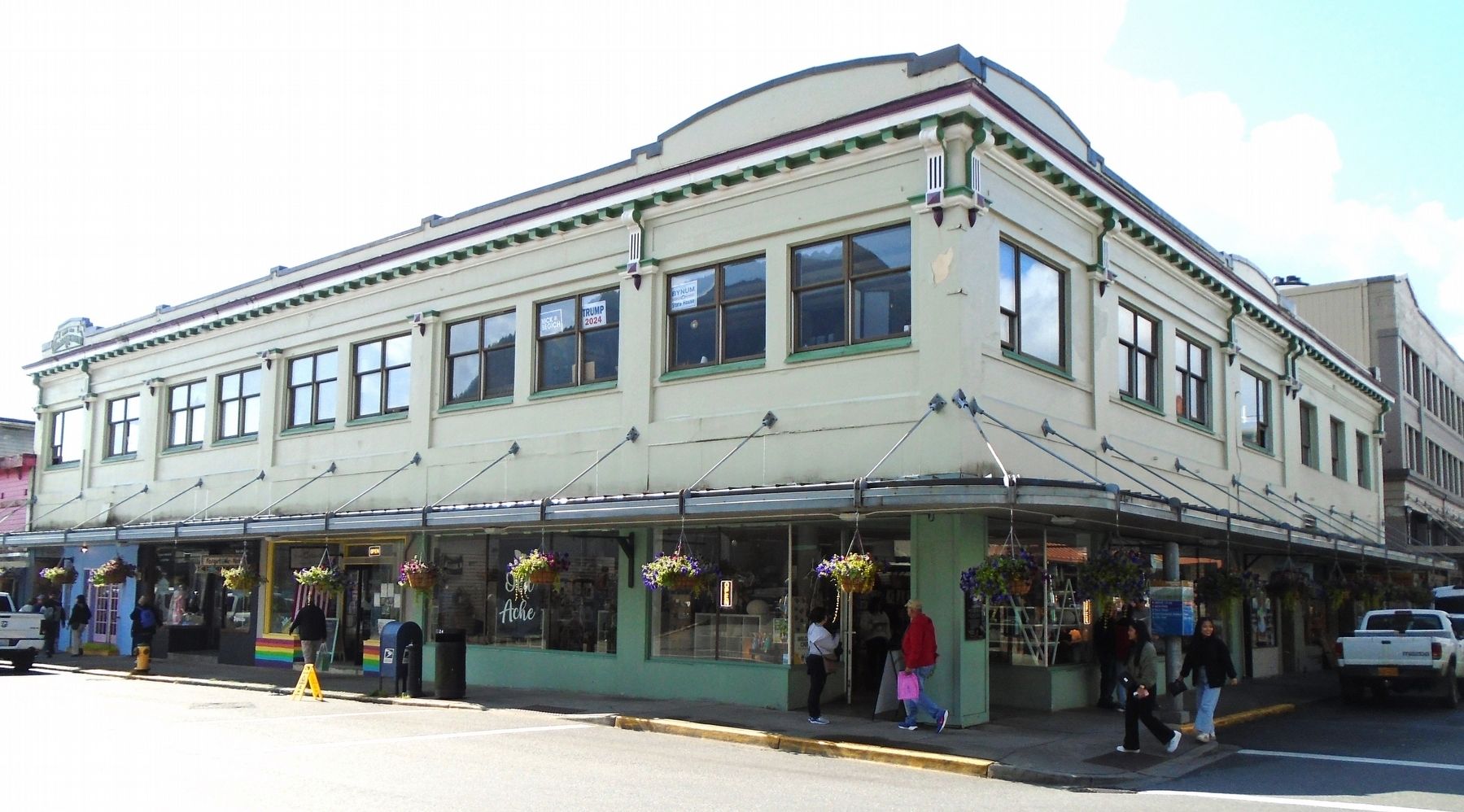
• By 1920, these two concrete buildings had replaced the original wood-framed mercantile stores. The three story Tongass Trading store is in the background. These buildings stand little changed today
• Fish traps were so efficient and abundant that they were seen as a primary reason for declining salmon runs and cannery output in the 1940s and 50s. The Statehood Act (1959) banned them.
Erected by Colorful Characters & Places Program of the Ketchikan Historic Commission & Historic Ketchikan, NPS & State of Alaska.
Topics. This historical marker is listed in these topic lists: Animals • Industry & Commerce • Settlements & Settlers
Photographed by William Fischer, Jr., August 26, 2024
2. J.R. Heckman Buildings
Location. 55° 20.527′ N, 131° 38.795′ W. Marker is in Ketchikan, Alaska, in Ketchikan Gateway Borough. It is at the intersection of Dock Street and Main Street, on the left when traveling east on Dock Street. Touch for map. Marker is at or near this postal address: 326 Dock Street, Ketchikan AK 99901, United States of America. Touch for directions.

Regionally, this marker is in Southeast Alaska, in Tlingit and Haida & Tsimshian Region. It is also on the American Pacific Coast. Globally, it is in North America, in the Inside Passage, on the Pacific Rim, in the Western Hemisphere, in the Western World, and in the Anglosphere. Historically, it finds itself in what was once the Russian Empire.
Other nearby markers. At least 8 other markers are within walking distance of this marker: First National Bank (a few steps from this marker); Tongass Trading Company (within shouting distance of this marker); Pioneer Hall (about 300 feet away, measured in a direct line); The Gilmore Hotel (about 300 feet away); Proud Canoes & Coastal Traders (about 300 feet away); Star-crossed Square Riggers (about 300 feet away); When 'Steam was Queen' (about 300 feet away); Ketchikan Waterfront from Pennock Island, 1905 (about 400 feet away). Touch for a list and map of all markers in Ketchikan.
Credits. This page was last revised on October 6, 2024. It was originally submitted on October 6, 2024, by William Fischer, Jr. of Reynoldsburg, Ohio. This page has been viewed 555 times since then and 86 times this year. Photos: 1, 2. submitted on October 6, 2024, by William Fischer, Jr. of Reynoldsburg, Ohio.
