Bainbridge in Decatur County, Georgia — The American South (South Atlantic)
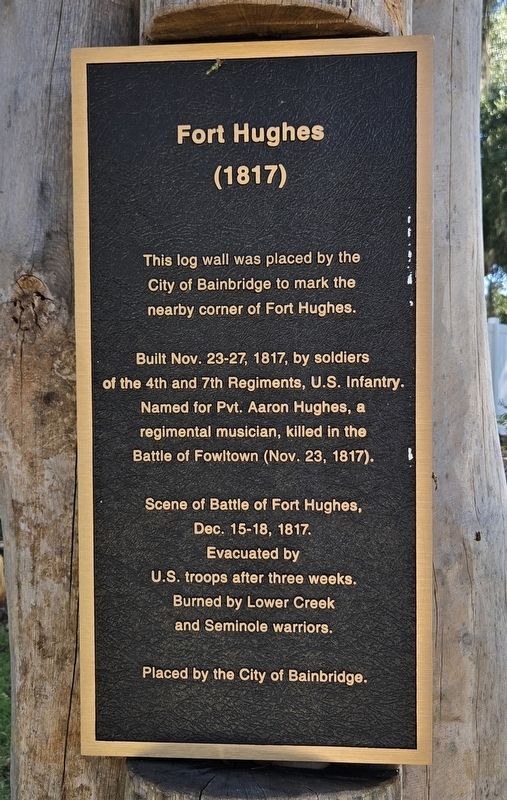
Fort Hughes
(1817)
Photographed by Cosmos Mariner, September 21, 2024
1. Fort Hughes Marker
This log wall was placed by the City of Bainbridge to mark the nearby corner of Fort Hughes.
Built Nov. 23-27, 1817, by soldiers of the 4th and 7th Regiments, U.S. Infantry. Named for Pvt. Aaron Hughes, a regimental musician, killed in the Battle of Fowltown (Nov. 23, 1817).
Scene of Battle of Fort Hughes, Dec. 15-18, 1817. Evacuated by U.S. troops after three weeks. Burned by Lower Creek and Seminole warriors.
Erected by The City of Bainbridge.
Topics. This historical marker is listed in these topic lists: Forts and Castles • Wars, US Indian. A significant historical date for this entry is November 23, 1817.
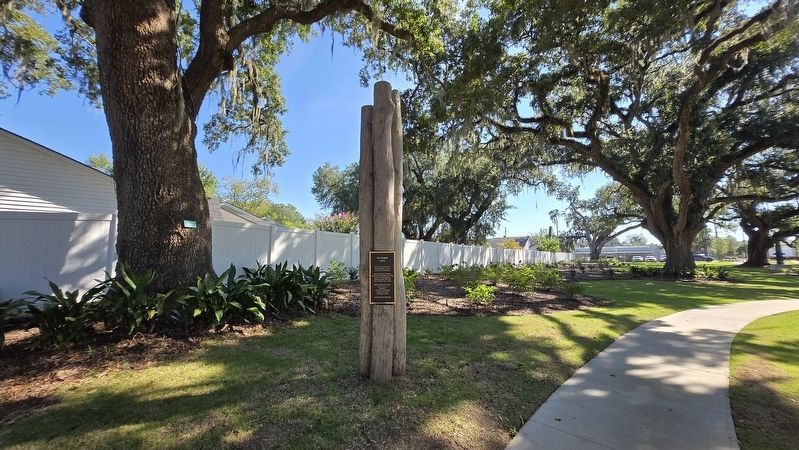
Location. 30° 54.494′ N, 84° 34.757′ W. Marker is in Bainbridge, Georgia, in Decatur County. It can be reached from the intersection of West Jackson Street and North Florida Street, on the right when traveling west. The marker is located along the walkway near the northwest corner of Chason Park. Touch for map. Marker is at or near this postal address: 233 Donalson Street, Bainbridge GA 39817, United States of America. Touch for directions.

Regionally, this marker is on Georgia’s Coastal Plain. It is also in the American South and specifically in the Deep South. Globally, it is in North America, the Western Hemisphere, the Western World, and the Anglosphere. Historically, it finds itself in what was once the territory of the Mississippian Culture, one of the original Thirteen Colonies, one of the Confederate States of America, and the Antebellum South.
Other nearby markers. At least 8 other markers are within walking distance of this marker: The Second Creek War and Removal in the Decatur County Area (here, next to this marker); The Battle of Fowltown (here, next to this marker); Decatur County During the Creek and Seminole Wars Era (here, next to this marker); The First Seminole War in Decatur County
this page online
Related markers. Click here for a list of markers that are related to this marker.
Also see . . . Fort Hughes (Wikipedia).
Excerpt: In 1817, during the First Seminole War, Fort Hughes was built on the south side of the Flint River in what is today Bainbridge, Georgia. It was on a bluff at the west end of today's J. D. Chason Memorial Park. Sovereignty over the land between the Flint River and today's border with Florida was an issue; the battle of nearby Fowltown, November 21–23, 1817, had been over this question. According to the U.S. Government, these lands had been ceded by the Lower Creek Indians in the Treaty of Fort Jackson, whereas the Upper Creeks, also known as Red Stick Creeks or Mikasuki, had not been party to the treaty, did not feel bound by it, and said the land did not belong to the Lower Creeks(Submitted on October 6, 2024, by Cosmos Mariner of Cape Canaveral, Florida.)in the first place.Photographed by Cosmos Mariner, September 21, 20242. Fort Hughes MarkerLooking east through the north side of Chason Park.The Fort consisted of a stockade 90 feet square, with two blockhouses at opposite corners, each 20 feet square. It was named for the only American killed at the Battle of Fowltown, the young fifer Aaron Hughes, whose grave, while unlocated, is believed to be somewhere at the site.
Credits. This page was last revised on October 7, 2024. It was originally submitted on October 6, 2024, by Cosmos Mariner of Cape Canaveral, Florida. This page has been viewed 282 times since then and 36 times this year. Photos: 1, 2. submitted on October 6, 2024, by Cosmos Mariner of Cape Canaveral, Florida.
