Guilford Township near Chambersburg in Franklin County, Pennsylvania — The American Northeast (Mid-Atlantic)
Sergeant Patrick Gass
1771-1870
⎯⎯⎯
The Journey of the Corps of Discovery

Photographed by Duane and Tracy Marsteller, September 26, 2024
1. Sergeant Patrick Gass side of marker
Sergeant Patrick Gass
Early Life
Patrick McLene Gass was born here, at Falling Springs on June 12, 1771 to Scotch-Irish parents, Mary McLene and Benjamin Gass. His uncle William built the 2½ story farmhouse circa 1760 to the west of the garden.
The family moved several times during his boyhood, from Maryland to western Pennsylvania, finally settling in Catfish Camp (Washington, PA).
In his youth Patrick was described as lean and broad-chested, standing at 5'7" with dark hair, gray eyes and a ruddy complexion. Physically strong and quick to learn, he excelled at mastering frontier survival skills.
{Caption) Dawn Among the Cottonwoods - Petty Auger builder's camp Winter 1805 - Michael Haynes 2004 www.mhaynesart.com
The Adventurer
Patrick took the place of his drafted father and joined Virginia's Captain Caton's Company of Rangers in 1792. He fought to repel Indian raids on the colonies' western frontiers under General “Mad Anthony” Wayne.
A year later Gass took a dangerous keelboat trip to New Orleans to sell commodities, traveling rivers through the Ohio and Mississippi territories before returning to
this page online
Upon returning to Mercersburg in 1794 Patrick became a carpenter's apprentice. While working on the James Buchanan homestead he met the very young future president, “Little Jimmy”.
In 1799 Gass enlisted as an Army private, serving under General Alexander Hamilton. Two years later he was stationed in Kaskaskia, Illinois Territory under Captain Bissell. It was there in 1803 that Gass met Captain Meriwether Lewis, who was recruiting men for the Corps of Discovery.
Only those who were “stout, healthy and capable of bearing bodily fatigue in a pretty considerable degree” were selected. Lewis chose one person for every one hundred that applied. Gass's carpentry skills and frontier experience were major assets.
Gass requested to join the Corps, but Capt. Bissell highly valued his carpentry skills and refused the request. Lewis interceded and in January 1804, at age 32, Patrick became the oldest participant chosen by Capt. Lewis and Lt.

Photographed by Duane and Tracy Marsteller, September 26, 2024
2. The Journey of the Corps of Discovery side of marker
The Journey
“On Monday the 14th of May 1804, we left our establishment at the mouth of the river du Bois or Wood river, a small river which falls into the Mississippi, on the east side, a mile below the Missouri, and having crossed the Mississippi proceeded up the Missouri on our intended voyage of discovery.” – Patrick Gass's first entry in A Journal of the Voyages and Travels of a Corps of Discovery, 1807.Patrick wrote in his journal during the entire trip. A self-taught reader and writer, he had spent less than one month in school. With a carpenter's eye, he recorded on June 18, 1804, “… well-timbered land, with ash, sugar tree, black walnut, buck-eye, cotton wood …”.
Two months later on Aug. 22, 1804, Private Gass was elected sergeant by the Corps after the death of Sgt. Charles Floyd. “The Commanding officers have every reason to hope from the previous faithfull services of Sergt. Gass, that this expression of their approbation will be still further confirmed, by his vigilent attention in the future to his duties as a Sergeant. The Commanding officers are still further confirmed in the high opinion they had previously formed of the capacity, deligence and integrety of Sergt. Gass, from the wish expressed by a large majority of his comrades for his appointment as Sergeant.”

Photographed by Duane and Tracy Marsteller, September 26, 2024
3. Sergeant Patrick Gass / The Journey of the Corps of Discovery Marker
The marker is in front of an almshouse built by Franklin County in 1811 next to the house where Gass was born in 1771.
Gass led the construction of 3 winter forts: Camp Dubois (Illinois) 1803-04, Fort Mandan (North Dakota) 1804-05 and Fort Clatsop (Oregon) 1805-06. He also hewed dugout canoes and built huts and wagons.
On June 23, 1805 Lewis chose Gass and two others to execute his “iron boat experiment”. This unfortunately failed due to the lack of proper sealing of elk and buffalo hides covering the hull.
The Corps split into three groups for part of the return trip in March 1806. Sgt. Gass commanded the main body while Lewis and Clark led the smaller parties. After five weeks, they came together near the mouth of the Yellowstone River for the remainder of the trek back to St. Louis.
Gass writes of the journey's final days: “the 19th [Sept.] was a fine day and at daylight we continued with our voyage. Passed the mouth of Mine River. Saw several turkeys on the shores, but did not delay a moment to hunt being so anxious to reach St. Louis, where, without any important occurrence, we arrived on the 23rd and were received with great
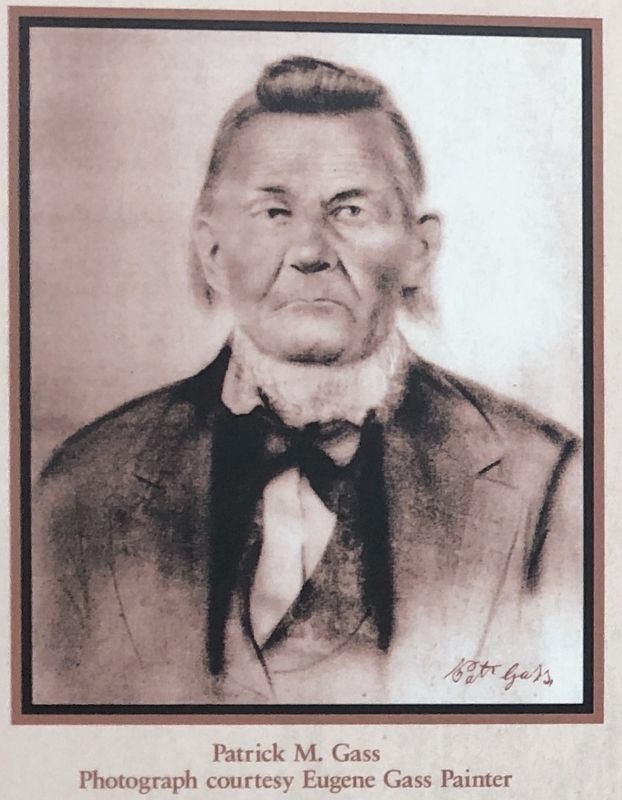
Photographed by Duane and Tracy Marsteller, September 26, 2024
4. Sergeant Patrick Gass / The Journey of the Corps of Discovery Marker detail
The men had survived extreme temperatures, hunger, disease and dangers of the wilderness during the 8,000-mile trip.
In writing to the US Secretary of War, Lewis said of Gass, “the ample support, which he gave me under every difficulty; the manly firmness, which he evinced on every necessary occasion; and the fortitude with which he bore … the fatigues and painful sufferings incident to that long voyage.”
Gass accompanied Lewis to Washington, DC before returning home to Wellsburg, WV.
The Journal
Even though his formal education was meager, he was one of the few men on the Journey able to read and write. Gass entrusted his journal to Wellsburg school teacher David McKeehan for editing and subsequent publication. Its title page (shown here) introduced the public to Jefferson's original phrase “Corps of Discovery”, popularizing it. McKeehan modified Gass's frontier style for publication purposes.
The journal recorded events, landscape, soil, climate, plants and animals. Gass's journal was the first account available
Photographed by Duane and Tracy Marsteller, September 26, 2024
5. The Journey of the Corps of Discovery Marker detail
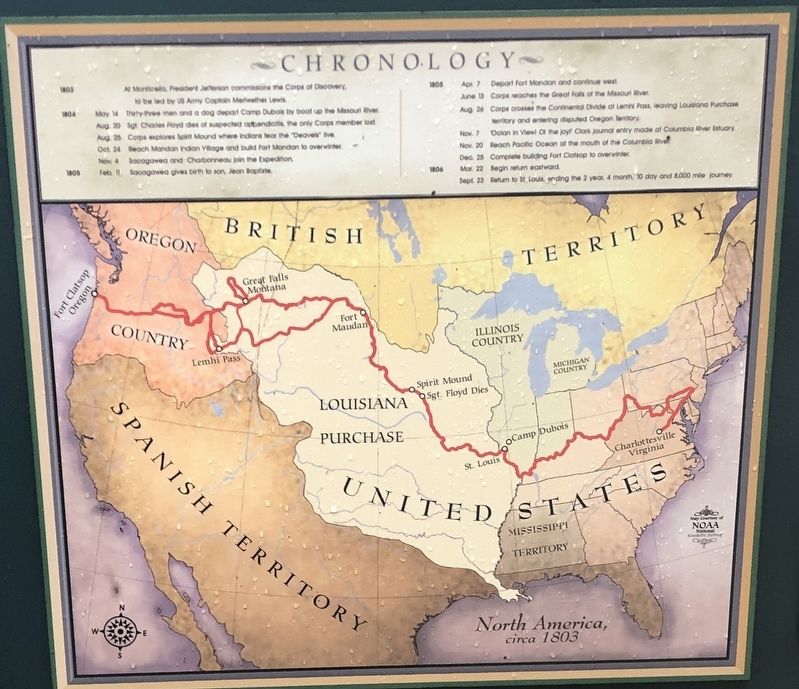
Chronology and route of the expedition.
When it was published in 1807 it sold for $1 per copy. At that time a loaf of bread cost about 12 cents. Patrick Gass was given 100 copies as compensation. Unfortunately Gass's original handwritten journal was destroyed in an 1893 flood.
[Captions (Counterclockwise from top left)]
• Patrick M. Gass Photograph courtesy of Eugene Gass Painter
• Patrick Gass's published journal, 1807 Courtesy West Virginia Division of Culture and History
• Woodcuts by Patrick Gass - 1810 Journal, second edition
• Sgt. Patrick Gass Michael Haynes mhaynesart.com
Return to Service
In 1807 Gass returned to military service in Kaskaskia. His patriotism led him to serve in Western frontier conflicts as well as in Canada from 1792-1815. He proudly fought in the War of 1812 at Lundy's Lane, Niagara Falls, Canada, where he lost vision in one eye from a falling tree splinter.
[Caption)] Lewis iron boat idea - Keith Rocco 2002 Courtesy NPS, Harper's Ferry Design Center, WV
Personal Life
After four decades of adventure and military service he returned to Wellsburg and pursued a variety of livelihoods. He was a brewery manager, ferry tender, millworker, caretaker and stray horse hunter.
Patrick was 60 when he married young Maria Hamilton. He built a log cabin in Pierce's Run, WV and settled down as a farmer, husband and father. Maria died of measles in 1847, shortly after she delivered their seventh child in fifteen years.
In 1855 he rode to Washington, DC as a delegate representing older soldiers asking for more liberal pension reforms. His trip was unsuccessful.
Ever patriotic, Gass volunteered to fight in the Mexican War. During the Civil War the 91-year-old tried to enlist in the Union Army.
Patrick had an incredible constitution. He walked eight miles before noon every day almost until the day he died, April 2, 1870. At age 98, he was the last living Corps survivor. Among his possessions was a razor box carved by Sacagawea and a hatchet he carried on the Expedition. He is buried in Wellsburg, WV.
Patrick M. Gass was born before the Revolutionary War, served in the War of 1812 and witnessed the Mexican and Civil Wars. He voted for 18 Presidents, from Washington to Grant. Patrick contributed significantly to our nation's history.
The Journey of the Corps of Discovery
Chronology
1803 At Monticello, President Jefferson commissions the Corps of Discovery to be led by US Army Captain Meriwether Lewis.
1804
• May 14 – Thirty-three men and a dog depart Camp Dubois by boat up the Missouri River.
• Aug. 20 – Sgt. Charles Floyd dies of suspected appendicitis, the only Corps member lost.
• Aug. 25 – Corps explores Spirit Mound where Indians fear the “Deavels” live.
• Oct. 24 – Reach Mandan Indian Village and build Fort Mandan to overwinter.
• Nov. 4 – Sacagawea and Charbonneau join the Expedition.
1805
• Feb. 11 – Sacagawea gives birth to son, Jean Baptiste.
• Apr. 7 – Depart Fort Mandan and continue west.
• June 13 – Corps reaches the Great Falls of the Missouri River.
• Aug. 26 – Corps crosses the Continental Divide at Lemhi Pass, leaving Louisiana Purchase territory and entering disputed Oregon Territory.
• Nov. 7 – ‘Ocean in view! O the joy!’ Clark journal entry made at Columbia River Estuary.
• Nov. 20 – Reach Pacific Ocean at the mouth of the Columbia River.
• Dec. 25 – Complete building Fort Clatsop to overwinter.
1806
• Mar. 22 – Begin return eastward.
• Sept. 23 – Return to St. Louis, ending the 2 year, 4 month, 10 day and 8,000 mile journey.
[Captions]
(Left side, top to bottom)
• Bartering Blue Beads for Otter Robe - Newman Myrah circa 1950 Lewis and Clark National Historical Park Collection, Courtesy National Park Service
• Lewis and Clark on the Lower Columbia - Charles M. Russell, 1905 Courtesy Amon Carter Museum of American Art, Fort Worth, Texas
• Spirit of Discovery - John Paul Strain 1903
(Center, bottom) Fort Mandan in Winter - Ralph W. Smith circa 1950 Courtesy of State Historical Society of North Dakota
(Right side, top to bottom)
• Lewis and Clark, The Departure from the Wood River Encampment, May 14, 1804 - Gary R. Lucy Courtesy of the Gary R. Lucy Gallery, Inc., Washington, MO www.garylucy.com
• With All Honors of War - The Burial of Sgt. Charles Floyd, Aug. 20, 1804 - Michael Haynes 2002 www.mhaynesart.com
• Lewis and Clark's Spirit Mound - Ron Backer 1988
The Gass Garden Committee recognizes Gass's great-grandson Eugene Gass Painter for his contributions to this panel
Erected by The Gass Garden Committee.
Topics. This historical marker is listed in these topic lists: Exploration • War of 1812 • Wars, US Indian. A significant historical date for this entry is June 12, 1771.
Location. 39° 55.786′ N, 77° 37.781′ W. Marker is near Chambersburg, Pennsylvania, in Franklin County. It is in Guilford Township. It is on Franklin Farms Lane 0.1 miles north of Lincoln Highway (U.S. 30), on the left when traveling north. Touch for map. Marker is at or near this postal address: 181 Franklin Farms Ln, Chambersburg PA 17202, United States of America. Touch for directions.

Regionally, this marker is in South-Central Pennsylvania. It is also in the American Northeast, in the Mid-Atlantic, in Appalachia, and specifically in Northern Appalachia. Globally, it is in North America, the Western Hemisphere, the Western World, and the Anglosphere. Historically, it finds itself in what was once the Haudenosaunee (Iroquois) Confederacy and also one of the original Thirteen Colonies.
Other nearby markers. At least 8 other markers are within 2 miles of this marker, measured as the crow flies: The Gass House (here, next to this marker); Patrick Gass (a few steps from this marker); Gettysburg Campaign (approx. ¼ mile away); Chambersburg (approx. 0.4 miles away); Timothy G. McCarthy (approx. 0.8 miles away); Messersmith's Woods (approx. 0.8 miles away); S. Sergt Glenn O. Elliott (approx. 0.8 miles away); Franklin County World War I Memorial (approx. 1.2 miles away). Touch for a list and map of all markers in Chambersburg.
Credits. This page was last revised on October 8, 2024. It was originally submitted on October 8, 2024, by Duane and Tracy Marsteller of Murfreesboro, Tennessee. This page has been viewed 549 times since then and 108 times this year. Photos: 1, 2, 3, 4, 5. submitted on October 8, 2024, by Duane and Tracy Marsteller of Murfreesboro, Tennessee.
