Civic Center in Denver in Denver County, Colorado — The American Mountains (Southwest)
Civic Center
The Heart of Denver

Photographed by Craig Baker, August 22, 2024
1. Civic Center Marker
An Ideal of Beauty
Civic Center was originally conceived as an ideal of beauty, ultimately merging several design schemes to give it its final form. Its history dates back to 1905, when Mayor Robert Speer's Art Commission hired noted planner Charles Mulford Robinson to design a plan promoting a "civic renaissance" for Denver, with a "civic center" in the heart of the city. It was delayed in 1909, when a bond proposal to begin acquisition of land did not pass a public vote. Mayor Speer persisted, commissioning sculptor Frederick MacMonnies to revise the plan. MacMonnies' simple solution proposed a grand central park, with a view that extended west to the Rocky Mountains. This won over Denver citizens, who approved initial funding for the project.
The Carnegie Library
Dedicated in 1910, the library was the first building to be constructed on the new civic center site. The Greek Revival style library was designed by Albert Ross of New York and funded with a $200,000 gift from steel magnate and philanthropist Andrew Carnegie. Its architectural style was consistent with the Art Commission's vision, and with the neoclassical aesthetic of the City Beautiful Movement.
Re-elected in 1916, Mayor Robert Speer immediately broke ground for one of the monumental colonnades defining the north and south boundaries of the Park that were essential features of his plan. By the time of his premature death in 1918, the "Colonnade of Civic Benefactors," to the south (now known as the Greek Theater), was well on the way to being completed.
The Vision Begins to Take Form
In 1912, the Olmsted Brothers landscape architecture firm from Brookline, Massachusetts was hired to assist the Park Board with their efforts to create a park system. Frederick Law Olmsted
this page online
The DeBoer Plan
In 1924, well-known City Beautiful landscape architect S.R. DeBoer created a new plan for Civic Center. DeBoer envisioned a broad, central mall that would extend from Bannock Street to Speer Boulevard to the west. The 'mall' was to be aligned along the central axis and, in the keeping with the axial symmetry of the civic center, it was to consist of a a broad central lawn flanked by civic buildings. This plan has played an important role in current developments

Photographed by Craig Baker, August 22, 2024
2. Civic Center Marker
A Civic Center
Chicago architect Edward H. Bennett was hired to complete Civic Center after Mayor Speer's return to office in 1916. Bennett produced a plan that adapted the McMonnies design framework with features of the other designs. Olmsted's concert grove became Bennett's Greek Theater, while the sunken pool and gardens became a sculpture garden with a classical gateway that included the Colonnade of Civic Benefactors. For the most part, Olmsted's concept remained the visible framework for the park.
The Bennett plan was adopted and construction of the Greek Theater and the re-alignment of 14th Avenue began in 1919. By 1920, the Voorhies Memorial was built and traffic on Colfax was re-routed along an ellipse, mirroring the design for 14th Avenue. Bennett conceived of the space as a "Civic Center" - a grand open space where thousands of citizens could gather, or individuals could contemplate in solitude. A park offering imposing monuments balanced with lawns and trees. Other plans for Civic Center have been proposed over the years, but the classical designs of the Bennett plan remain as the dominant features of the park today.
A Place for History
Since it first opened, music, community gatherings, and political events have been traditions at Civic Center. Beginning in 1915, the Denver Municipal Band, in existence since 1892 and one of the oldest on-going municipal bands in the country, began performing in the Greek Theater. In 1895, the first Festival of Mountain and Plain was held on this site. The festival was organized to boost community spirit and pride after the silver panic and economic downturn of 1893.
"The Burning Issues Forum," organized in the summer of 1920 in the Greek Theater, allowed anyone to take the
Photographed by Craig Baker, August 22, 2024
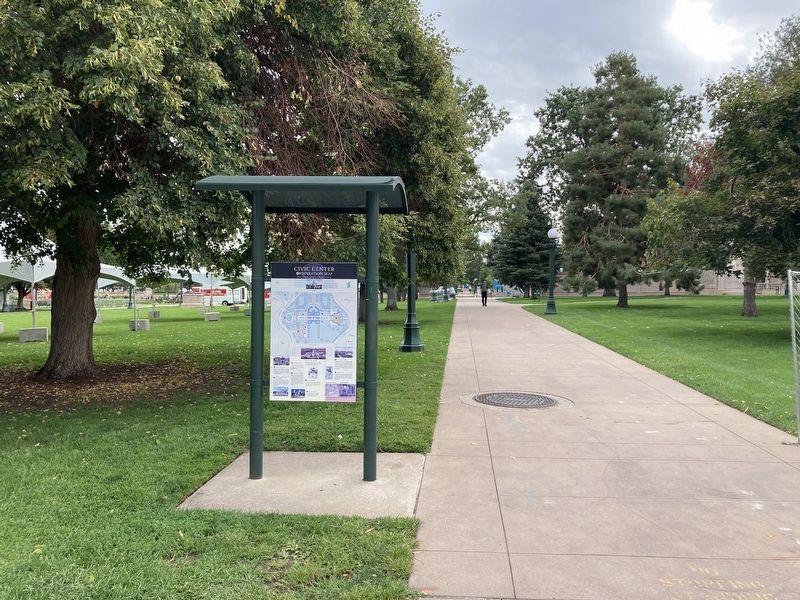
3. Civic Center Marker
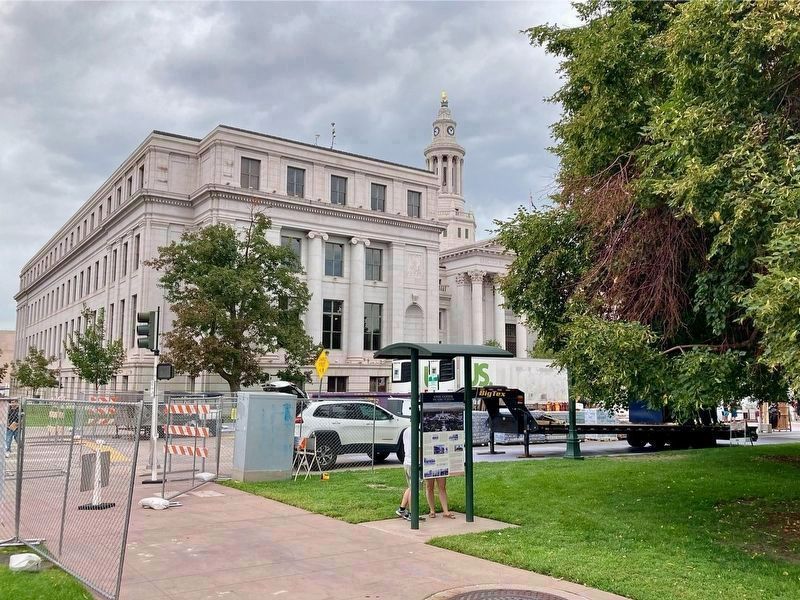
The City & County Building is in the background.
Pioneer Monument
Dedicated in 1911, the sculpture depicts Kit Carson atop a fountain surrounded by 3 sculptures: a prospector, a hunter, and a pioneer woman with her child. The sculpture, created by American artist Frederick MacMonnies, symbolically marks the end of the Smokey Hill Trail used by early settlers.
Voorhies Memorial and Seal Fountain
Banker and successful mining entrepreneur John E. Voorhies donated funds to build this memorial. Designed by Willam Ellsworth and Arthur Addison Fisher, the structure was meant to resemble the Water Gateway at the 1893
Photographed by Craig Baker, August 22, 2024
4. Civic Center Marker
Columbus Statue
Presented to the City of Denver by Alfred and Anna Adamo in 1970, the statue honors the state of Colorado as the first to officially recognize Columbus Day as a holiday.
McNichols Building
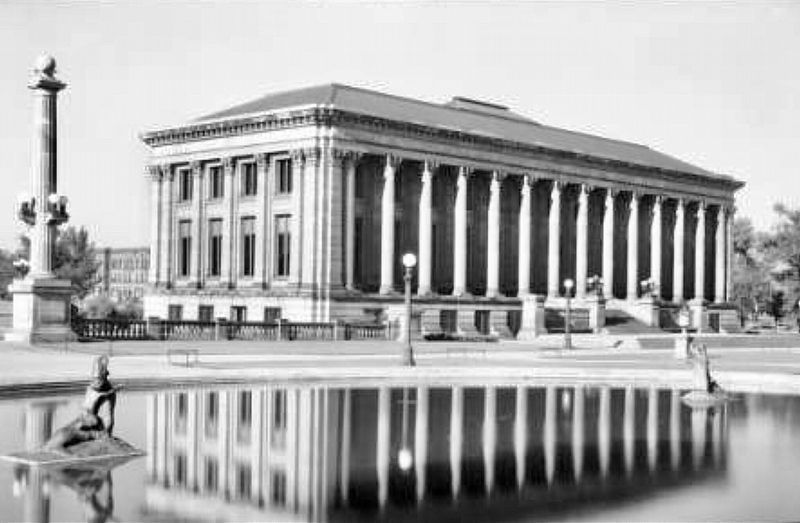
Dedicated in 1910, this Greek Revival style building was originally Denver's main public library. Funded by a gift from steel magnate and philanthropist Andrew Carnegie, the Carnegie Library was the first building on the Civic Center site. It is now used as offices for City staff. The building is constructed of Turkey Creek gray sandstone from Stone City, near Pueblo. The foundation is made of Pike's Peak granite.
City & County Building
Across Bannock Street (behind you, and to the west) stands Denver's City & County Building. Completed in 1932, the building is constructed of granite from Colorado and Georgia.
On The Warpath
A tribute to Native Americans, the companion piece to the "Bronco Buster" was sculpted by Denver artist Alexander Phimister Proctor. The sculpture was presented to Denver by Stephen Knight
from McNicholsBuilding.com
5. Carnegie Library
Today this is the McNichols Building.
Flower Gardens
Each spring, thousands of flowers are planted in formal gardens at the Park, creating a spectacular summer display in the center of the park.
The Greek Theater
This classical revival structure was designed by Denver architects Willis A. Marean and Albert J. Norton. The theater has two elements: the temple-like Colonnade of Civic Benefactors which flanks and includes the stage, and the open air amphitheater which includes the circular brick plaza ringed by the stepped seating area. Public concerts at the theater in 1920 by the Denver Municipal Band began its enduring popularity as a forum for free civic events.
Bronco Buster
A tribute to the American cowboy, and presented to Denver by philanthropist and businessman John K. Mullen in 1920, the sculpture was created by Denver artist Alexander Phimister Proctor. Proctor was best known for his life-sized animal sculptures shown at the 1893 World's Columbian Exhibition in Chicago.
Erected by City of Denver.
Topics and series. This historical marker is listed in these topic lists: Architecture • Arts, Letters, Music • Government & Politics • Parks & Recreational Areas. In addition, it is included in the Carnegie Libraries series list. A significant historical year for this entry is 1905.
Location. 39° 44.315′ N, 104° 59.407′ W. Marker is in Denver, Colorado, in Denver County. It is in Civic Center. It is at the intersection of Bannock Street and 14th Avenue, on the right when traveling north on Bannock Street. Touch for map. Marker is at or near this postal address: 1400 Bannock St, Denver CO 80202, United States of America. Touch for directions.

Regionally, this marker is in the Front Range. It is also in the American Mountain West. Globally, it is in North America, the Rocky Mountains, the Western Hemisphere, the Western World, and the Anglosphere. Historically, it finds itself in what was once the Louisiana Purchase.
Other nearby markers. At least 8 other markers are within walking distance of this marker: Broncho Buster (about 300 feet away, measured in a direct line); On The War Trail (about 400 feet away); In Honor of Christopher Columbus (about 500 feet away); Passing of the Street Car (about 800 feet away); Smoky Hill Trail (approx. 0.2 miles away); In Memory of Sadie M. Likens (approx. 0.2 miles away); General Rose Monument (approx. 0.2 miles away); Alfred Dach (approx. 0.2 miles away). Touch for a list and map of all markers in Denver.
Also see . . . Civic Center Park. - Photos, history, and an audio architecture tour. (Submitted on October 9, 2024.)
Credits. This page was last revised on October 9, 2024. It was originally submitted on October 9, 2024, by Craig Baker of Sylmar, California. This page has been viewed 421 times since then and 62 times this year. Photos: 1, 2, 3, 4, 5. submitted on October 9, 2024, by Craig Baker of Sylmar, California.
