Swope Parkway - Elmwood in Kansas City in Jackson County, Missouri — The American Midwest (Upper Plains)
The Battle of Westport, October 21-23, 1864
| — | Battle of Westport • Byram's Ford • Big Blue Battlefield • 22-23 October 1864 | — |
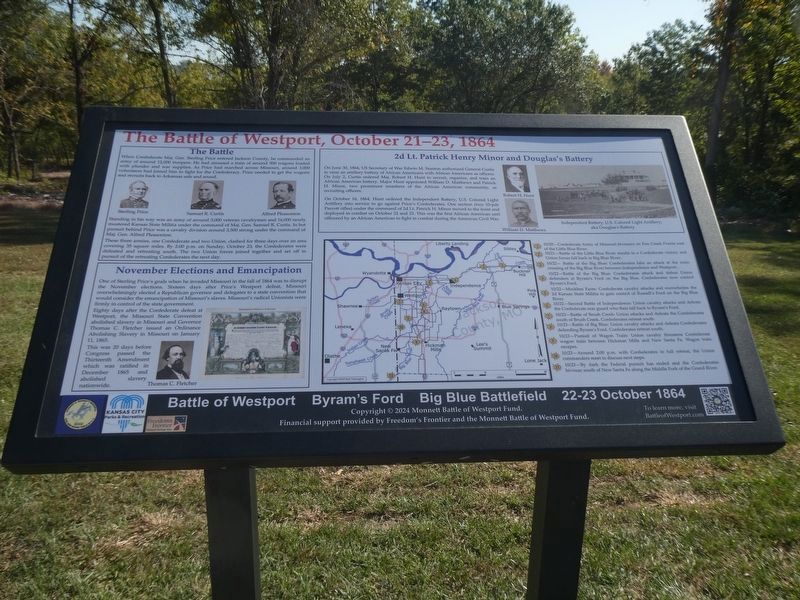
Photographed by Robert J Macoubrie, October 3, 2024
1. The Battle of Westport Marker
The Battle
When Confederate Maj. Gen. Sterling Price entered Jackson County, he commanded an army of around 12,000 troopers. He had amassed a train of around 500 wagons loaded with plunder and war supplies. As Price had marched across Missouri, around 3,000 volunteers had joined him to fight for the Confederacy. Price needed to get the wagons and recruits back to Arkansas safe and sound.
(caption) Sterling Price • Samuel R. Curtis • Alfred Pleasonton
Standing in his way was an army of around 3,000 veteran cavalrymen and 16,000 newly mustered Kansas State Militia under the command of Maj. Gen. Samuel R. Curtis. In hot pursuit behind Price was a cavalry division around 3,500 strong under the command of Maj. Gen. Alfred Pleasonton.
These three armies, one Confederate and two Union, clashed for three days over an area covering 35 square miles. By 2:00 p.m. on Sunday, October 23, the Confederates were defeated and retreating south. The two Union forces joined together and set off in pursuit of the retreating Confederates the next day.
November Elections and Emancipation
One of Sterling Price's goals when he invaded
this page online
This was 20 days before Congress passed the Thirteenth Amendment which was ratified in December 1865 and abolished slavery nationwide.
(caption) Thomas C. Fletcher
2d Lt. Patrick Henry Minor and Douglas's Battery
On June 30, 1864, US Secretary of War Edwin M. Stanton authorized General Curtis to raise an artillery battery of African Americans with African Americans as officers. On July 2, Curtis ordered Maj. Robert H. Hunt to recruit, organize, and train an African American battery. Major Hunt appointed William D. Matthews and Patrick H. Minor, two prominent members of the African American community, as recruiting officers.
On October 16, 1864, Hunt ordered the Independent Battery, U.S. Colored Light Artillery into service to go against Price's Confederates. One section (two 10-pdr Parrott rifles) under the command of 2d Lt. Patrick H. Minor moved to the front and deployed in combat on October 22 and 23. This was the first African American unit officered by an African American to fight in combat during the American Civil War.
(caption) Robert H. Hunt • William D. Matthews
Independent Battery, U.S. Colored Light Artillery, aka Douglas's Battery
(1) • 10/20-Confederate Army of Missouri bivouacs on Fire Creek Prairie east of the Little Blue River.
(2) • 10/21-Battle of the Little Blue River results in a Confederate victory and Union forces fall back to Big Blue River.
(3) • 10/22- Battle of the Big Blue: Confederates fake an attack at the main crossing of the Big Blue River between Independence and Westport.
(4) • 10/22-Battle of the Big Blue: Confederates attack and defeat Union defenders at Byram's Ford on the Big Blue. Confederates now control Byram's Ford.
(5) • 10/22-Mockbee Farm: Confederate cavalry attacks and overwhelms the 2d Kansas State Militia to gain control of Russell's Ford on the Big Blue River.
(6) • 10/22-Second Battle of Independence: Union cavalry attacks and defeats the Confederate rear guard who then fall back to Byram's Ford.
(7) • 10/23-Battle of Brush Creek: Union attacks and defeats the Confederates south of Brush Creek. Confederates retreat south.
(8) • 10/23-Battle of Big Blue: Union cavalry attacks and defeats Confederates defending Byram's Ford. Confederates retreat south.
(9) • 10/23-Pursuit of Wagon Train: Union cavalry threatens Confederate wagon train between Hickman Mills and New Santa Fe. Wagon train escapes.
(10) • 10/23-Around 2:00 p.m. with Confederates in full retreat, the Union commanders meet to discuss next steps.
(11) • 10/23-By dark the Federal pursuit has ended and the Confederates bivouac south of New Santa Fe along the Middle Fork of the Grand River.
Copyright 2024 Monnett Battle of Westport Fund. Financial support provided by Freedom's Frontier and the Monnett Battle of Westport Fund.
Erected 2024 by Freedom's Frontier and the Monnett Battle of Westport Fund.
Topics. This historical marker is listed in these topic lists: African Americans • War, US Civil. A significant historical date for this entry is October 21, 1864.
Location. 39° 0.892′ N, 94° 31.807′ W. Marker is in Kansas City, Missouri, in Jackson County. It is in Swope Parkway - Elmwood. It can be reached from East 63rd Street west of Manchester Trafficway, on the right when traveling west. Located near the Water Services Department. Touch for map. Marker is at or near this postal address: 4800 E 63rd St, Kansas City MO 64130, United States of America. Touch for directions.

Regionally, this marker is in the American Midwest, in the Lewis & Clark Corridor, in the Corn Belt, and on the Santa Fe Trail Corridor. Globally, it is in North America, the Western Hemisphere, the Western World, and the Anglosphere. Historically, it finds itself in what was once the territory of the Mississippian Culture, the Louisiana Purchase, and the Antebellum South.
Other nearby markers. At least 8 other markers are within walking distance of this marker: Marmaduke's Defense Line, October 23, 1864 (within shouting distance of this marker); The Log House, October 23, 1864 (within shouting distance of this marker); Pratt's Artillery (about 500 feet away, measured in a direct line); Battle of the Big Blue (about 500 feet away); Byram's Ford Battlefield (about 800 feet away); Battle of the Big Blue, October 22, 1864 (approx. 0.2 miles away); a different marker also named Battle of Westport (approx. ¼ mile away); a different marker also named Battle of the Big Blue (approx. ¼ mile away). Touch for a list and map of all markers in Kansas City.
Also see . . . Battle of Westport. Three day campaign fought from October 21 - 23, 1864 (Submitted on October 12, 2024.)
Credits. This page was last revised on November 22, 2024. It was originally submitted on October 11, 2024, by Robert J Macoubrie of Olathe, Kansas. This page has been viewed 842 times since then and 104 times this year. Photo 1. submitted on October 11, 2024, by Robert J Macoubrie of Olathe, Kansas. • Bernard Fisher was the editor who published this page.
Editor’s want-list for this marker. Wide shot of marker and its surroundings. • Can you help?
