Crisfield in Somerset County, Maryland — The American Northeast (Mid-Atlantic)
Crab Pots
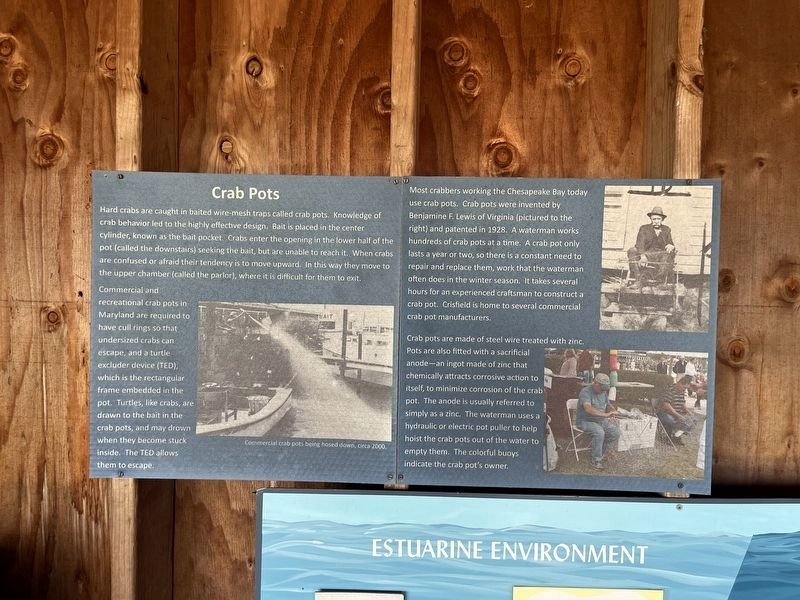
Hard crabs are caught in bated wire-mesh traps called crab pots. Knowledge of crab behavior led to the highly effective design. Bait is placed in the center cylinder, known as the bait pocket. Crabs enter the opening in the lower half of the pot (called the downstairs) seeking the bait, but are unable to reach it. When crabs are confused or afraid of their tendency is to move upward. In this way they move to the upper chamber (called the parlor), where it is difficult for them to exit.
Commercial and recreational crab pots in Maryland are required to have cull rings so that undersized crabs can escape, and a turtle excluder devise (TED), which is the rectangular frame embedded in the pot. Turtles, like crabs, are drawn to the bait in the crab pots, and may drown when they become stuck inside. The TED allows them to escape.
Most crabbers working the Chesapeake Bay today use crab pots. Crab pots were invented by Benjamine F. Lewis of Virginia (pictured to the right) and patented in 1928. A waterman works hundreds of crab pots at a time. A crab pot only lasts a year or two, so there is a constant need to repair
this page online
Crab pots are made of steel wire treated with zinc. Pots are also fitted with a sacrificial anode—an ingot made of zinc that chemically attracts corrosive action to itself, to minimize corrosion of the crab pot. The anode is usually referred to simply as a zinc. The waterman uses a hydraulic or electric pot puller to help hoist the crab pots out of the water to empty them. The colorful buoys indicate the crab pot's owner.
Erected by Crisfield Heritage Foundation.
Topics. This historical marker is listed in these topic lists: Animals • Industry & Commerce • Waterways & Vessels. A significant historical year for this entry is 1928.
Location. 37° 58.683′ N, 75° 51.571′ W. Marker is in Crisfield, Maryland, in Somerset County. It can be reached from the intersection of Spruce Street and 9th Street, on the right when traveling east. Touch for map. Marker is at or near this postal address: 927 Spruce St, Crisfield
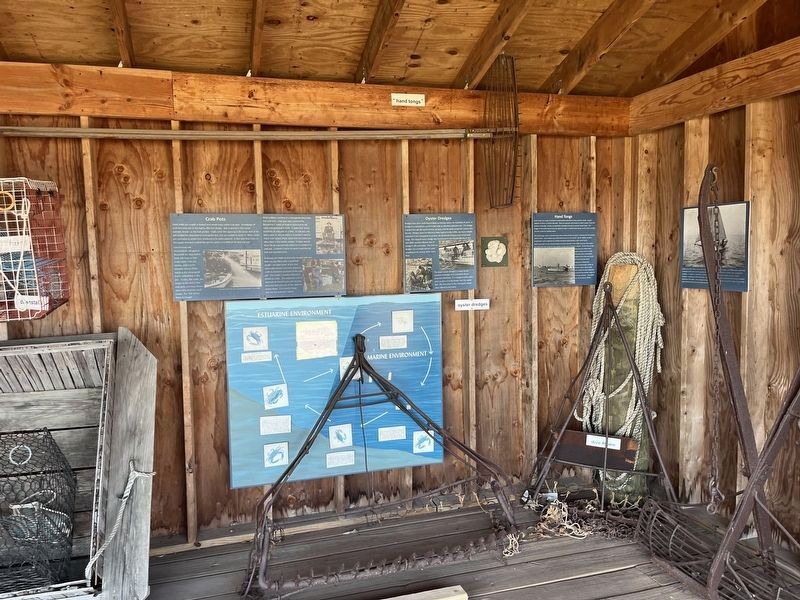

Regionally, this marker is on the Eastern Shore. It is also in the American Mid-Atlantic, on the Delmarva Peninsula, in the Tidewater, in the Chesapeake Bay Region, and on the Eastern Seaboard. Globally, it is in the North Atlantic Region, North America, the Western Hemisphere, the Western World, and the Anglosphere. Historically, it finds itself in what was once one of the original Thirteen Colonies and also the Antebellum South.
Other nearby markers. At least 8 other markers are within walking distance of this marker: Crab Shedding Float (here, next to this marker); Crab Scrape (here, next to this marker); African American Watermen of the Chesapeake (here, next to this marker); Oyster Dredges (here, next to this marker); Drop Tongs (here, next to this marker); Hand Tongs (here, next to this marker); Skipjacks and Bugeyes (here, next to this marker); Watermen of the Tangier Sound (here, next to this marker). Touch for a list and map of all markers in Crisfield.
Credits. This page was last revised on October 13, 2024. It was originally submitted on October 13, 2024, by Devry Becker Jones of Washington, District of Columbia. This page has been viewed 378 times since then and 74 times this year. Photos: 1, 2. submitted on October 13, 2024, by Devry Becker Jones of Washington, District of Columbia.
