Crisfield in Somerset County, Maryland — The American Northeast (Mid-Atlantic)
The Crab Shanty
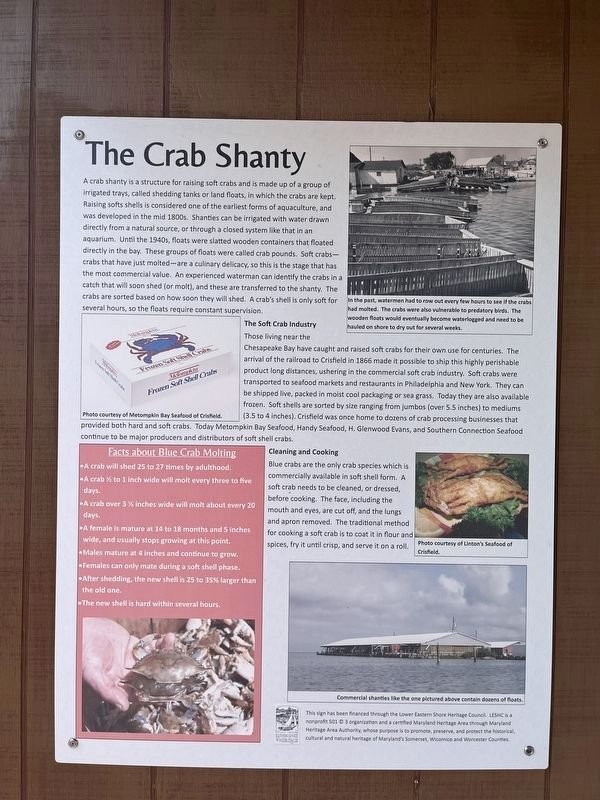
A crab shanty is a structure for raising soft crabs and is made of a group of irrigated trays, called shedding tanks or land floats, in which the crabs are kept. Raising softs shells is considered one of the earliest forms of aquaculture, and was developed in the mid 1800s. Shanties can be irrigated with water drawn directly from a natural source, or through a closed system like that in an aquarium. Until the 1940s, floats were slatted wooden containers that floated directly into the bay. These groups of floats were called crab pounds. Soft crabs—crabs that have just molted—are a culinary delicacy, so this is the stage that has the most commercial value. An experienced waterman can identify the crabs in the catch that will soon shed (or molt), and these are transferred to the shanty. The crabs are sorted based on how soon they will shed. A crab's shell is only soft for several hours, so the floats require constant supervision.
The Soft Crab Industry
Those living near the Chesapeake Bay have caught and raised soft crabs for their own use for centuries. The arrival of the railroad to Crisfield in 1866 made it possible
this page online
Cleaning and Cooking
Blue crabs are the only crab species which is commercially available in soft shell form. A soft crab needs to be cleaned, or dressed before cooking. The face, including the mouth and eyes are cut off, and the lungs and apron removed. The traditional method for cooking a soft crab is to coat it in flour and spices, fry it until crisp, and serve it on a roll.
Facts about Blue Crab Molting • A crab will she 25 to 27 times by adulthood.
• A crab½ to 1 inch wide will molt every three to five days.
• A crab over 3 ½ inches wide will molt about every 20 days.
• A female is mature at 14 to 18 months and 5 inches wide, and usually stops growing at this point.
• Males mature at 4 inches and continue to grow.
• Females can only mate during a soft shell phase.
• After shedding, the new shell is 25 to 35% larger than the old one.
• The new shell is hard within several hours.
[Captions:]
In the past, watermen had to row out every few hours to see if the crabs had molted. The crabs were also vulnerable to predatory birds. The wooden floats would eventually become waterlogged and need to be hauled on shore to dry out for several weeks.
Commercial shanties like the one pictured above contain dozens of floats.
Erected by Lower Eastern Shore Heritage Council.
Topics. This historical marker is listed in these topic lists: Animals • Industry & Commerce • Waterways & Vessels. A significant historical year for this entry is 1866.
Location. 37° 58.679′ N, 75° 51.566′ W. Marker is in Crisfield, Maryland, in Somerset County. It can be reached from the intersection

Photographed by Devry Becker Jones (CC0), October 12, 2024
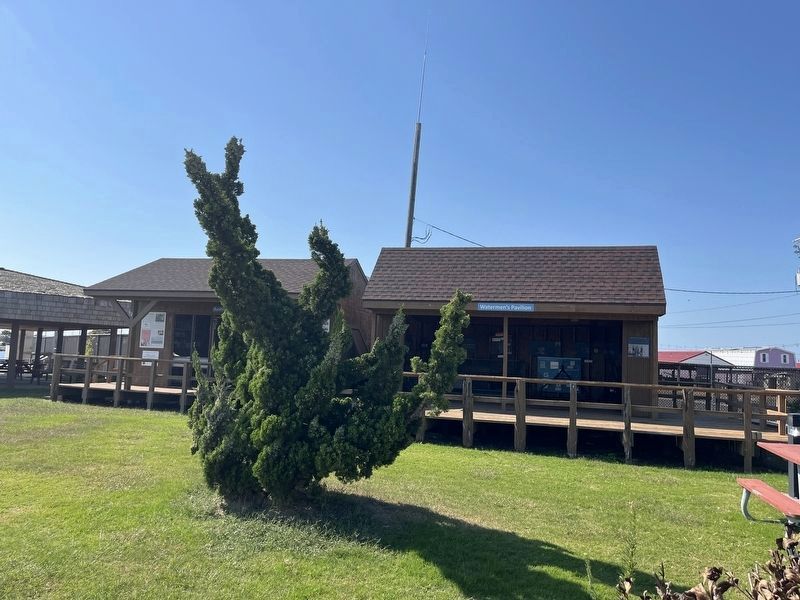
3. Dedication plaque for the shanty display

Regionally, this marker is on the Eastern Shore. It is also in the American Mid-Atlantic, on the Delmarva Peninsula, in the Tidewater, in the Chesapeake Bay Region, and on the Eastern Seaboard. Globally, it is in the North Atlantic Region, North America, the Western Hemisphere, the Western World, and the Anglosphere. Historically, it finds itself in what was once one of the original Thirteen Colonies and also the Antebellum South.
Other nearby markers. At least 8 other markers are within walking distance of this marker: African American Watermen of the Chesapeake (here, next to this marker); Crab Scrape (a few steps from this marker); Crab Pots (a few steps from this marker); Crab Shedding Float (a few steps from this marker); Oyster Dredges (a few steps from this marker); Drop Tongs (a few steps from this marker); Hand Tongs (a few steps from this marker); Watermen of the Tangier Sound (a few steps from this marker).
Photographed by Devry Becker Jones (CC0), October 12, 2024
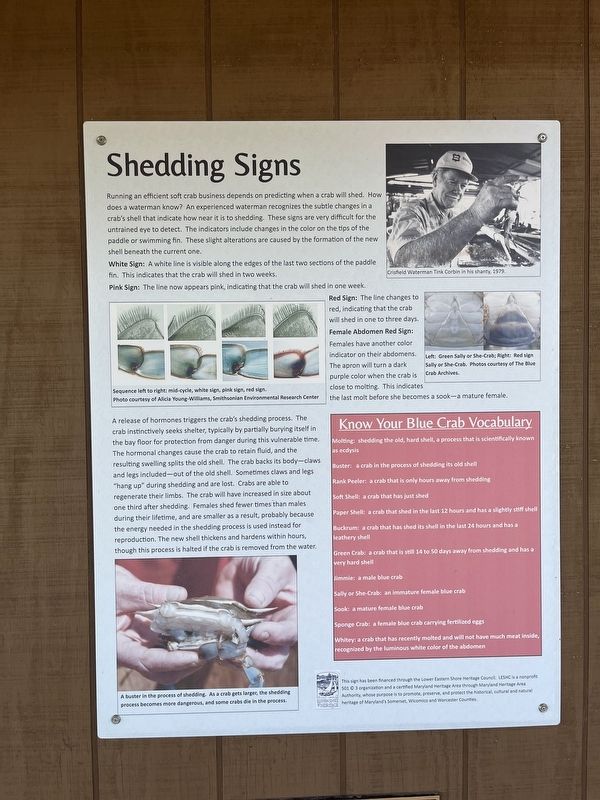
4. Shedding Signs signage featuring the shedding process
Credits. This page was last revised on October 13, 2024. It was originally submitted on October 13, 2024, by Devry Becker Jones of Washington, District of Columbia. This page has been viewed 315 times since then and 46 times this year. Photos: 1, 2, 3, 4. submitted on October 13, 2024, by Devry Becker Jones of Washington, District of Columbia.
