Lower Saucon Township near Hellertown in Northampton County, Pennsylvania — The American Northeast (Mid-Atlantic)
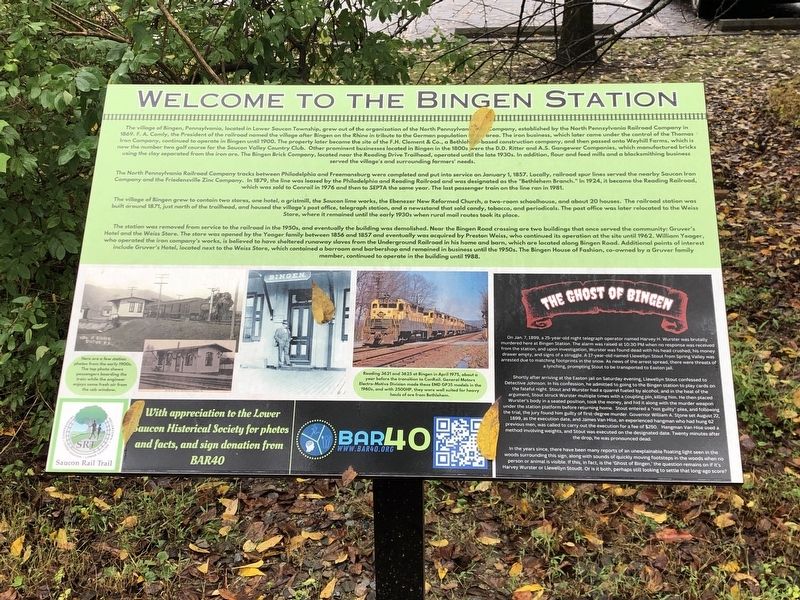
Welcome to the Bingen Station
Photographed by Duane and Tracy Marsteller, September 28, 2024
1. Welcome to the Bingen Station Marker
The village of Bingen, Pennsylvania, located in Lower Saucon Township, grew out of the organization of the North Pennsylvania Iron Company, established by the North Pennsylvania Railroad Company in 1869. F.A. Comly, the President of the railroad need the village after Bingen on the Rhine in tribute to the German population of the area. The iron business, which later come under the control of the Thomas Iron Company, continued to operate in Bingen until 1900. The property later become the site of the F.H. Clement & Co., a Bethlehem-based construction company, and then passed on to Weyhill Farms, which is now the number two golf course for the Saucon Valley Country Club. Other prominent businesses located in Bingen in the 1800s were the D.D. Ritter and A.S. Gangewer Companies, which manufactured bricks using the clay separated from the iron ore. The Bingen Brick Company, located near the Reading Drive Trailhead, operated until the late 1930s. In addition, flour and feed mills and a blacksmithing business served the village's and surrounding farmers' needs.
The North Pennsylvania Railroad Company tracks between Philadelphia
this page online
The village of Bingen grew to contain two stores, one hotel, a gristmill, the Saucon lime works, the Ebenezer New Reformed Church, a two-room schoolhouse, and about 20 houses. The railroad station was built around 1871, just north of the trailhead, and housed the village's post office, telegraph station, and a newsstand that sold candy, tobacco, and periodicals. The post office was later relocated to the Weiss Store, where it remained until the early 1930s when rural mail routes took its place.
The station was removed from service to the railroad in the 1950s, and eventually the building was demolished. Near the Bingen Road crossing are two buildings that once served the community: Gruver's

Photographed by Duane and Tracy Marsteller, September 28, 2024
2. Welcome to the Bingen Station Marker
[Sidebar] The Ghost of Bingen
On Jan. 7, 1899, a 25-year-old night telegraph operator named Harvey H. Wurster was brutally murdered here at Bingen Station. The alarm was raised at 10:30 PM when no response was received from the station, and upon investigation, Wurster was found dead with his head crushed, his money drawer empty, and signs of a struggle. A 17-year-old named Llewellyn Stout from Spring Valley was arrested due to matching footprints in the snow. As news of the arrest

A.M. Simon, New York via Lower Saucon Township Historical Society (Public Domain), circa 1920
3. Philadelphia & Reading Railroad, Bingen Station
Shortly after arriving at the Easton jail on Saturday evening, Llewellyn Stout confessed to Detective Johnson. In his confession, he admitted to going to the Bingen station to play cards on the fateful night. Stourt and Wurster had a quarrel fueled by alcohol, and in the heat of the argument, Stout struck Wurster multiple times with a coupling pin, killing him, He then placed Wurster's body in a seated position, took the money, and hid it along with the murder weapon under the station platform before returning home. Stout entered a “not guilty” plea, and following the trial, the jury found him guilty of first-degree murder. Governor William A. Stone set August 22, 1899, as the execution date, and James Van Hise, an experienced hangman who had hung 62 previous men, was called to carry out the execution for a fee of $250. Hangman Van Hise used a method involving weights, and Stout was executed on the designated date. Twenty minutes after the drop, he was pronounced dead.
In the years since, there have been many reports of an unexplainable floating light seen in the woods surrounding this sign, along with sounds of quickly moving footsteps in the woods when no person or animal is visible. If this, in fact, is the ‘Ghost of Bingen,’ the question remains on if it's Harvey Wurster or Llewellyn Stout. Or is it both, perhaps still looking to settle that long-ago score?
[Captions (left to right)]
• Here are a few station photos from the early 1900s. The top photo shows passengers boarding the train while the engineer enjoys some fresh air from the cab window.
• Reading 3621 and 3625 at Bingin in April 1975, about a year before the transition to ConRail. General Motors Electro-Motive Division made these EMD GP35 models in the 1960s, and with 2500HP, they were well-suited for heavy hauls of ore from Bethlehem.
Topics and series. This historical marker is listed in these topic lists: Industry & Commerce • Law Enforcement • Railroads & Streetcars • Settlements & Settlers. In addition, it is included in the Believe It or Not series list. A significant historical year for this entry is 1869.
Location. 40° 33.512′ N, 75° 21.389′ W. Marker is near Hellertown, Pennsylvania, in Northampton County. It is in Lower Saucon Township. It can be reached from Reading Drive south of Bingen Road, on the right when traveling south. Marker is on the Saucon Valley Rail Trail at the Bingen trailhead. Touch for map. Marker is at or near this postal address: 1770 Reading Dr, Bethlehem PA 18015, United States of America. Touch for directions.

Regionally, this marker is in Southeast Pennsylvania and in Lehigh Valley. It is also in the American Northeast and in the Mid-Atlantic. Globally, it is in North America, the Western Hemisphere, the Western World, and the Anglosphere. Historically, it finds itself in what was once the Haudenosaunee (Iroquois) Confederacy and also one of the original Thirteen Colonies.
Other nearby markers. At least 8 other markers are within 2 miles of this marker, measured as the crow flies: Ehrharts Mill Historic District (approx. half a mile away); Saucon Valley Veterans Memorial (approx. 1.2 miles away); War Memorial (approx. 1.2 miles away); Joseph J. Beyer (approx. 1.3 miles away); Cpl. Charles C. Seifert (approx. 1.3 miles away); 173 Main Street (approx. 1.3 miles away); Reverend Samuel Hess House (approx. 1.4 miles away); Michael & Margaret Heller House (approx. 1½ miles away). Touch for a list and map of all markers in Hellertown.
Credits. This page was last revised on July 19, 2025. It was originally submitted on October 15, 2024, by Duane and Tracy Marsteller of Murfreesboro, Tennessee. This page has been viewed 979 times since then and 203 times this year. Photos: 1, 2, 3. submitted on October 15, 2024, by Duane and Tracy Marsteller of Murfreesboro, Tennessee.
