Port Credit in Mississauga in Peel Region, Ontario — Central Canada (North America)
The Harvest
Photographed by Tim Boyd, September 26, 2024
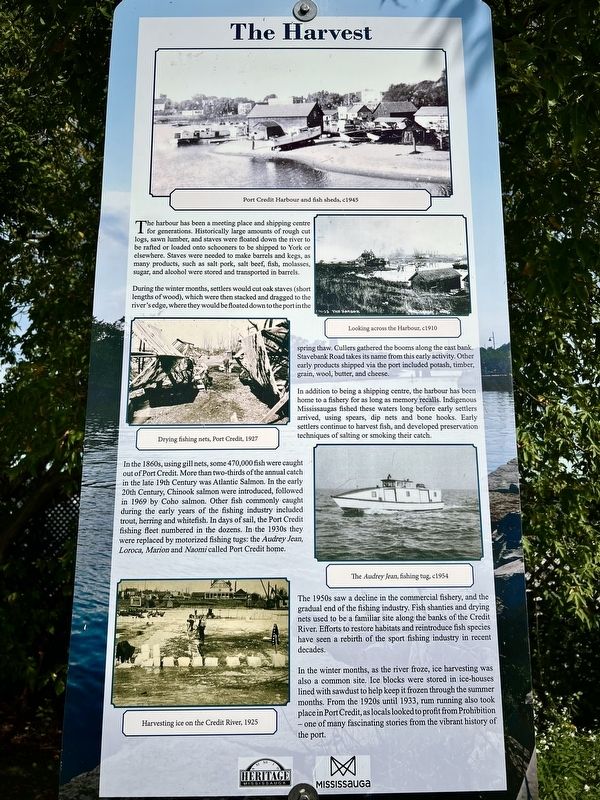
1. The Harvest Marker
The harbour has been a meeting place and shipping centre for generations. Historically large amounts of rough cut logs, sawn lumber, and staves were floated down the river to be rafted or loaded onto schooners to be shipped to York or elsewhere. Staves were needed to make barrels and kegs, as many products, such as salt pork, salt beef, fish, molasses, sugar, and alcohol were stored and transported in barrels.
During the winter months, settlers would cut oak staves (short lengths of wood), which were then stacked and dragged to the river's edge, where they would be floated down to the port in the spring thaw. Cullers gathered the booms along the east bank. Stavebank Road takes its name from this early activity. Other early products shipped via the port included potash, timber, grain, wool, butter, and cheese.
In addition to being a shipping centre, the harbour has been home to a fishery for as long as memory recalls. Indigenous Mississaugas fished these waters long before early settlers arrived, using spears, dip nets and bone hooks. Early settlers continue to harvest fish, and developed preservation techniques
this page online
In the 1860s, using gill nets, some 470,000 fish were caught out of Port Credit. More than two-thirds of the annual catch in the late 19th Century was Atlantic Salmon. In the early 20th Century, Chinook salmon were introduced, followed in 1969 by Coho salmon. Other fish commonly caught during the early years of the fishing industry included trout, herring and whitefish. In days of sail, the Port Credit fishing fleet numbered in the dozens. In the 1930s they were replaced by motorized fishing tugs: the Audrey Jean, Loroca, Marion and Naomi called Port Credit home.
The 1950s saw a decline in the commercial fishery, and the gradual end of the fishing industry. Fish shanties and drying nets used to be a familiar site along the banks of the Credit River. Efforts to restore habitats and reintroduce fish species have seen a rebirth of the sport fishing industry in recent decades.
In the winter months, as the river froze, ice harvesting was also a common site. Ice blocks were stored in ice-houses lined with sawdust to help keep it frozen through the summer months. From the 1920s until 1933, rum running
Photographed by Tim Boyd, September 26, 2024
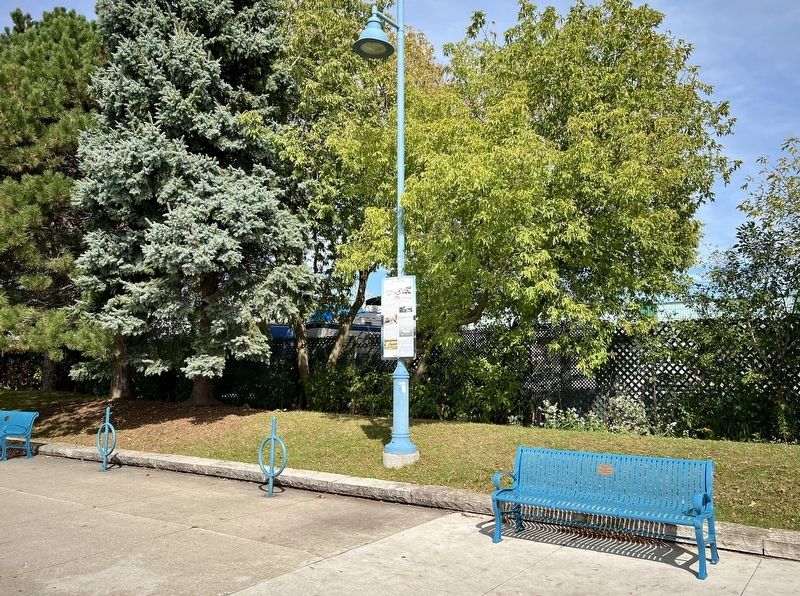
2. The Harvest Marker
Topics. This historical marker is listed in these topic lists: Industry & Commerce • Waterways & Vessels. A significant historical year for this entry is 1969.
Location. 43° 32.966′ N, 79° 34.892′ W. Marker is in Mississauga, Ontario, in Peel Region. It is in Port Credit. It can be reached from Port Street East. The marker is at the water’s edge in J.J. Plaus Park, approx. 150 metres from the parking lot at the end of Stavebank Road South. Touch for map. Marker is in this post office area: Mississauga ON L5G 4V5, Canada. Touch for directions.

Regionally, this marker is in Greater Toronto, specifically on the Golden Horseshoe, and in the Toronto Metropolitan Area. It is also in Central Canada. Globally, it is in North America, on the Great Lakes, in the Western Hemisphere, in the Western World, and in the Anglosphere. Historically, it finds itself in what was once a British colony, the Viceroyalty of New France, the Haudenosaunee (Iroquois) Confederacy, and Rupert’s
Photographed by Tim Boyd, September 26, 2024
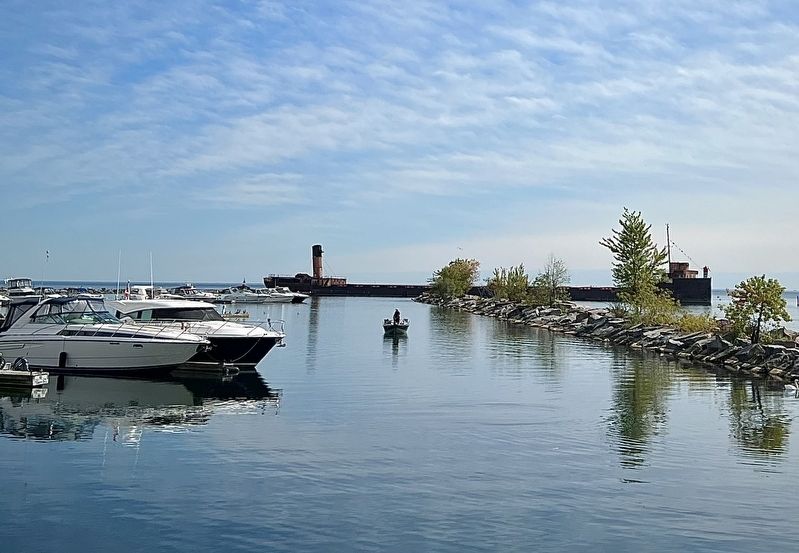
3. Port Credit Harbour, 2024
Other nearby markers. At least 8 other markers are within walking distance of this marker: Remembering the Stonehookers (within shouting distance of this marker); A Sailor’s Memorial (within shouting distance of this marker); The Mills of the Credit River (within shouting distance of this marker); The Changing Port (within shouting distance of this marker); The Lighthouse (about 90 meters away, measured in a direct line); The Harbour (about 120 meters away); The Ridgetown (about 150 meters away); Crossing the River (about 150 meters away). Touch for a list and map of all markers in Mississauga.
Credits. This page was last revised on October 18, 2024. It was originally submitted on October 15, 2024, by Tim Boyd of Hamilton, Ontario. This page has been viewed 122 times since then and 20 times this year. Photos: 1, 2, 3. submitted on October 15, 2024, by Tim Boyd of Hamilton, Ontario. • Andrew Ruppenstein was the editor who published this page.
