Port Credit in Mississauga in Peel Region, Ontario — Central Canada (North America)
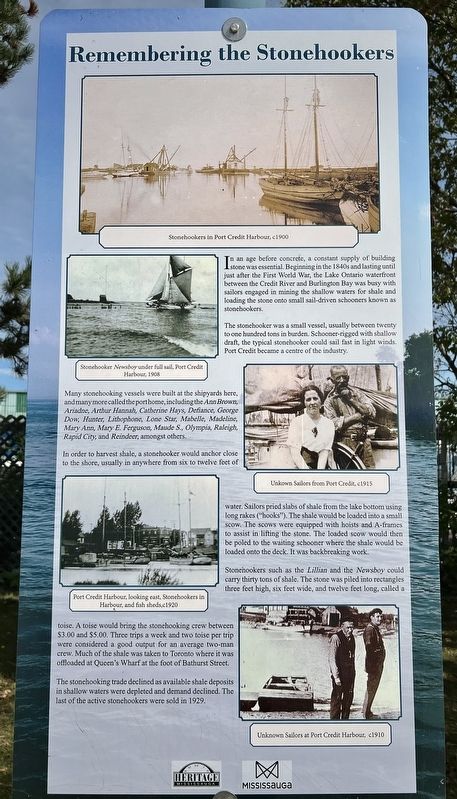
Remembering the Stonehookers
Photographed by Tim Boyd, September 26, 2024
1. Remembering the Stonehookers Marker
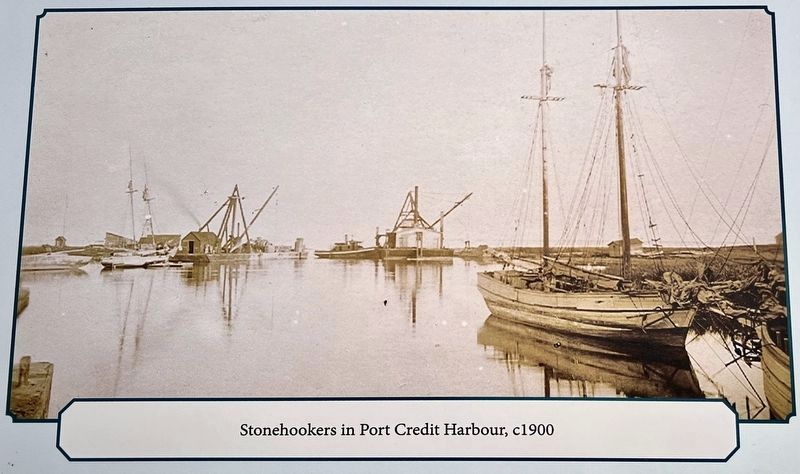
In an age before concrete, a constant supply of building stone was essential. Beginning in the 1840s and lasting until just after the First World War, the Lake Ontario waterfront between the Credit River and Burlington Bay was busy with sailors engaged in mining the shallow waters for shale and loading the stone onto small sail-driven schooners known as stonehookers.
The stonehooker was a small vessel, usually between twenty to one hundred tons in burden. Schooner-rigged with shallow draft, the typical stonehooker could sail fast in light winds. Port Credit became a centre of the industry.
Many stonehooking vessels were built at the shipyards here, and many more called the port home, including the Ann Brown, Ariadne, Arthur Hannah, Catherine Hays, Defiance, George Dow, Hunter, Lithophone, Lone Star, Mabelle, Madeline, Mary Ann, Mary E. Ferguson, Maude S., Olympia, Raleigh, Rapid City, and Reindeer, amongst others.
In order to harvest shale, a stonehooker would anchor close to the shore, usually in anywhere from six to twelve feet of water. Sailors pried slabs of shale from the lake bottom using long rakes ("hooks"). The shale would be loaded into a small scow. The scows were equipped with hoists and A-frames to assist in lifting the stone. The loaded scow would then be poled to the waiting schooner where the shale would be loaded onto the deck. It was backbreaking work.
Stonehookers such as the Lillian and the Newsboy could carry thirty tons of shale. The stone was piled into rectangles three feet high, six feet wide, and twelve feet long, called a toise. A toise would bring the stonehooking crew between $3.00 and $5.00. Three trips a week and two toise per trip were considered a good output for an average two-man crew. Much of the shale was taken to Toronto where it was offloaded at Queen's Wharf at the foot of Bathurst Street.
The stonehooking
this page online
Erected by Heritage Mississauga.
Topics. This historical marker is listed in these topic lists: Industry & Commerce • Waterways & Vessels. A significant historical year for this entry is 1929.
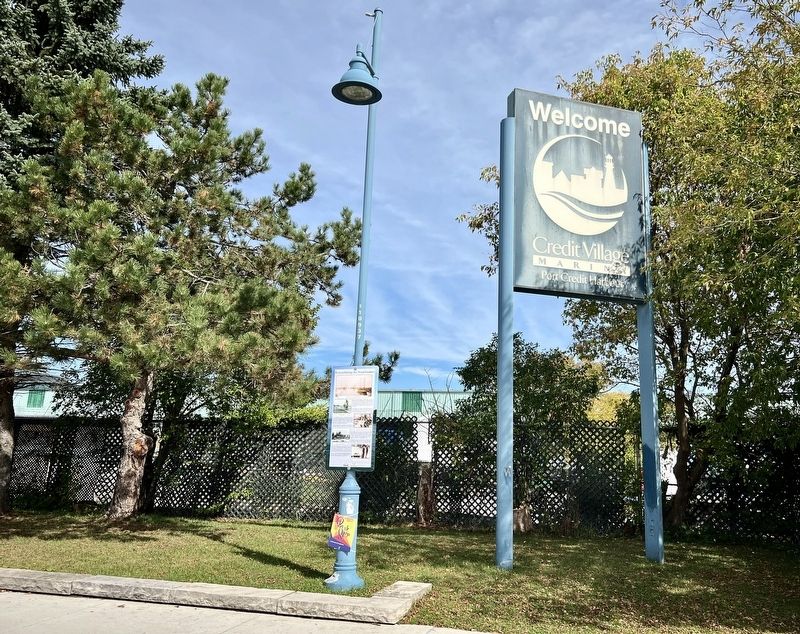
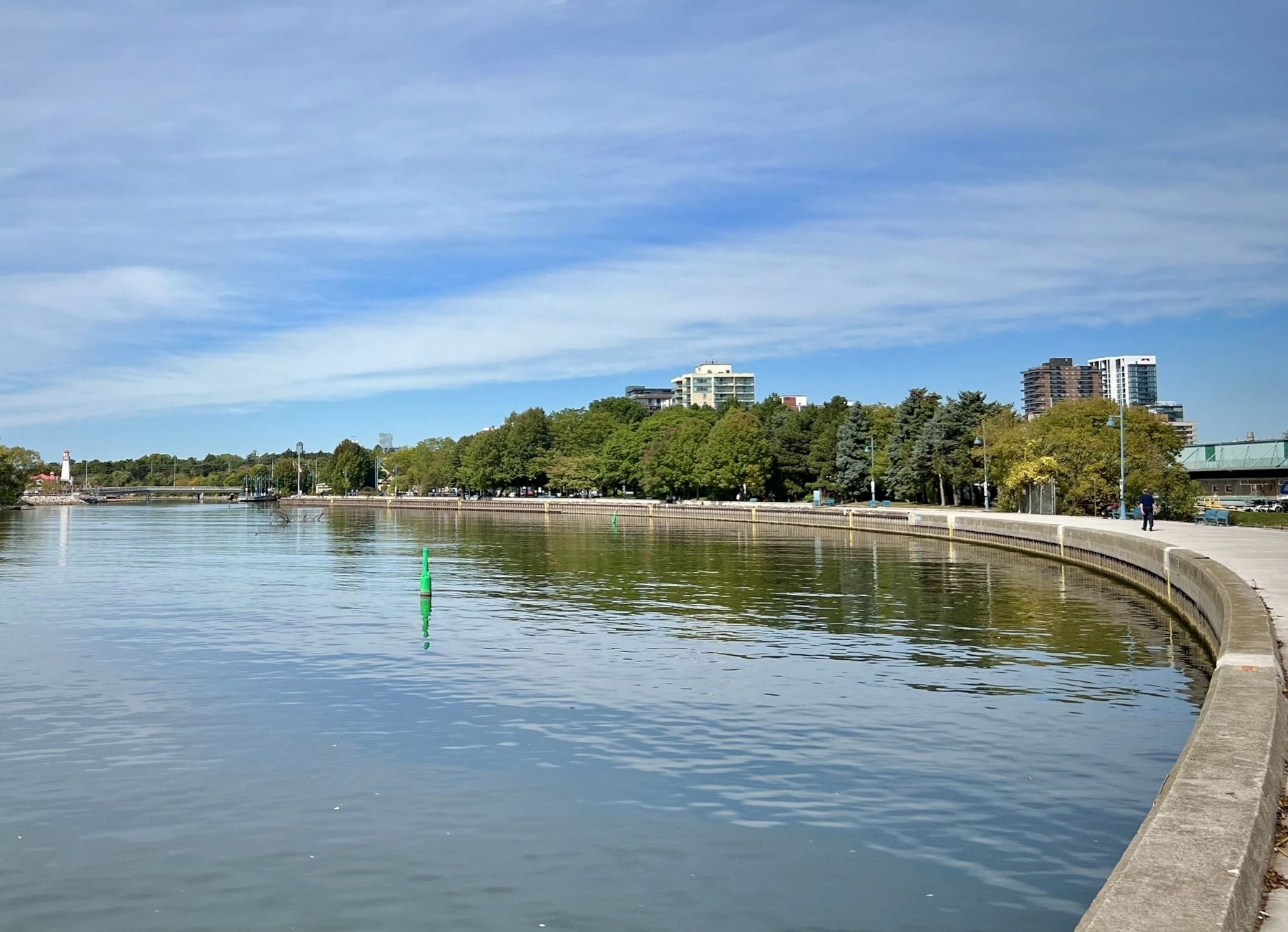
Location. 43° 32.954′ N, 79° 34.871′ W. Marker is in Mississauga, Ontario, in Peel Region. It is in Port Credit. It can be reached from Port Street East. The marker is by the waters edge in J.J. Plaus park, approx. 150 metres from the parking lot at the end of Stavebank Road South. Touch for map. Marker is in this post office area: Mississauga ON L5G 2T2, Canada. Touch for directions.

Regionally, this marker is in Greater Toronto, specifically on the Golden Horseshoe, and in the Toronto Metropolitan Area. It is also in Central Canada. Globally, it is in North America, on the Great Lakes, in the Western Hemisphere, in the Western World, and in the Anglosphere. Historically, it finds itself in what was once a British colony, the Viceroyalty of New France, the Haudenosaunee (Iroquois) Confederacy, and Rupert’s Land.
Photographed by Tim Boyd, September 26, 2024
2. Remembering the Stonehookers Marker
Other nearby markers. At least 8 other markers are within walking distance of this marker: A Sailor’s Memorial (here, next to this marker); The Changing Port (within shouting distance of this marker); The Harvest (within shouting distance of this marker); The Lighthouse (within shouting distance of this marker); The Ridgetown (about 90 meters away, measured in a direct line); The Mills of the Credit River (about 90 meters away); The Harbour (about 150 meters away); Crossing the River (about 180 meters away). Touch for a list and map of all markers in Mississauga.
circa 1900
3. Remembering the Stonehookers marker photo detail
Photographed by Tim Boyd, September 26, 2024
4. J.J. Plaus Park
Credits. This page was last revised on October 17, 2024. It was originally submitted on October 16, 2024, by Tim Boyd of Hamilton, Ontario. This page has been viewed 236 times since then and 55 times this year. Photos: 1, 2, 3, 4. submitted on October 16, 2024, by Tim Boyd of Hamilton, Ontario. • Andrew Ruppenstein was the editor who published this page.
