Saint Victor in Paris in Département de Paris, Île-de-France, France — Western Europe
Évariste Galois
Photographed by Andrew Ruppenstein, September 11, 2024
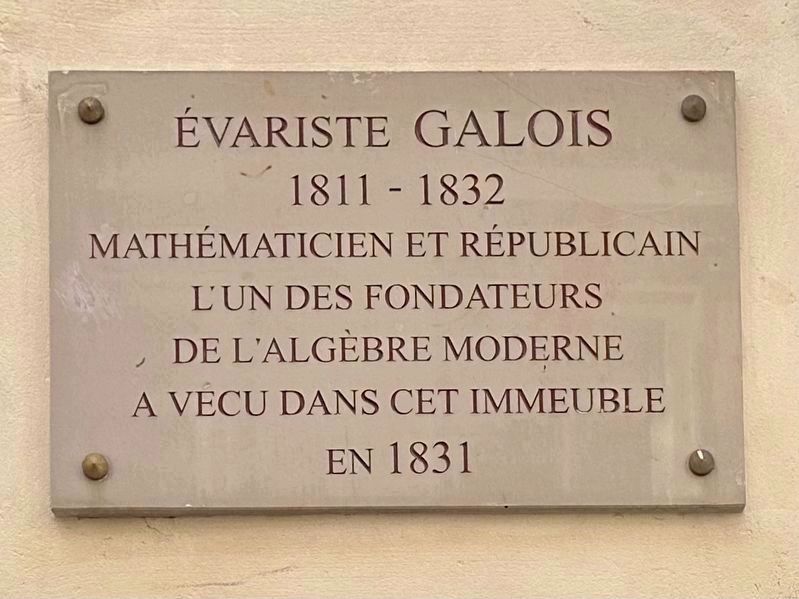
1. Évariste Galois

(1811-1832)
Mathématicien et Républicain
L'un des fondateurs
de l'algèbre moderne
a vecu dans cet immeuble
en 1831
Évariste Galois (1811-1832) - Mathematician and Republican - One of the founders of modern algebra lived in this building in 1831.
Topics. This historical marker is listed in these topic lists: Government & Politics • Science & Medicine. A significant historical year for this entry is 1831.
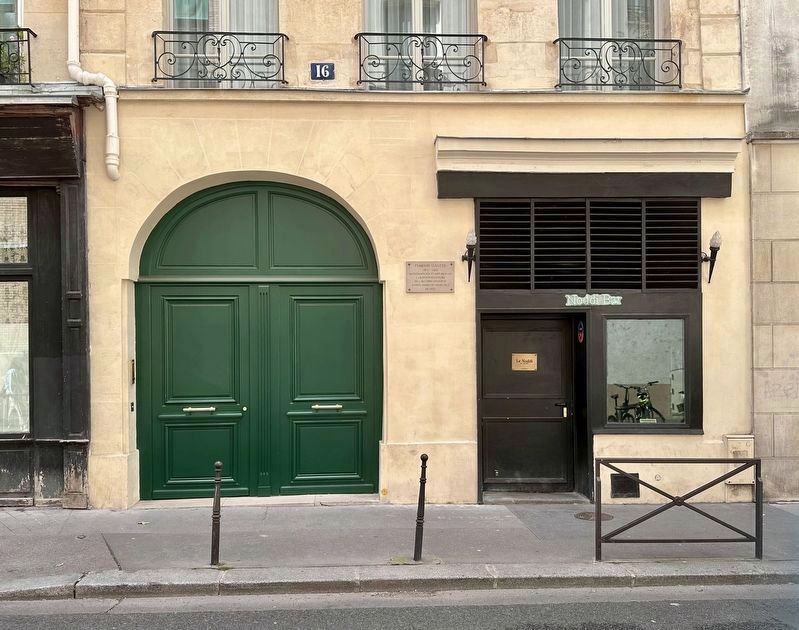
Location. 48° 51.025′ N, 2° 21.045′ E. Marker is in Paris, Île-de-France, in Département de Paris. It is in Saint Victor. It is on Rue des Bernardins north of Boulevard Saint-Germain, on the left when traveling north. Touch for map. Marker is at or near this postal address: 16 Rue des Bernardins, Paris, Île-de-France 75005, France. Touch for directions.

Regionally, it is in the North Atlantic Region, Europe, the European Union, Atlantic Europe, the Schengen Area, Western Europe, a coastal Mediterranean country, and the Western World. Historically, it finds itself in what was once a French colony and also the Roman Empire.
Other nearby markers. At
this page online
Also see . . . Évariste Galois (Wikipedia). Overview:
Évariste Galois (25 October 1811 – 31 May 1832) was a French mathematician and political activist. While still in his teens, he was able to determine a necessary and sufficient condition for a polynomial to be solvable by radicals, thereby solving a problem that had been open for 350 years. His work laid the foundations for Galois theory and group theory, two major branches of abstract algebra.(Submitted on October 18, 2024.)
Galois was a staunchrepublican and was heavily involved in the political turmoil that surrounded the French Revolution of 1830. As a result of his political activism, he was arrested repeatedly, serving one jail sentence of several months. For reasons that remain obscure, shortly after his release from prison, Galois fought in a duel and died of the wounds he suffered.Photographed by Andrew Ruppenstein, September 11, 20242. Évariste Galois Marker - wide view
Photographed by Andrew Ruppenstein, September 11, 2024
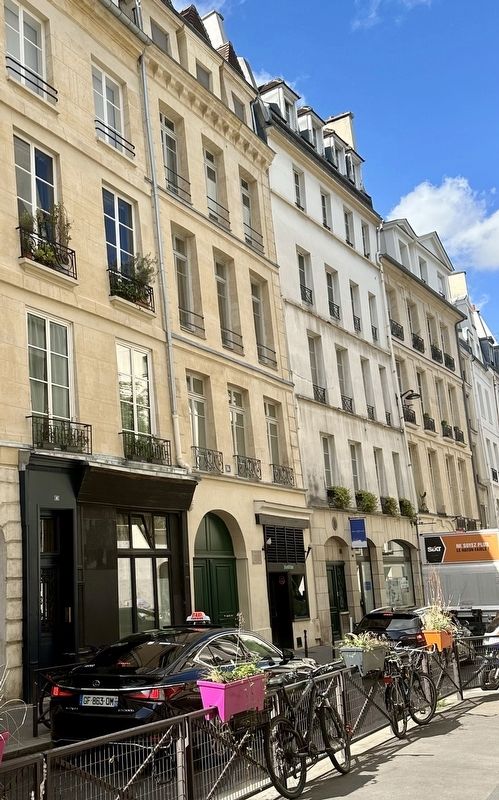
3. Évariste Galois Marker - wider view
Credits. This page was last revised on October 18, 2024. It was originally submitted on October 18, 2024, by Andrew Ruppenstein of Lamorinda, California. This page has been viewed 315 times since then and 120 times this year. Photos: 1, 2, 3. submitted on October 18, 2024, by Andrew Ruppenstein of Lamorinda, California.
