Otsego in Otsego County, New York — The American Northeast (Mid-Atlantic)
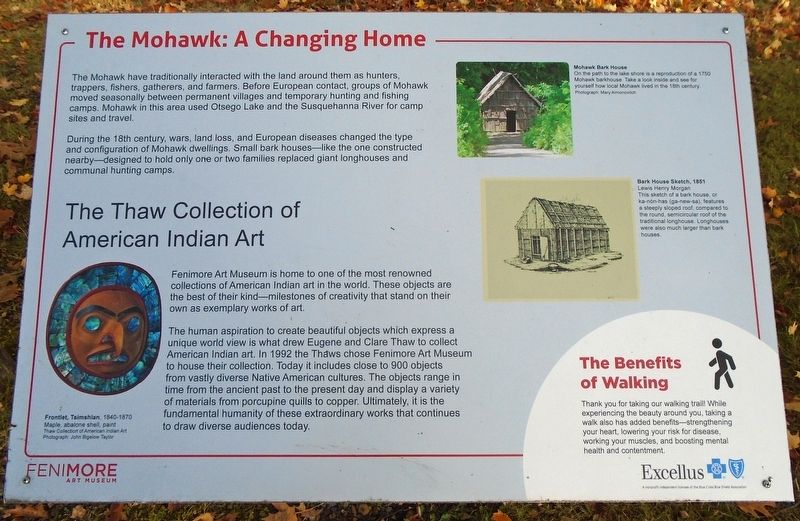
The Mohawk: A Changing Home
Photographed by William Fischer, Jr., October 16, 2024
1. The Mohawk: A Changing Home Marker
The Mohawk have traditionally interacted with the land around them as hunters, trappers, fishers, gatherers, and farmers. Before European contact, groups of Mohawk moved seasonally between permanent villages and temporary hunting and fishing camps. Mohawk in this area used Otsego Lake and the Susquehanna River for camp sites and travel.
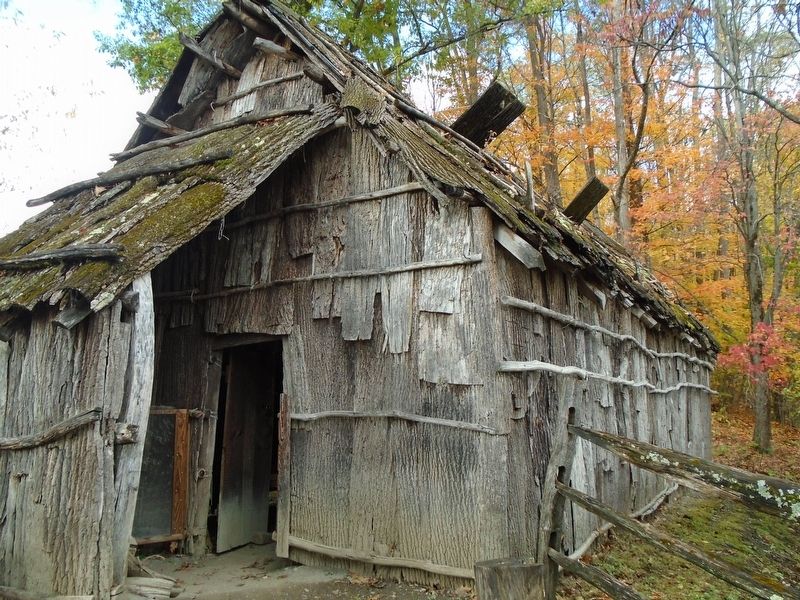
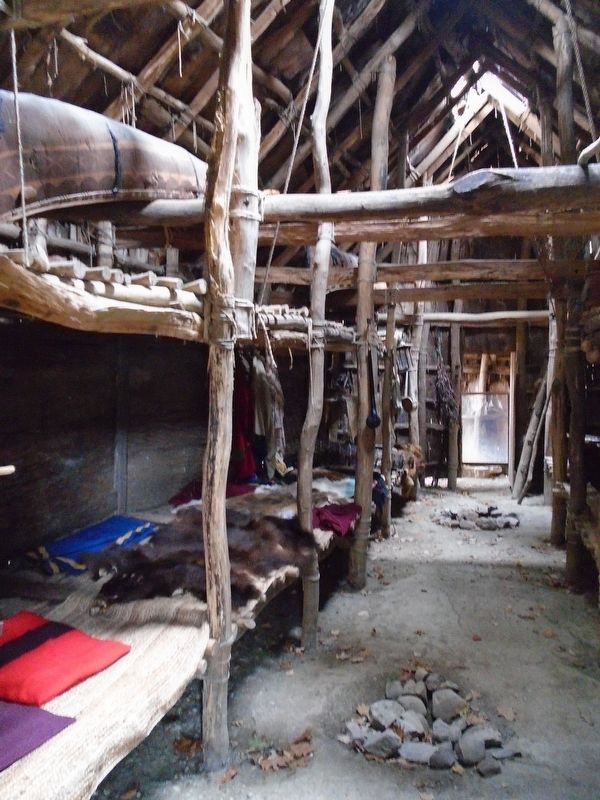
During the 18th century, wars, land loss, and European diseases changed the type and configuration of Mohawk dwellings. Small bark houses—like the one constructed nearby—designed to hold only one or two families replaced giant longhouses and communal hunting camps.
The Thaw Collection of American Indian Art
Fenimore Art Museum is home to one of the most renowned collections of American Indian art in the world. These objects are the best of their kind—milestones of creativity that stand on their own as exemplary works of art.
The human aspiration to create beautiful objects which express a unique world view is what drew Eugene and Clare Thaw to collect American Indian art. In 1992 the Thaws chose Fenimore Art Museum to house their collection. Today it includes close to 900 objects from
this page online
[Photo captions, clockwise from bottom left, read]
• Frontlet, Tsimshian, 1840-1870 · Maple, abalone shell, paint
• Mohawk Bark House · On the path to the lake shore is a reproduction of a 1750 Mohawk barkhouse. Take a look inside and see for yourself how local Mohawk lived in the 18th century.
• Bark House Sketch, 1851 · Lewis Henry Morgan
This sketch of a barkhouse or ka-nón-has (ga-new-sa), features a steeply sloped roof, compared to the round, semicircular roof the traditional longhouse. Longhouses were also much larger than bark houses.
The Benefits of Walking
Thank you for taking our walking trail! While experiencing the beauty around you, taking a walk also has added benefits—strengthening your heart, lowering your risk for disease, working your muscles, and boosting mental health and contentment.
Excellus [Blue Cross Blue
Photographed by William Fischer, Jr., October 16, 2024
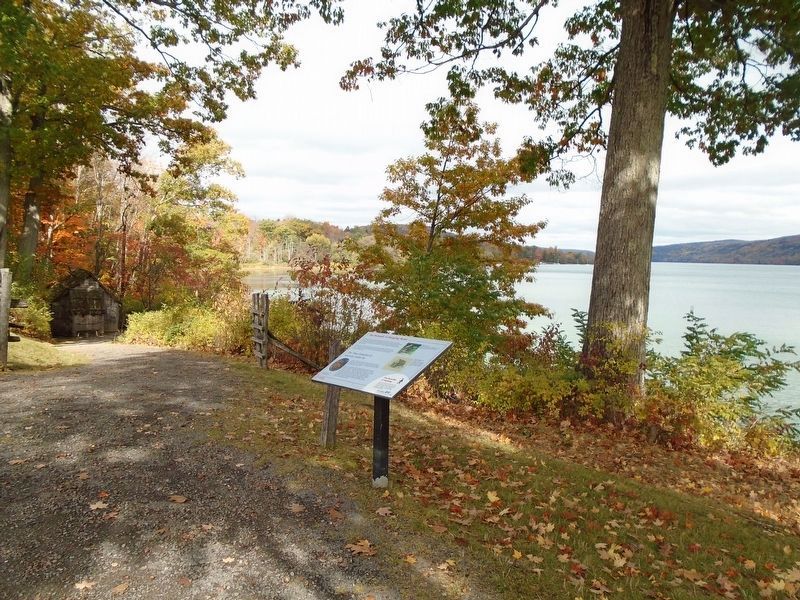
2. Reproduction Mohawk Bark House and Marker
Erected by Fenimore Art Museum and Concerned Benefactors.
Topics. This historical marker is listed in these topic lists: Indigenous Peoples and Communities • Settlements & Settlers. A significant historical year for this entry is 1750.
Location. 42° 42.976′ N, 74° 55.501′ W. Marker is in Otsego, New York, in Otsego County. It can be reached from New York 80. Marker and cabin are on the Fenimore Art Museum grounds, along Otsego Lake. Touch for map. Marker is at or near this postal address: 5798 New York Route 80, Cooperstown NY 13326, United States of America. Touch for directions.

Regionally, this marker is in Upstate New York and in the Mohawk Valley. It is also in the American Northeast, in the Mid-Atlantic, in Appalachia, and specifically in Northern Appalachia. Globally, it is in North America, the Western Hemisphere, the Western World, and the Anglosphere. Historically, it finds itself in what was once the Haudenosaunee (Iroquois) Confederacy, New Netherland, and one of the original Thirteen Colonies.
Other nearby markers. At least 8 other markers are within walking distance of this marker: Otsego Lake
Photographed by William Fischer, Jr., October 16, 2024
3. Reproduction Bark-Covered Cabin near Marker
Photographed by William Fischer, Jr., October 16, 2024
4. Bark-Covered Cabin Interior View
Credits. This page was last revised on October 20, 2024. It was originally submitted on October 20, 2024, by William Fischer, Jr. of Reynoldsburg, Ohio. This page has been viewed 154 times since then and 19 times this year. Photos: 1, 2, 3, 4. submitted on October 20, 2024, by William Fischer, Jr. of Reynoldsburg, Ohio.
