Sardis in Panola County, Mississippi — The American South (East South Central)
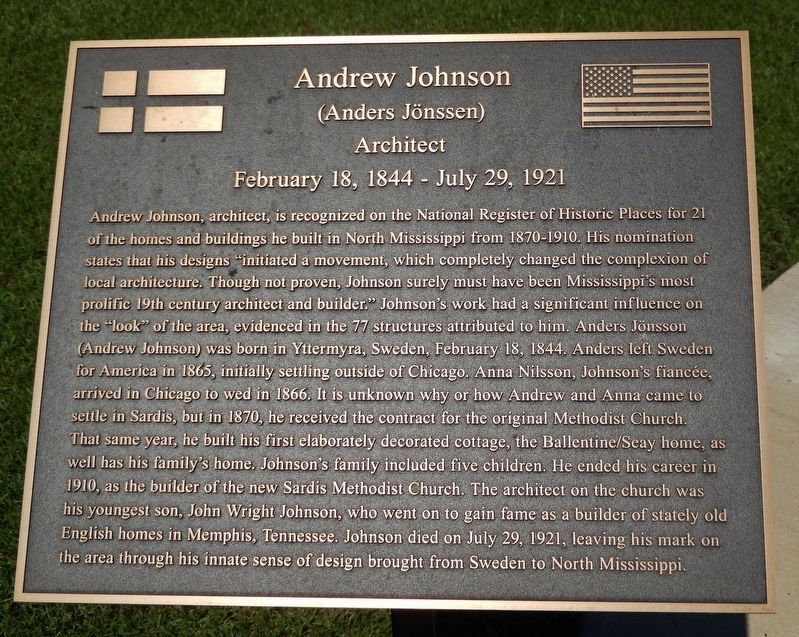
Andrew Johnson (Anders Jönssen)
Architect
| — | February 18, 1844 - July 29, 1921 | — |
Photographed by Cosmos Mariner, September 18, 2024
1. Andrew Johnson Marker
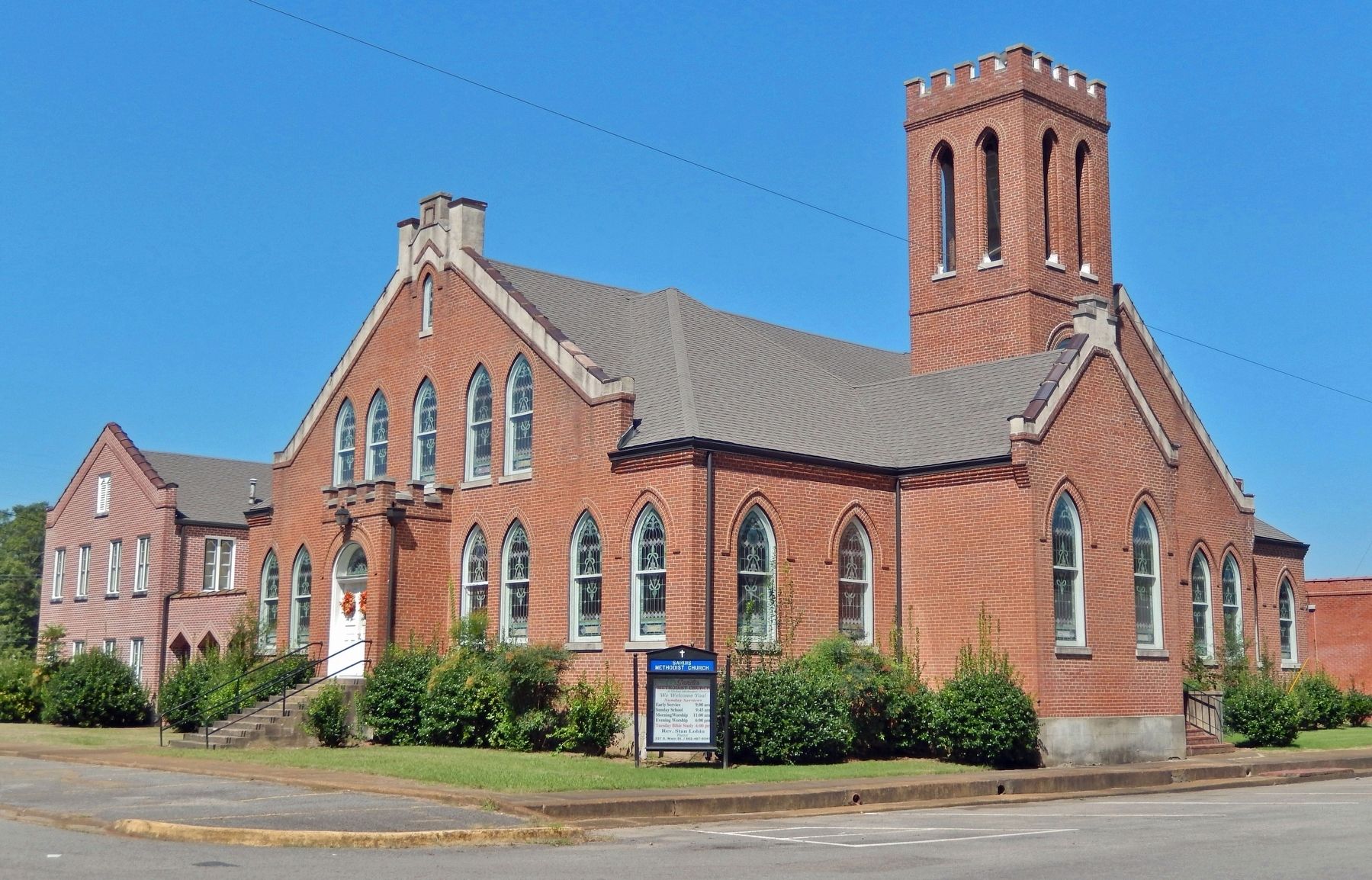
Andrew Johnson, architect, is recognized on the National Register of Historic Places for 21 of the homes and buildings he built in North Mississippi from 1870-1910. His nomination states that his designs "initiated a movement, which completely changed the complexion of local architecture. Though not proven, Johnson surely must have been Mississippi's most prolific 19th century architect and builder." Johnson's work had a significant influence on the "look" of the area, evidenced in the 77 structures attributed to him. Anders Jönsson (Andrew Johnson) was born in Yttermyra, Sweden, February 18, 1844. Anders left Sweden for America in 1865, initially settling outside of Chicago. Anna Nilsson, Johnson's fiancée, arrived in Chicago to wed in 1866. It is unknown why or how Andrew and Anna came to settle in Sardis, but in 1870, he received the contract for the original Methodist Church. That same year, he built his first elaborately decorated cottage, the Ballentine/Seay home, as well has his family's home. Johnson's family included five children. He ended his career in 1910, as the builder of the new Sardis Methodist Church.
this page online
Topics. This historical marker is listed in these topic lists: Architecture • Immigration. A significant historical date for this entry is February 18, 1844.
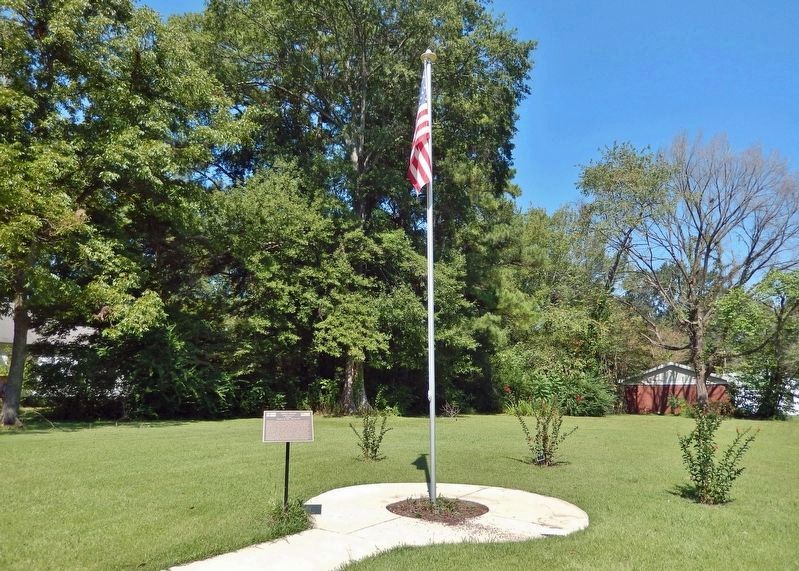
Location. 34° 26.032′ N, 89° 54.826′ W. Marker is in Sardis, Mississippi, in Panola County. It is at the intersection of East McLaurin Street and Franklin Street, on the left when traveling east on East McLaurin Street. The marker is located near the northwest corner of the intersection. Touch for map. Marker is in this post office area: Sardis MS 38666, United States of America. Touch for directions.

Regionally, this marker is in the American South, specifically in the Deep South, and in the Mississippi Delta. Globally, it is in North America, a Gulf of Mexico state, the Western Hemisphere, the Western World, and the Anglosphere. Historically, it finds itself in what was once the territory
Photographed by Cosmos Mariner, September 18, 2024
2. Andrew Johnson Marker and Memorial Flagpole
Other nearby markers. At least 8 other markers are within 6 miles of this marker, measured as the crow flies: Sardis (approx. 0.3 miles away); Walton Chapel Vocational High School (approx. 4.2 miles away); Dr. Lynda Ruth Campbell (approx. 5.3 miles away); Como (approx. 5½ miles away); Stark Young (approx. 5.6 miles away); a different marker also named Stark Young (approx. 5.6 miles away); Napolian Strickland (approx. 5.6 miles away); Mississippi Fred McDowell (approx. 5.7 miles away). Touch for a list and map of all markers in Sardis.
Related markers. Click here for a list of markers that are related to this marker. Andrew Johnson (Anders Jönssen) — Architect
Also see . . .
1. Andrew Johnson (Wikiwand).
Excerpt: Anders Jönsson was born in the parish of Ovansjö in the county of Gävleborg, Sweden. He was trained at Uppsala University where he received an award from King Charles XV of Sweden for his contest winning design. He used the prize money to emigrate to America in 1865, where his building career lasted from(Submitted on October 21, 2024, by Cosmos Mariner of Cape Canaveral, Florida.)1870 to 1910.Photographed by Cosmos Mariner, September 18, 20243. Sardis Methodist ChurchAndrew Johnson ended his career in 1910, as the builder of the new Sardis Methodist Church.After arriving in the United States, his name was changed to Andrew Johnson. He first settled in a Swedish-American community in Evanston, Illinois. About 1870, he moved to Sardis, Mississippi where he became associated with James B. Cook, an English-trained architect who had moved from London to Memphis, Tennessee in 1855. Johnson served as contractor building the Second Empire style Panola County Courthouse that Cook designed and was built in 1873 and as contractor on at least two other buildings.
2. Andrew Johnson (livingplaces.com).
Excerpt: he was granted a contract by the Illinois Central Railroad to construct several depots along the company's rapidly expanding rail network in the South. By the 1870s the Illinois Central Railroad was becoming a major factor in the economy of Mississippi, and Johnson soon settled in Sardis (MS) near the center of the state's rejuvenating cotton production, an important source of business for the railroad. Research has not yet uncovered information on the railroad depots Andrew Johnson constructed. Possibly his finest public building was the Second Empire First Sardis courthouse (ca. 1878), which unfortunately has burned.(Submitted on October 21, 2024, by Cosmos Mariner of Cape Canaveral, Florida.)
Credits. This page was last revised on February 18, 2025. It was originally submitted on October 21, 2024, by Cosmos Mariner of Cape Canaveral, Florida. This page has been viewed 411 times since then and 39 times this year. Photos: 1, 2, 3. submitted on October 21, 2024, by Cosmos Mariner of Cape Canaveral, Florida.
