Sentrum in Oslo, Norway — Northern Europe (a Nordic Country in Scandinavia)
Slottsparken
⎯⎯⎯
Palace Park
Photographed by Andrew Ruppenstein, July 11, 2024
1. Slottsparken / Palace Park Marker

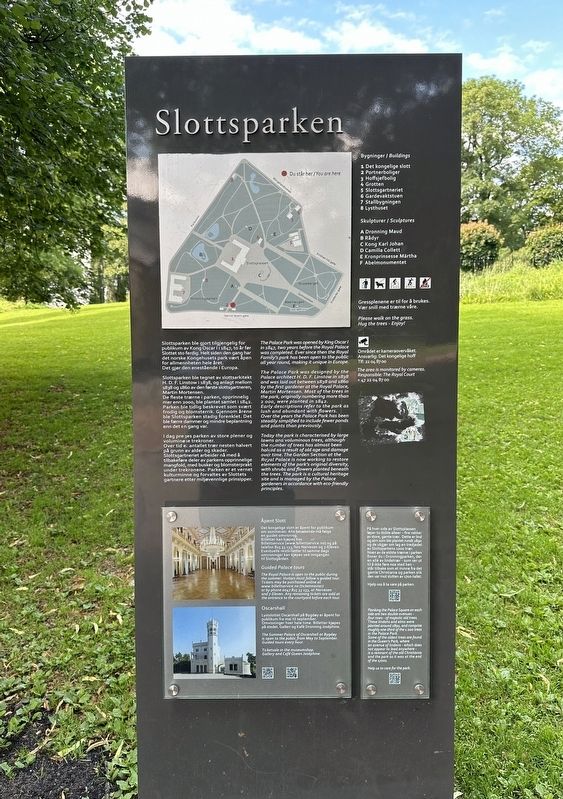
Slottsparken ble tegnet av slottsarkitekt H. D. F. Linstow i 1838, og anlagt mellom 1838 og 1860 av den første slottsgartneren, Martin Mortensen. De fleste trærne i parken, opprinnelig mer enn 2000, ble plantet samlet i 1842. Parken ble tidlig beskrevet som svært frodig og blomsterrik. Gjennom årene ble Slottsparken stadig forenklet. Det ble færre dammer og mindre beplantning enn det en gang var.
I dag preges parken av store plener og voluminose trekroner. Over tid er antallet trær nesten halvert på grunn av alder og skader. Slottsgartneriet arbeider nå med å tilbakeføre deler av parkens opprinnelige mangfold, med busker og blomsterprakt under trekronene. Parken er et vernet kulturminne og forvaltes av Slottets gartnere etter miljøvennlige prinsipper.
The Palace Park was opened by King Oscar I in 1847, two years before the Royal Palace was
this page online
The Palace Park was designed by the Palace architect H. D. F. Linstow in 1838 and was laid out between 1838 and 1860 by the first gardener at the Royal Palace, Martin Mortensen. Most of the trees in the park, originally numbering more than 2 000, were planted in 1842. Early descriptions refer to the park as lush and abundant with flowers. Over the years the Palace Park has been steadily simplified to include fewer ponds and plants than previously.
Today the park is characterised by large lawns and voluminous trees, although the number of trees has almost been halved as a result of old age and damage over time. The Garden Section at the Royal Palace is now working to restore elements of the park's original diversity, with shrubs and flowers planted beneath the trees. The park is a cultural heritage site and is managed by the Palace gardeners in accordance with eco-friendly principles.
Topics. This historical marker is listed in this topic list: Parks & Recreational Areas. A significant historical year for this entry is 1847.
Location. 59° 54.938′ N,
Photographed by Andrew Ruppenstein, July 11, 2024
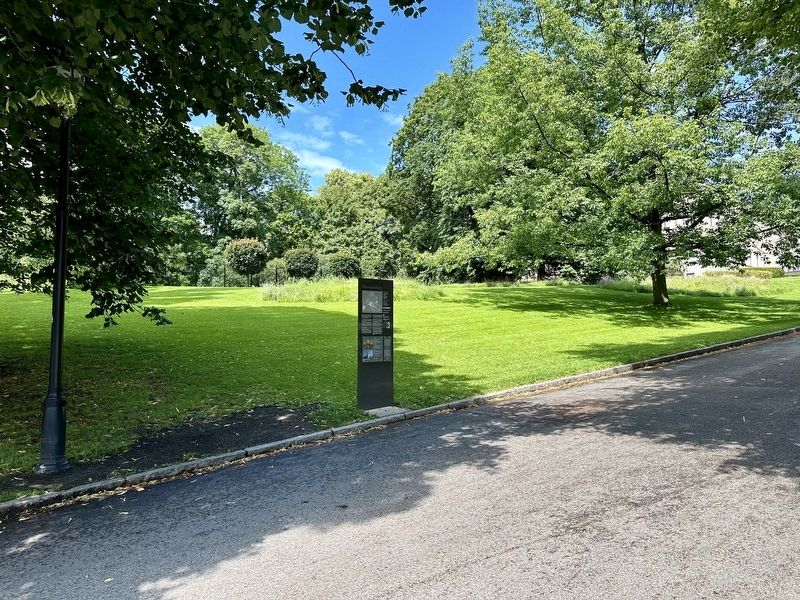
2. Slottsparken / Palace Park Marker - wide view

Regionally, it is in the North Atlantic Region, on the Atlantic Arc, in Europe, in Atlantic Europe, in Scandinavia, in the Nordic Countries, in the Schengen Area, and in the Western World.
Other nearby markers. At least 8 other markers are within walking distance of this marker: Henrik Ibsen (within shouting distance of this marker); Svaret 1891-1906 / The Answer, 1891-1906 (within shouting distance of this marker); Harriet Backer (about 120 meters away, measured in a direct line); Bombeangrep / Bomb Attack (about 120 meters away); Oslo Sjømannsforening / Oslo Seamen’s Association (about 120 meters away); Ingeniørenes Hus / Engineers Building (about 180 meters away); Kirsten Ohm (about 180 meters away); Cora Sandel (about 180 meters away). Touch for a list and map of all markers in Oslo.
Also see . . . The Palace Park (Royal House of Norway). Excerpt:
The Palace Park, one of the Norwegian capital’s first and largest parks, surrounds the Royal Palace on all sides and features grassy areas as well as old, majestic trees. The Palace Park was developed simultaneously with the construction of the new Royal Palace, and is based on the ideal model of nature that prevailed in European horticulture in the mid-1800s.(Submitted on October 22, 2024.)
Comprising part of the Palace Park, the Queen’s Park dates all the way back to 1751 when it was created as a private garden in the Rococo style on the plot of land known as Sommerro. It was integrated into the Palace Park in 1840.
Credits. This page was last revised on October 22, 2024. It was originally submitted on October 22, 2024, by Andrew Ruppenstein of Lamorinda, California. This page has been viewed 157 times since then and 41 times this year. Photos: 1, 2. submitted on October 22, 2024, by Andrew Ruppenstein of Lamorinda, California.
