Northeastern State University Centennial Plaza
Dedicated March 6, 2009

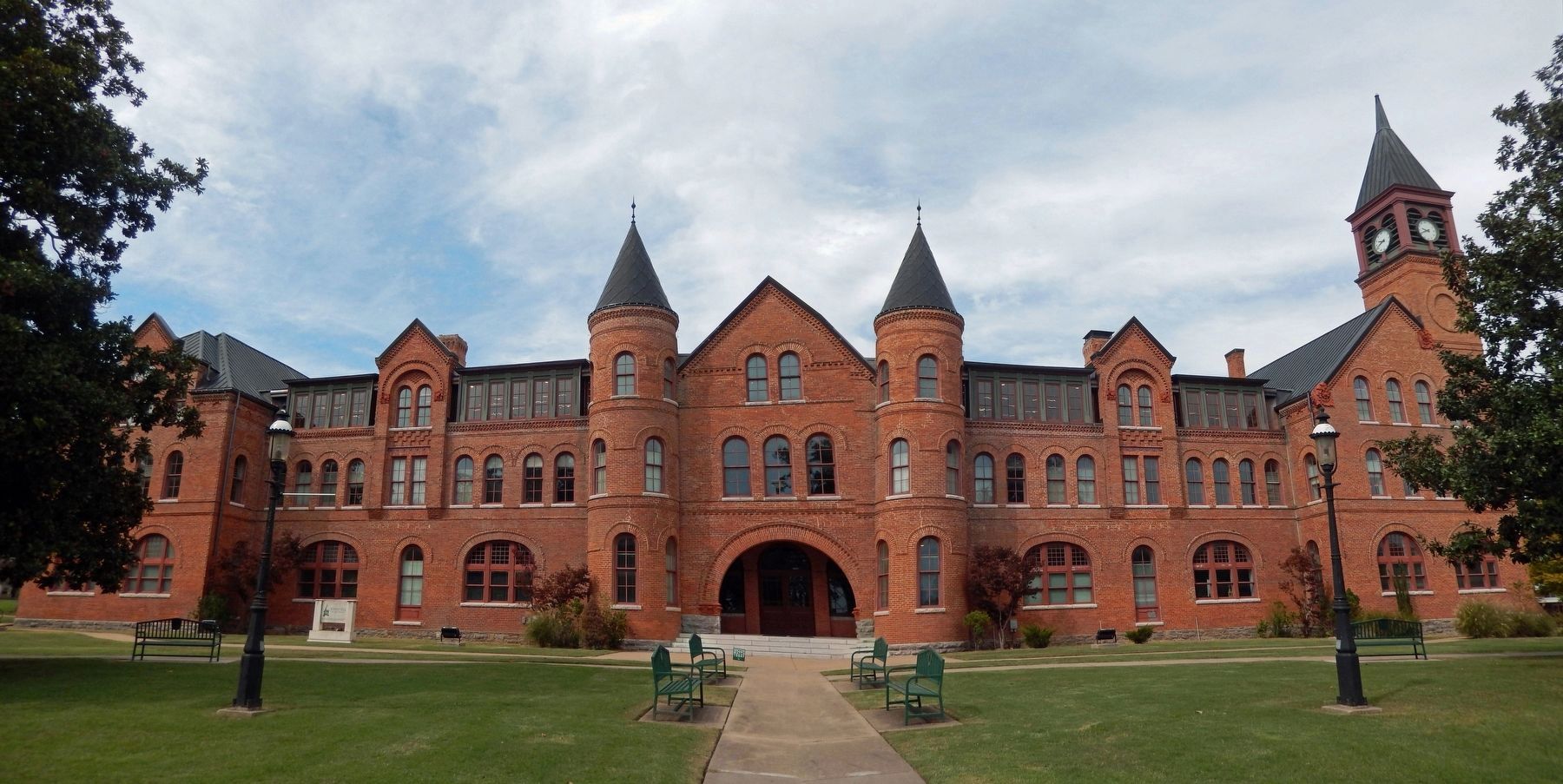
This gathering place is established on the 100th anniversary of the founding of Northeastern as an Oklahoma Normal School dedicated to the preparation of teachers with its home in historic Seminary Hall.
The Plaza commemorates the enduring commitment to teaching and learning which began here with the establishment of the Cherokee National Male and Female Seminaries in 1846. The lasting connection with Cherokee people is found in the Plaza design and the honoring of Sequoyah as a pioneering teacher who, through the Cherokee Syllabary, demonstrated the power of learning in shaping the lives of all peoples.
May all who visit this Plaza be inspired to champion education for all.
Regional University System of Oklahoma
Board of Regents
Dr. Joe Anna Hibler, Chair • Ms. Jan Gordon, Vice Chair • Ms. Connie Reilly, Secretary • Mr. Mark Stansberry • Mr. Harold Jackson
Mrs. Belva Howard • Mr. Michael W. Mitchel • Mrs. Ann Holloway • Ms. Sandy Garrett
Erected 2009.
Topics and series. This historical marker is listed in these topic lists: Architecture • Education • Indigenous Peoples and Communities.
this page online
Location. 35° 55.188′ N, 94° 58.126′ W. Marker is in Tahlequah, Oklahoma, in Cherokee County. It can be reached from North Grand Avenue just north of Spring Street, on the left when traveling north. The marker and Centennial Plaza are located on the Northeastern State University campus, on the south side of Seminary Hall. Touch for map. Marker is at or near this postal address: 600 North Grand Avenue, Tahlequah OK 74464, United States of America. Touch for directions.

Regionally, this marker is in the Cherokee Nation and in Northeast Oklahoma—Green Country. It is also in the American South, specifically in the Ozarks, on the prairies, and on the Southern Plains. Globally, it is in North America, the Western Hemisphere, the Western World, and the Anglosphere. Historically, it finds itself in what was once the territory of the Mississippian Culture and also the Louisiana Purchase.
Other nearby markers. At least 8 other markers are within walking distance of this marker: The Workman's Horse

Regarding Northeastern State University Centennial Plaza. National Register of Historic Places № 73001558, as Cherokee Female Seminary.
From the National Register Nomination prepared by Kent Ruth, Oklahoma Historical Society, 12/1972:
C. E. Illsley of St. Louis was chosen chief architect. W. A. Illsley and Son of Chetopa, Kansas, won the construction contract for $57,000. Construction began Nov. 3rd, 1887. Bricks were burned on the site. Lumber was sawed locally and the stone quarried nearby. The cornerstone was laid April 25th, 1888. It was a major social event that drew a crowd of 1,500 from all over the Nation. The building was completed April 18, 1889, ata final cost of over $60,000. The Seminary was the largest building ever erected by an Indian tribe.Photographed by Cosmos Mariner, September 11, 20243. Sequoyah (George Gist) SculptureSculpture by Dan Horsechief, 3/6/2009
Presented to George Gist
by the
General Council of the
Cherokee Nation
for his ingenuity in
the invention of the
Cherokee Alphabet
1825Indian Territory joined Oklahoma Territory to become the State of Oklahoma in 1907. Two years later, in 1909, the Cherokee Female Seminary was purchased by the new state. As Northeastern State Normal School it opened September 14, 1909, with an enrollment of 511 students. A decade later, in 1919, the normal school became a full four-year college, its name changed to Northeastern State Teachers College. In 1939, its curriculum broadened in scope, and it became Northeastern State College. The old seminary building, well maintained over the years, remains its highly decorative centerpiece. Only recently refurbished inside and out, and its name changed officially to Seminary Hall, it stands as a fine tribute to the Cherokee's high regard for education.

Also see . . . The History of Seminary Hall.
Seven years after the last detachment of Cherokees arrived in Indian Territory following their forced removal from their homelands, Principal Chief John Ross oversaw the passage of an act by the Cherokee Nation that created institutions(Submitted on October 26, 2024, by Cosmos Mariner of Cape Canaveral, Florida.)for secondary education for young women and young men.Photographed by Cosmos Mariner, September 11, 20244. Cherokee National Male Seminary Memorial Column(also located in front of Seminary Hall)
This column is erected from bricks of the
original Cherokee National Male Seminary
1851-1910Financial difficulties and the disruption of the American Civil War forced the closing of both seminaries. Indian Territory experienced divisions and armed conflict as the opposing forces sometimes used the vacant Female Seminary for military purposes including a hospital for soldiers. By 1875, both seminaries had re-opened.
On Easter Sunday, 1887, the Female Seminary burned to the ground. Determined students climbed into the cupola to strike the clapper to the bell by hand when no rope could be found, but to no avail.
The Female Seminary was rebuilt in its new location and re-opened to much fanfare on May 7, 1889. From the day it opened in 1889, the true character of Seminary Hall has been defined by the people who study, teach and work there.


This column is erected from bricks of the
original Cherokee National Female Seminary
1851-1887
• The second oldest public institution of higher learning west of the Mississippi River.
• The oldest public institution of higher learning in the trans-Mississippi West dedicated to provide a liberal arts education for women.
• One of the half-dozen oldest American institutions to provide a liberal arts education for women.
• The first institution in America to pay equal salaries to men and women professors.
• The first nationally operated institution of higher learning in America.
• The first institution of higher education to provide tuition, books, room, board, and supplies free of charge to its students.
• The Alma Mater of more Indian students than any other accredited college in the United States.
Credits. This page was last revised on October 26, 2024. It was originally submitted on October 25, 2024, by Cosmos Mariner of Cape Canaveral, Florida. This page has been viewed 158 times since then and 31 times this year. Photos: 1, 2, 3, 4, 5, 6. submitted on October 26, 2024, by Cosmos Mariner of Cape Canaveral, Florida.
