Elkton in Rockingham County, Virginia — The American South (Mid-Atlantic)
Rockingham Memorial for Families Displaced
By the Creation of Shenandoah National Park
Photographed by Craig Swain, September 16, 2024
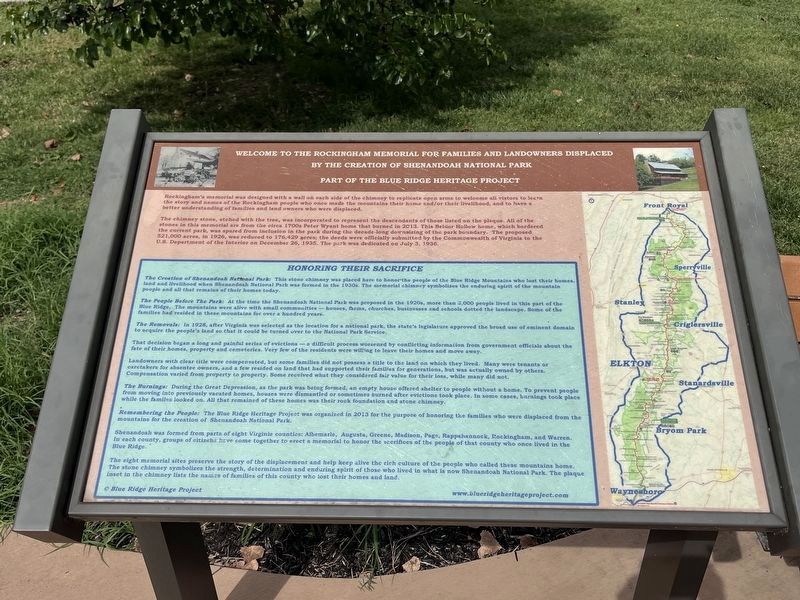
1. Rockingham Memorial for Families Displaced Marker
On the upper left and right of the marker are photos of a house. On the left is a black-and-white photo, undated. On the right is a color photo which appears to be the same house. This may be the Peter Wyant house mentioned on the marker, but that is not indicated in the text.
By the Creation of Shenandoah National Park
Part of the Blue Ridge Heritage Project
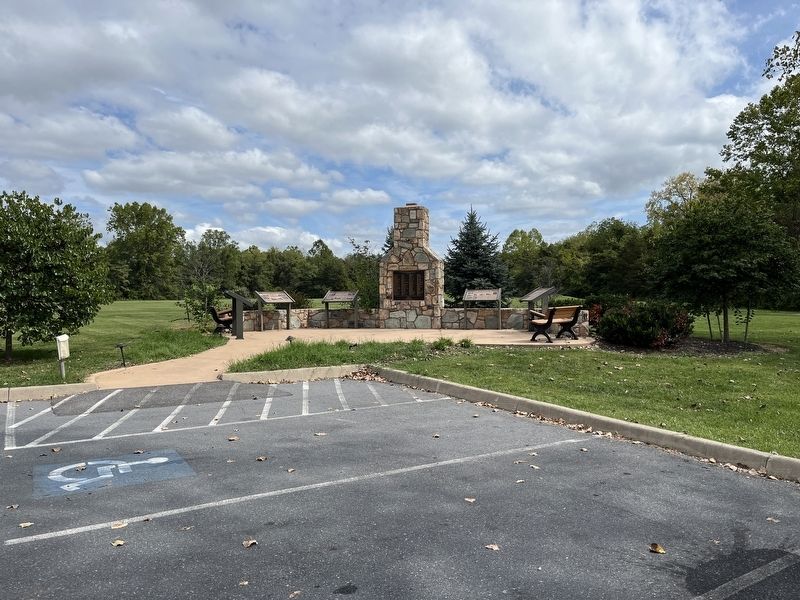
Rockingham's memorial was designed with a wall on each side of the chimney to replicate open arms to welcome all visitors to learn the story and names of the Rockingham people who once made the mountain their home and/or livelihood, and to have a better understanding of families and land owners who were displaced.
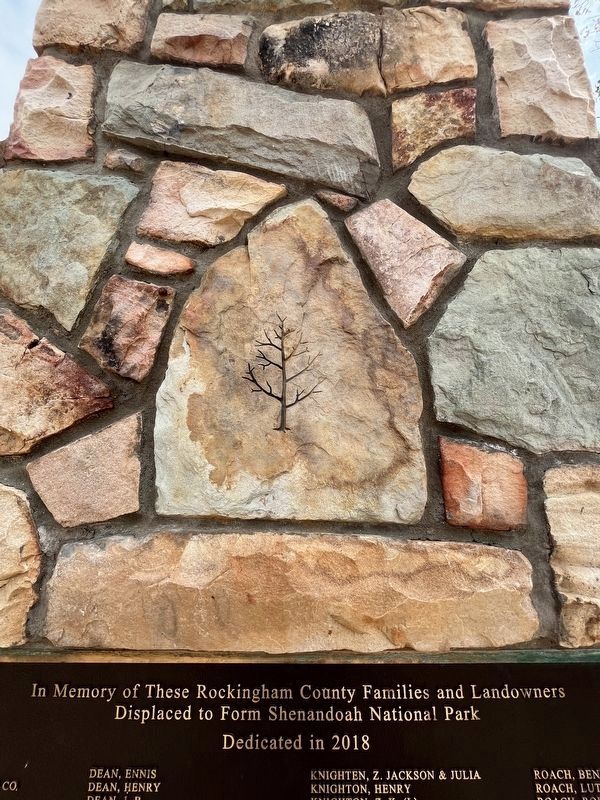
The chimney stone, etched with the tree, was incorporated to represent the descendants of those listed on the plaque. All of the stones in this memorial are from the circa 1700s Peter Wynat home that burned in 2013. This Beldor Hollow home, which bordered the current park, was spared from inclusion in the park during the decade-long downsizing of the park boundary. The proposed 521.000 acres, in 1926, was reduced to 176,429 acres; the deeds were officially submitted by the Commonwealth of Virginia to the U.S. Department of the Interior on December 26, 1935. The park was dedicated on July 3, 1936.
The Creation of Shenandoah National Park:
this page online
The People Before The Park: At the time the Shenandoah National Park was proposed in the 1920s, more than 3,000 people lived in this part of the Blue Ridge. The mountains were alive with small communities - houses, farms, churches, businesses and schools dotted the landscape. Some of the families had resided in these mountains for over a hundred years.
The Removals: In 1928, after Virginia was selected as the location for a national park, the state's legislature approved the broad use of eminent domain to acquire the people's land so that it could be turned over to the National Park Service.
That decision began a long and painful series of evictions - a difficult process worsened by the conflicting information from government officials about the fate of their homes, property and cemeteries. Very few of the residents were willing to
Photographed by Craig Swain, September 16, 2024
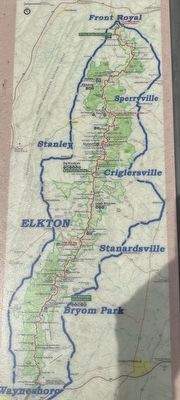
2. Map of Memorial Locations
Map showing the general locations of other memorials to displaced families of the Blue Ridge.
Landowners with clear title were compensated, but some families did not possess a title to the land on which they lived. Many were tenants or caretakers for absentee owners, and a few resided on land that had supported their families for generations, but was actually owned by others. Compensation varied from property to property. Some received what they considered fair value for their loss, while many did not.
The Burnings: During the Great Depression, as the park was being formed, an empty house offered shelter to people without a home. To prevent people from moving into previously vacated homes, houses were dismantled or sometimes burned after evictions took place. In some cases, burnings took place while families looked on. All that remained of these homes was their rock foundations and stone chimney.
Remembering the People: The Blue Ridge Heritage Project was organized in 2013 for the purpose of honoring the families who were displaced from the mountains for the creation of Shenandoah National Park.
Shenandoah was formed from parts of eight Virginia counties: Albemarle, Augusta, Greene,
Photographed by Craig Swain, September 16, 2024
3. Rockingham Memorial and Markers
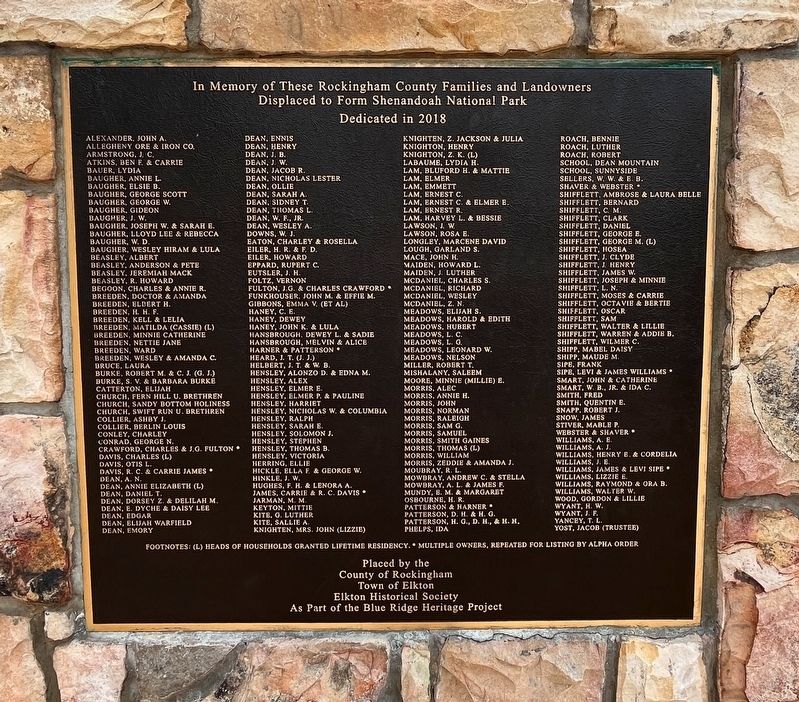
The eight memorial sites preserve the story of the displacement and help keep alive the rich culture of the people who called these mountains home. The stone chimney symbolizes the strength, determination and enduring spirit of those who lived in what is now Shenandoah National Park. The plaque inset in the chimney lists the names of families of this county who lost their homes and land.
Erected 2024 by Blue Ridge Heritage Project.
Topics. This historical marker is listed in this topic list: Parks & Recreational Areas. A significant historical date for this entry is July 3, 1936.
Location. 38° 24.368′ N, 78° 36.994′ W. Marker is in Elkton, Virginia, in Rockingham County. It is on Blue and Gold Drive, on the right when traveling east. Located next to the Elkton Area Community Center. Touch for map. Marker is at or near this postal address: 20593 Blue and Gold Dr, Elkton VA 22827, United States of America. Touch for directions.

Regionally,
Photographed by Craig Swain, September 16, 2024
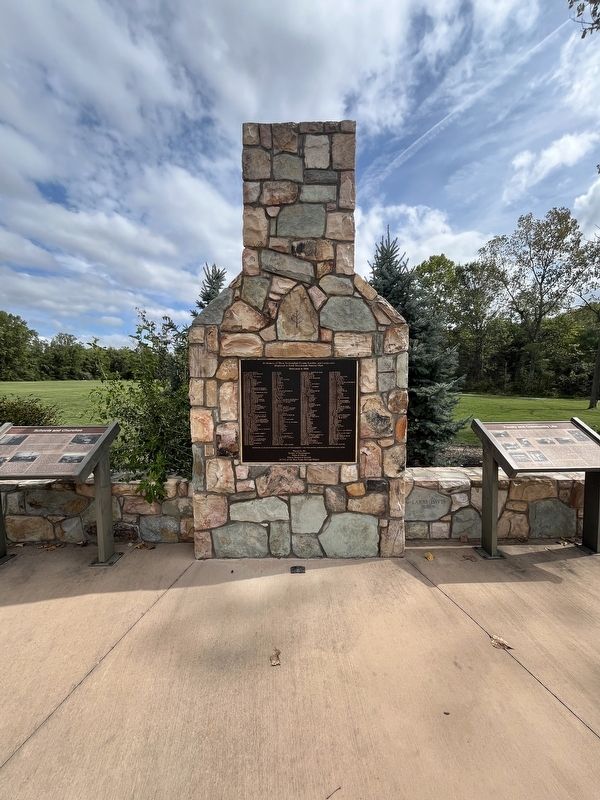
4. Rockingham Memorial for Families Displaced Marker
Other nearby markers. At least 8 other markers are within walking distance of this marker: Making a Living on the Mountain (here, next to this marker); Schools and Churches (here, next to this marker); Family and Community Life (here, next to this marker); Displacement (a few steps from this marker); Miller-Kite House (approx. 0.2 miles away); Jennings House (approx. 0.3 miles away); Elkton 9-11 Memorial (approx. 0.6 miles away); Veterans Memorial (approx. 0.6 miles away). Touch for a list and map of all markers in Elkton.
Another marker is no longer nearby. Miller-Argabright-Cover-Kite House (was approx. 0.2 miles away but has been replaced with another marker now near it).
Also see . . . Blue Ridge Heritage Project.
Photographed by Craig Swain, September 16, 2024
5. Plaque Listing Families
The plaque on the memorial lists the families who were displaced by creation of Shenandoah National Park.
Photographed by Craig Swain, September 16, 2024
6. Tree Symbol on the Chimney/Memorial
Credits. This page was last revised on April 13, 2025. It was originally submitted on October 26, 2024, by Craig Swain of Leesburg, Virginia. This page has been viewed 399 times since then and 65 times this year. Photos: 1, 2, 3, 4, 5, 6. submitted on October 26, 2024, by Craig Swain of Leesburg, Virginia.
