Rheinau in Schwetzingen in Rhein-Neckar-Kreis, Baden-Württemberg, Germany — Central Europe
Christian Mayer
1719-1783
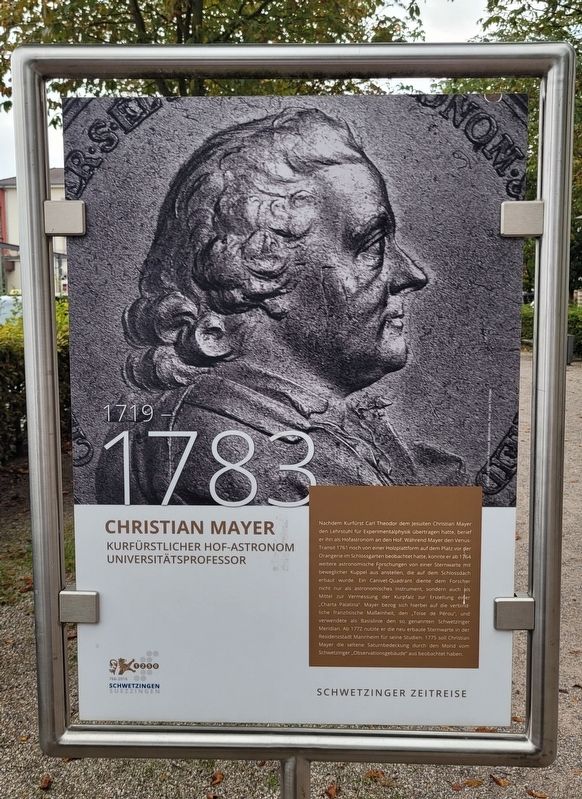
Photographed by James Hulse, September 23, 2024
1. Christian Mayer Marker

Kurfürstlicher Hof-Astronom Universitätsprofessor
Nachdem Kurfürst Carl Theodor dem Jesuiten Christian Mayer den Lehrstuhl für Experimentalphysik übertragen hatte, berief er ihn als Hofastronom a den Hof. Während Mayer den Venus-Transit 1761 noch von einer Holzplattform auf dem Platz vor der Orangerie im Schlossgarten beobachtet hatte, konnte er ab 1764 weitere astronomische Forschungen von einer Sternwarte mit beweglicher Kuppel aus anstellen, die auf dem Schlossdach erbaut wurde. Ein Canivet-Quadrant diente dem Forscher nicht nur als astronomisches Instrument, sondern auch als Mittel zur Vermessung der Kurpfalz zur Erstellung einer „Charta Palatina". Mayer bezog sich hierbei auf die verbindliche französische Maßeinheit, den „Toise de Pérou", und verwendete als Basislinie den so genannten Schwetzinger Meridian. Ab 1772 nutzte er die neu erbaute Sternwarte in der Residenzstadt Mannheim für seine Studien. 1775 soll Christian Mayer die seltene Saturnbedeckung durch den Mond vom Schwetzinger Observationsgebäude" aus beobachtet haben.
Electoral Court Astronomer University Professor
After
this page online
Erected by Schwetzinger Zeitreise.
Topics. This historical marker is listed in this topic list: Science & Medicine. A significant historical year for this entry is 1761.
Location. 49° 23.05′ N,
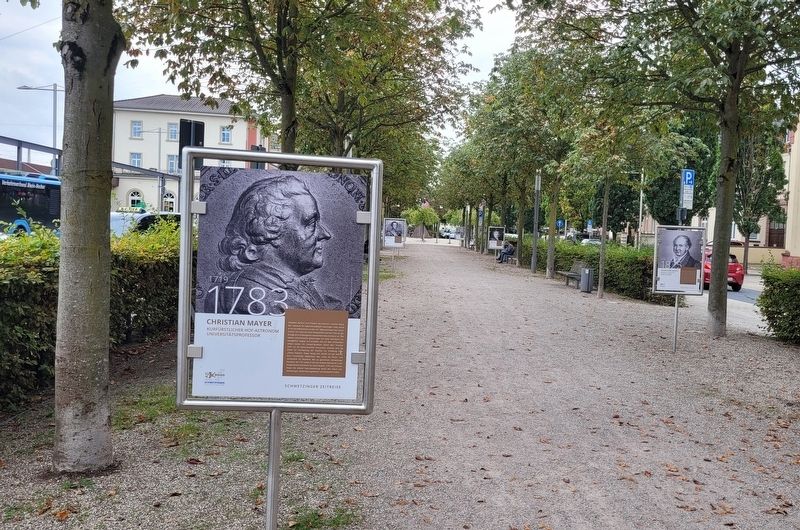
Photographed by James Hulse, September 23, 2024
2. The view of the Christian Mayer Marker along the pathway

Regionally, this marker is on the German Upper Rhine. Globally, it is in Europe, the European Union, Atlantic Europe, Central Europe, the Schengen Area, Western Europe, and the Western World. Historically, it finds itself in what was once the Roman Empire, the Holy Roman Empire, and the former West Germany.
Other nearby markers. At least 8 other markers are within walking distance of this marker: Johann Jakob Hemmer (here, next to this marker); Friedrich Ludwig von Sckell (here, next to this marker); Nicolas de Pigage (here, next to this marker); Maximilian I Joseph (a few steps from this marker); Stéphanie de Beauharnais (a few steps from this marker); Christian Cannabich (a few steps from this marker); Johann Stamitz* (a few steps from this marker); Friedrich I. (a few steps from this marker). Touch for a list and map of all markers in Schwetzingen.
More about this marker. There is a non-related marker attached on the other side of the post.
Also see . . . Christian Mayer (astronomer). Wikipedia
By 1752 his reputation was such that he was selected as a professor of mathematics and physics at Heidelberg. By this age, however, he had developed a strong interest in astronomy. He was appointed Court Astronomer at Mannheim, and was tasked with selecting the instruments for the new observatories at Schwetzingen and Mannheim. With these completed, he was able to pursue his astronomical studies, and published numerous works. In 1769 he was invited to St. Petersburg to observe the transit of Venus, which he did together with Anders Johan Lexell. In 1773, the Jesuit order was dissolved by Pope Clement XIV, and consequently he was removed as Court Astronomer. However he was still able to continue his astronomical observations and studies. He applied for and was granted in December 1765 a Fellowship of the Royal Society and in 1768 he was elected to the American Philosophical Society.(Submitted on October 27, 2024, by James Hulse of Medina, Texas.)
Credits. This page was last revised on October 27, 2024. It was originally submitted on October 27, 2024, by James Hulse of Medina, Texas. This page has been viewed 137 times since then and 17 times this year. Photos: 1, 2. submitted on October 27, 2024, by James Hulse of Medina, Texas.
