Rheinau in Schwetzingen in Rhein-Neckar-Kreis, Baden-Württemberg, Germany — Central Europe
Friedrich I.
1826-1907
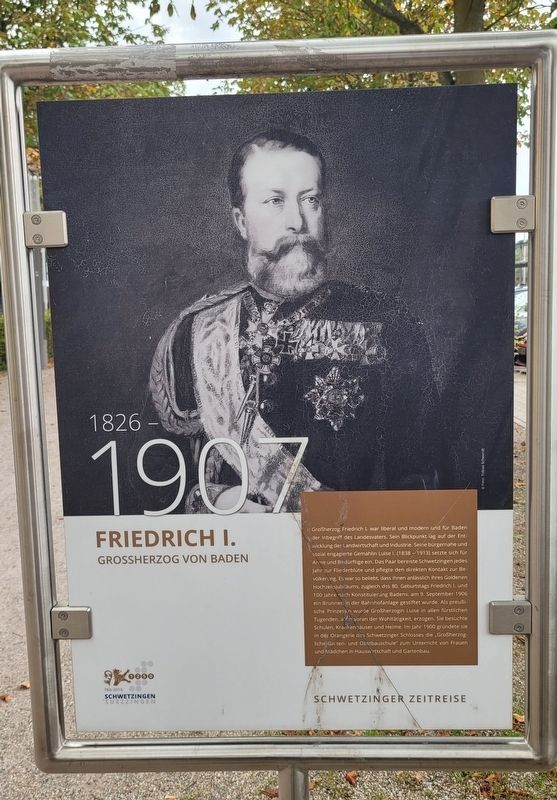
Photographed by James Hulse, September 23, 2024
1. Friedrich I. Marker

Grossherzog von Baden
Großherzog Friedrich I. war liberal und modern und für Baden der Inbegriff des Landesvaters. Sein Blickpunkt lag auf der Entwicklung der Landwirtschaft und Industrie. Seine bürgernahe und sozial engagierte Gemahlin Luise I. (1838-1913) setzte sich für Arme und Bedürftige ein. Das Paar bereiste Schwetzingen jedes Jahr zur Fliederblüte und pflegte den direkten Kontakt zur Bevölkerung. Es war so beliebt, dass ihnen anlässlich ihres Goldenen Hochzeitsjubiläums, zugleich des 80. Geburtstags Friedrich I. und 100 Jahre nach Konstituierung Badens, am 9. September 1906 ein Brunnen in der Bahnhofanlage gestiftet wurde. Als preußische Prinzessin wurde Großherzogin Luise in allen fürstlichen Tugenden, allen voran der Wohltätigkeit, erzogen. Sie besuchte Schulen, Krankenhäuser und Heime. Im Jahr 1900 gründete sie in der Orangerie des Schwetzinger Schlosses die „Großherzogliche Garten- und Obstbauschule" zum Unterricht von Frauen und Mädchen in Hauswirtschaft und Gartenbau.
Grand Duke of Baden
Grand Duke Friedrich I was liberal and modern, embodying the spirit of the
this page online
Erected by Schwetzinger Zeitreise.
Topics. This historical marker is listed in these topic lists: Forts and Castles • Horticulture & Forestry • Industry & Commerce • Women. A significant historical date for this entry is September 9, 1906.
Location. 49° 23.04′ N, 8° 34.672′ E.
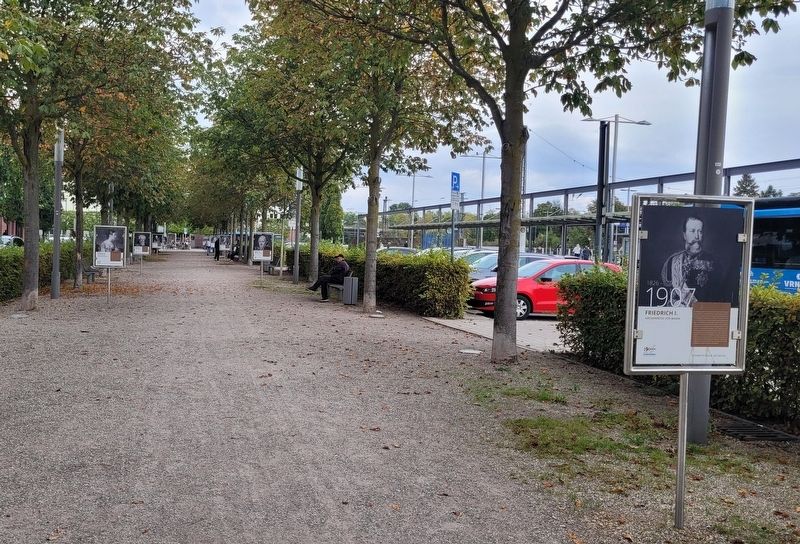
Photographed by James Hulse, September 23, 2024
2. The Friedrich I. Marker is on the right side of the markers

Regionally, this marker is on the German Upper Rhine. Globally, it is in Europe, the European Union, Atlantic Europe, Central Europe, the Schengen Area, Western Europe, and the Western World. Historically, it finds itself in what was once the Roman Empire, the Holy Roman Empire, and the former West Germany.
Other nearby markers. At least 8 other markers are within walking distance of this marker: Leopold I. (here, next to this marker); Stéphanie de Beauharnais (a few steps from this marker); Karl Friedrich Schimper (a few steps from this marker); Johann Michael Zeyher (a few steps from this marker); Maximilian I Joseph (a few steps from this marker); Johann Jakob Hemmer (a few steps from this marker); Christian Mayer (a few steps from this marker); Friedrich Ludwig von Sckell (a few steps from this marker). Touch for a list and map of all markers in Schwetzingen.
More about this marker. There is a non-related marker attached on the other side of the post.
Also see . . . Frederick I, Grand Duke of Baden. Wikipedia
Frederick was born in Karlsruhe, Baden, on 9 September 1826. He was the third son of Leopold, Grand Duke of Baden and Princess Sophie of Sweden. He became the heir presumptive to the grand duchy upon the death of his father in 1852 and the accession of his brother as Grand Duke Louis II. Due to his brother's mental ill-health, he was regent ad interim of Baden in 1852–1855, and took the title of grand duke in 1856. His brother, Louis II, died in 1858. He was considered a relatively liberal supporter of a constitutional monarchy. During his reign the option of civil marriages was introduced in Baden as well as direct elections to the Lower House of the Parliament of Baden in 1904.(Submitted on October 29, 2024, by James Hulse of Medina, Texas.)
Credits. This page was last revised on October 29, 2024. It was originally submitted on October 28, 2024, by James Hulse of Medina, Texas. This page has been viewed 142 times since then and 16 times this year. Photos: 1, 2. submitted on October 29, 2024, by James Hulse of Medina, Texas.
